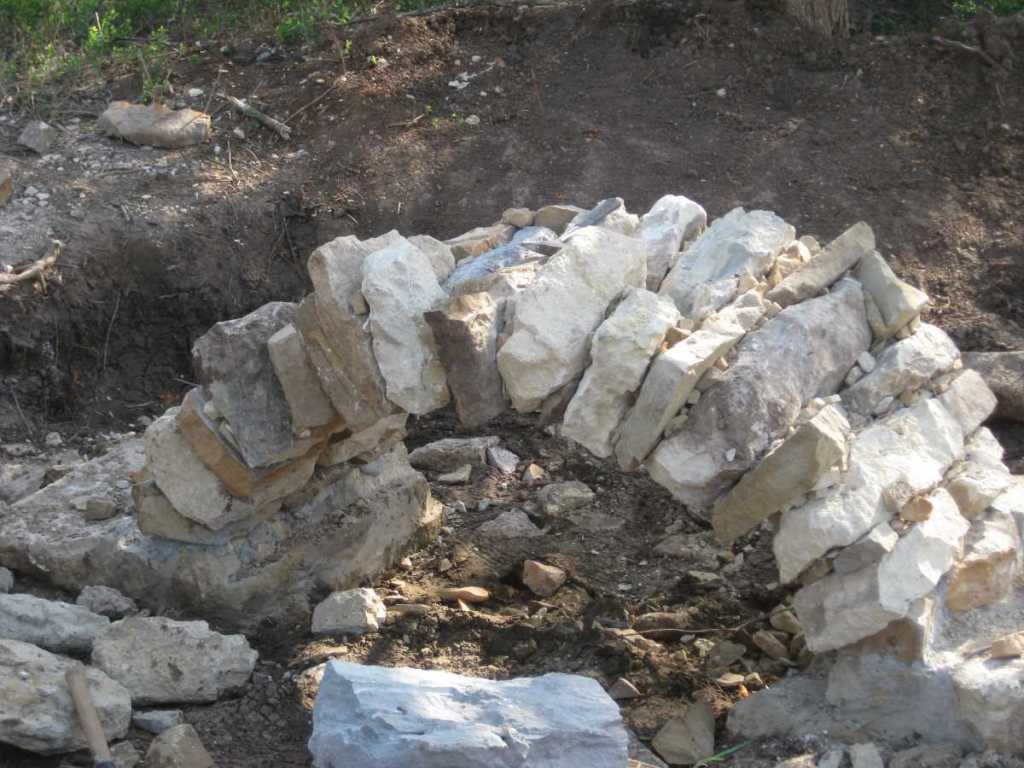
There is still a great urge to build stone arch bridges. Not, perhaps, on the massive scale of old, but as attractive, durable footbridges over small streams. When done right, the results are quite rewarding, and the building process itself can be enjoyable. Furthermore, a stone arch bridge should need but little maintenance, especially compared to wooden structures. One of the main considerations to think about is: how thick should the arch ring be?
Calculating the Arch Ring
The arch ring must be a certain minimum thickness to ensure stability. A good rule for arch ring thickness is given by the following formula developed a long time ago based on empirical data:
Arch thickness (in feet) = (The square root of (½ span + radius of the arc of the arch))/ 4 + .2 ft.
Unless you are precisely cutting the stones to fit exactly, multiply that answer by 1.25.
So, for an example, say we are building a Roman arch with a span of 6 feet. One half the span is 3 feet, which number happens to also be the radius of the arc of the arch. Using the formula, we see the arch ring should be .81 foot thick. If we choose to avoid the precision-cut stones, we will have to build a “rubble” arch. This means we will need to multiply the arch thickness number by 1.25 and get the final answer: about 1 foot. The rise of the Roman arch is 3 feet; we added another foot, so that now our arch is 4 feet high total. Add a few inches of dirt or gravel on top, and we have a rather taller structure than, perhaps, we were planning on.
An Alternative Formula
Having studied numerous stone arch bridges, we noticed some bridges that have an arch thickness that looks correct, at least to the eye. However, this appears to be borne out by the superior ability of bridges of such dimensions to handle the test of time and heavy loads. After some trial and error we created a simple formula that adequately represented what we were seeing. It is rather similar in some ways to the formula above, but tends to result in thicker arches:
Arch thickness (in feet) = The square root of span/2.5.
This simple formula consistently checks out. However, it is only applicable for round arches down to a 90 degree segment of a circle. Note how there is no compensation for the rise of the arch. It was found that for free-standing arches a low-rise arch actually more closely conforms to the natural line of thrust than a Roman arch. All that said, low-rise is fairly relative; again the formula is not suitable for spans lower than about 90 degrees of a circle.
Arches in Small Bridges
Most historic authorities on stone arch bridge design recommend never building the arch thinner than one foot thickness. This is true even if their recommended empirical formula suggests otherwise. Thus, most small-span stone arch bridges will have a one foot thick arch. It is not that an arch thinner than one foot won’t stand, but that a small and therefore light stone bridge with a small, light stone arch won’t handle heavy loads as well. Furthermore, really thin arches can be tricky to build. All of these considerations mean that for a small stone arch bridge serving heavy loads needs to be thicker. For a small footbridge, however, with some care of stone fitting a thinner arch can be used successfully, as the load demands are light.
The Problem With Roman Arches
The example above would probably not hold true in practical use, as a Roman arch has certain weaknesses peculiar to it which necessitates an increase of arch ring thickness. To sum up the difficulty, the lines of thrust of an arch tend to follow a more parabolic shape, which a Roman arch is not. To accommodate for this, the arch would have to be made significantly thicker.
The idea is that the lines of thrust of an arch should be kept in the middle third of the arch for maximum stability; if this is not the case, the stones can move, which is highly undesirable and simply asking for collapse.
In regards to the 60-foot-span Roman arch, one engineer tackled the problem with a Roman arch of that size and said for stability the arch should be 7 feet thick! In a bridge, these larger Roman arches are typically held in place by the weight of the fill material pushing down on the stones. So large Roman arch bridges with arches that are thinner than strictly required for a freestanding arch have successfully been made.
Flatter arches tend to follow the parabolic shape much more closely, with the result that the above formula tends to work well with such arches.
 Stone Arch Bridges