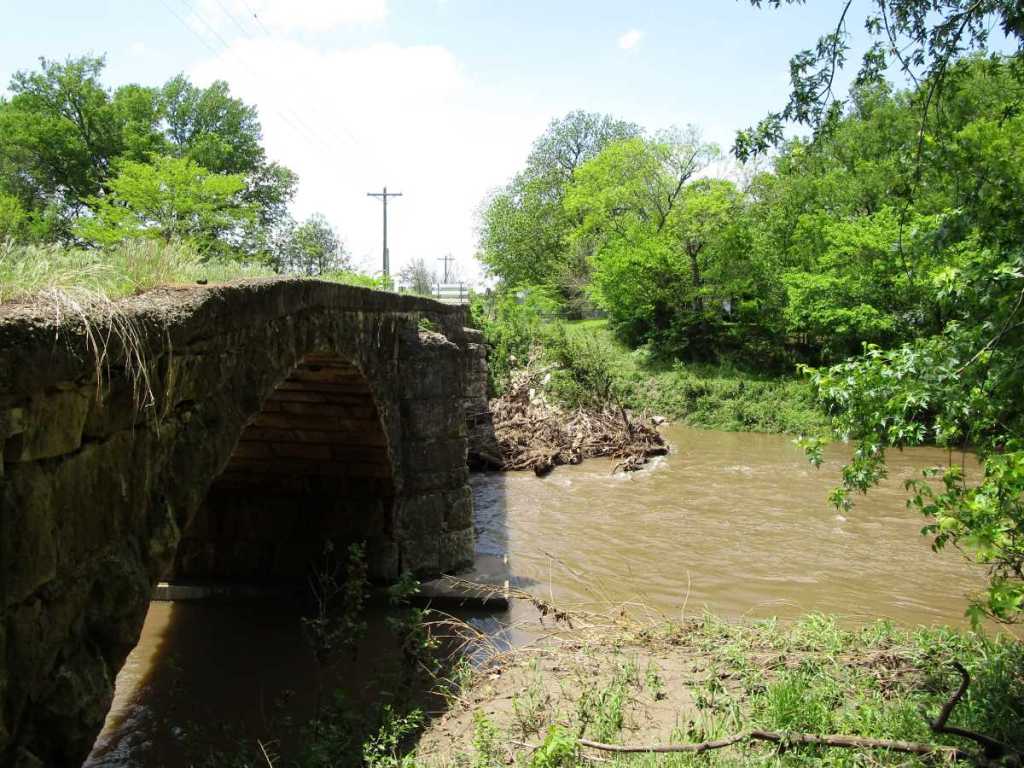
We have recently heard a concern that the damaged triple-arch Esch’s Spur Bridge in Cowley County, Kansas, is to be demolished. This bridge, originally called Kirk Bridge and also known as Pudden Bridge, is the only triple-arch bridge in Cowley County. In light of the circumstances, it seemed appropriate to take a brief pause from our series on compression and once again look into what makes the Esch’s Spur Bridge unique, as well as to determine whether it could be repaired sufficiently to be usable again.
What Makes Esch’s Spur Bridge Unique
Here are some factors that make the Esch’s Spur Bridge unique and significant among Cowley County and Kansas stone bridges.

- National Significance. The placement of this bridge on the National Register of Historical Places implies that this structure was deemed significant even in a national historical context.
- Large Size. One of the largest stone arch bridges in all of Kansas, the Esch’s Spur Bridge features an aggregate waterway of approximately 150 feet. The only remaining triple-arch stone bridge in Cowley, this bridge is clearly unique.
- A Clearly Defined History. Unlike many bridges in Cowley County, Esch’s Spur has an interesting history that was well documented in the old newspapers. (Please see Pudden Bridge (Esch’s Spur Bridge): History and Heritage.)
- Unusual Design. The Esch’s Spur Bridge is unique in design for the area. Most stone bridges in Kansas, and many across the United States feature arches placed at or near the streambed level. To increase waterway, the Esch’s Spur Bridge was built with low-rise arches atop tall piers, making it unique from an engineering standpoint.
- A Long Heritage. This bridge has been photographed and featured extensively in various newspapers over the years. An idealized mural of it is located in the nearby town of Dexter. A large part of Dexter’s stone arch bridge tradition, this bridge has been a significant part of the town’s history. Walter Sharp, the builder, held up this bridge as an example of good bridge construction.
- Tourism. As the biggest stone bridge in Cowley County, Esch’s Spur Bridge naturally possesses tourist value for both the Dexter community and Cowley as a whole. Furthermore, Cowley County, known as the Stone Arch Bridge Capital of Kansas, was so designated for major bridges such as this one, which was arguably one of the most famous bridges in Cowley in its better days. It was also specifically mentioned in The Kansas Guidebook by Marci Penner published in 2005.
- A Major Bridge. Cowley has lost several major bridges over the years, such as the state’s longest single-span stone bridge in the early 2000s (H. Branson Bridge, span 75 feet), and the state’s second longest span stone bridge (McCaw/Fox Bridge, span 70 feet) in 2016. Each of these bridges represents an irreplaceable loss of the county’s stone bridge heritage. Though Cowley apparently has numerous stone arch culverts, the county has but a limited number of major stone bridges. Indeed, Butler County, Kansas, for instance, already has more stone bridges on the roads than Cowley, as a look at the state highway maps (which have all bridges as opposed to culverts clearly designated) will show. Esch’s Spur Bridge is one of Cowley’s relatively few remaining major stone arch bridges, and is definitely the county’s largest and most significant.
Is It Repairable?
The first and most obvious question about the Esch’s Spur Bridge is whether it is even repairable or not. Happily, the answer is an emphatic yes. The damage to the middle arch, while serious, is entirely fixable.
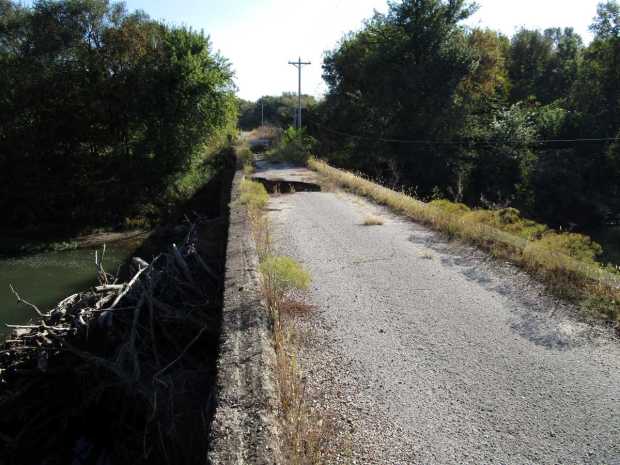
There are several modern instances of such repairs being succesfully carried out. One of the most striking was the repair of the Avoca Bridge in Ireland in the 1980s. This bridge sustained far worse damage than the Esch’s Spur Bridge, as not only large sections of two arches collapsed, but part of a pier as well, all due to undermining. The repair, while expensive, proved to be much less costly than building a new bridge. For more details on how partially collapsed arches can be repaired please see Repair of Partially Collapsed Arches.
What Caused the Damage
The other factor to be considered is what caused the collapse in the first place; this is helpful to ensure such doesn’t happen again, whether to Esch’s Spur Bridge or, for that matter, any of Cowley’s other stone bridges. The damage is almost certainly attributable to debris impacts. Based on observations, it appears that some of the mortar joints had been allowed to go “dry.” This in turn allowed the important interior mortar to leach out of the arches over the years, loosening the arch stones (see Arch Building Simplified: Walter Sharp’s Secret to Building Stone Arch Bridges). Once loose, a well-placed debris impact knocked out two arch stones in 2016, right at the springing line of the middle arch. This further loosened other arch stones, creating the more catastrophic collapse in 2019. The bridge has now remained partially collapsed for four years. Obviously, the structure is surprisingly stable to have not deteriorated noticeably more in these four years.
An Example of Arch Repair
Recently, thanks to a general clearing of the previously overabundant underbrush, we found a local example of a bridge that sustained serious arch damage that had been repaired. The Ellis Bridge, in Butler County, Kansas, clearly lost some pieces of one of its two arches at some point. This double-arch bridge over the Walnut River is the biggest stone bridge in Butler County and actively carries a two-lane blacktop. The missing section of the arch was replaced with several smaller stones.
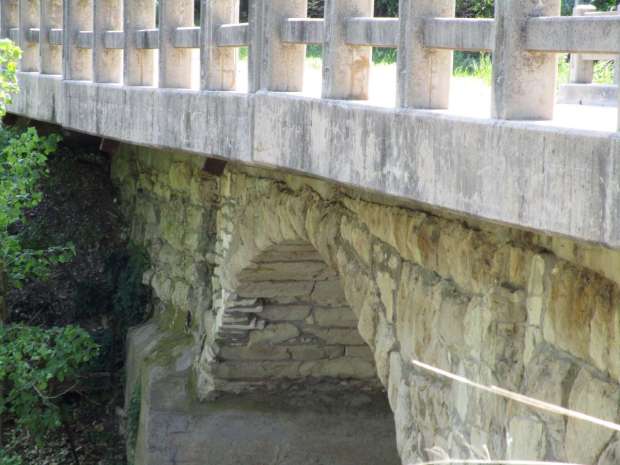
Granted, this repair does not match the character of the original, but it shows that such repairs can indeed be successfully undertaken; the Ellis Bridge still carries a moderately busy road.
Conclusion
Ultimately, it is up to the people of Cowley County what the fate of the Esch’s Spur Bridge will be.

Update: Late in 2025, this bridge was demolished.
 Stone Arch Bridges