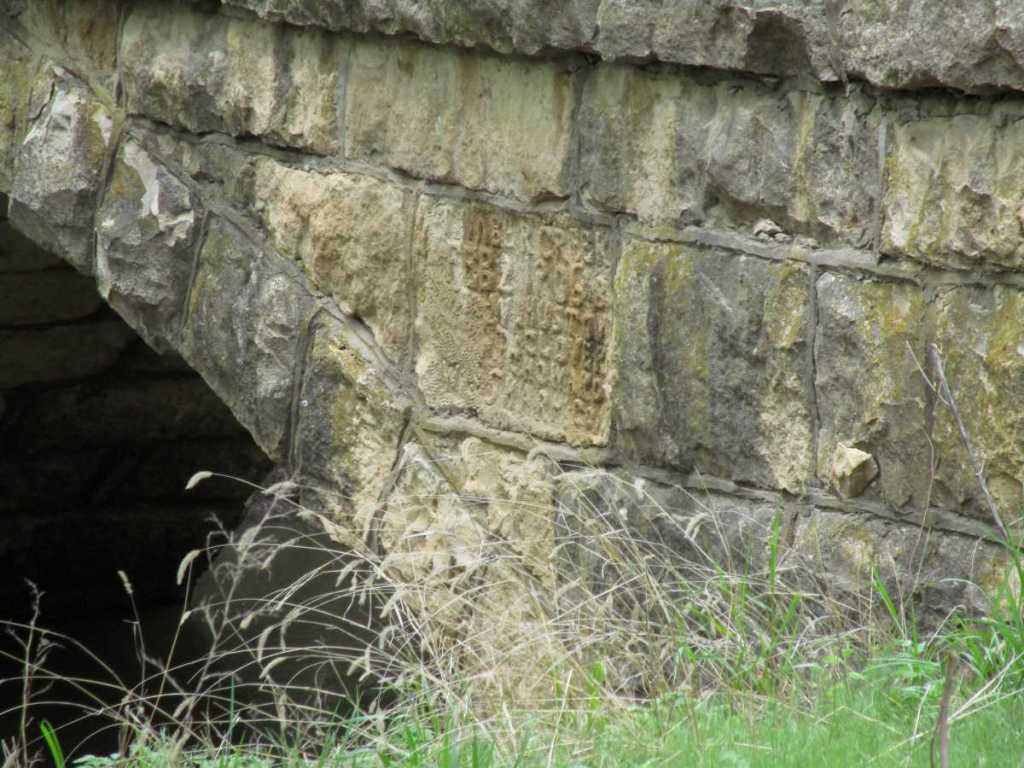
In this post we will quote Walter Sharp, pioneer builder of stone arch bridges and builder of concrete arch and slab bridges, as we mentioned in the previous post of this series. Walter Sharp understood bridges, and his summaries on arch and girder bridges are well worth reading, for he nutshells the problem quite well.
Walter Sharp on Arch Vs. Girder Bridges
Here is Walter Sharp on arch bridges vs. girder bridges, and why the fact that the arch operates under compression is so important:
“Cowley county was one of the first counties in the state to build the reinforced girder type of bridge. A copy from the bridge record in the county engineer’s office explains itself. This bridge is located two miles north of Wilmot and is known as the Deichman Bridge over Dutch creek.
“This beam, concrete bridge, was the first of its form built in Cowley county. The abutments were of plain concrete with a 1-3-5 mixture (washed gravel). Floor and parapet walls 1-2-4 mixtures. Floor finished with 3/4 of 1-2 mixtures. On the 13th day of June 1907 a test was made, by running a 22-H. P. engine, estimated weight 25,000 lbs. over the bridge, 4-5 of weight considered to be on the drivers, with additional weight estimated at 5000 pounds or a total of 30,000 pounds. The deflection at center of span indicated 1-32 of an inch. Small cracks appeared on the work soon after completion at the top of the parapet walls and running down nearly to floor over the cast pier where work joins an 18-foot span. All the work of the two spans was continuous and no expansion joints provided. Also a small crack appeared about one foot below beam level, in northwest corner of the west abutment, and extending horizontally about 6 inches into abutment.
“This may seem like a small matter but if what I am going to say is true, it means millions upon millions of loss to the state of Kansas and untold millions to the United States. I built the Deichman for Cowley County 15 years ago. One year ago our county board authorized me to take men out and enough dynamite to blow it to pieces. This bridge was getting very dangerous and it was done to save someone from getting killed for it was sure to fall. Another 40-foot, same type, bridge south of Dexter known as the Ridgeway bridge, did fall not ten minutes after three autos loaded with people passed over it. This bridge too, had been built just fourteen years.
“I had the contract for building both of them, and the contract for rebuilding both of them. I think I know what made them fall. Not a reinforcing rod had failed. There were million of cracks and the bars were almost loose in the concrete. Vibration caused from heavy trucks and cars had done its work, and it will get them all. More steel was added, and the girder is made heavier and no doubt the last bridges will last longer[,] but [vibration] means destruction.
“It is a further well known jest that reinforcing rods used in concrete work are subject to attack by rust and that eventually rust and the gnawing teeth of time will destroy these rods. Any structure depending on that kind of support will collapse and the structure dissolve, into its original constituent elements.
“Concrete in arch form will last much longer, because all concrete in the arch is held in compression and the weight of the hill adds to the strength of the bridge and lessens [vibration]. If vibration destroys girder bridges what will it do to concrete roads, not right away of course, but in 15 or 20 years?”
Walter Sharp, “Tyranny in Kansas Road Building,” The Wichita Eagle, September 10, 1922.
The Deichman and Ridgeway Bridges
The two bridges mentioned in the above article, the Deichman and Ridgeway bridges, were both concrete girder spans. Neither of the replacements for these bridges that Walter Sharp mentions having built remain intact.
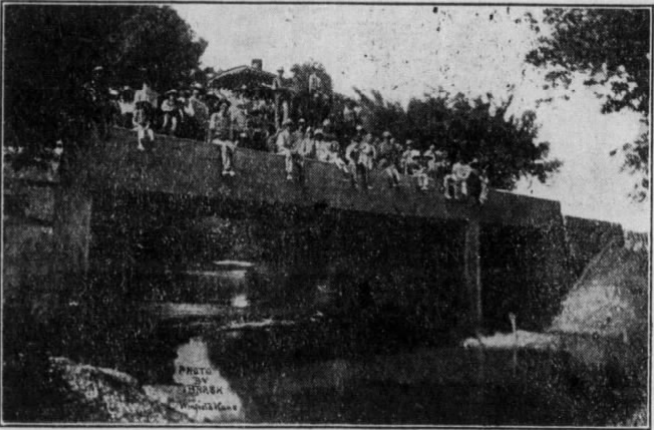
The bridge at the site of the Diechman bridges, while apparently containing some pieces from previous bridges, is primarily a structure composed of steel I beams supporting a metal deck. The second Ridgeway Bridge is completely gone, K-15 now crossing where it stood.
It is only fair to mention that, according to the September 24, 1921, edition of the Winfield Daily Courier, the Ridgeway Bridge’s failure was attributed primarily to the gravel used in the concrete. It was claimed that the river gravel originally specified by the county was found later to have too much silt in it to make good concrete. The April 28, 1922, edition of the same paper claimed that silty gravel was responsible for the demise of the Deichman Bridge as well. All that said, it was noted in the Courier article on the collapse of the Ridgeway Bridge that the rebar had actually been sliding loose within the concrete, as Sharp indicated. This problem, where the rebar did not bind well to the cement, the article claimed, was being fixed in newer bridges by bending the ends of the rebar in an effort to hopefully make it grip the concrete better. This difficulty where the rebar does not bind to the cement is why modern rebar is made with ridges in it. The Courier article also stated that the slab thickness originally called for for the Ridgeway Bridge was considered too thin. Note, however, that even with weak concrete vibration is still what ultimately caused the failure of the Ridgeway Bridge, as Sharp said; if the cement had been held in compression it would have been much harder for it to disintegrate even if weak.
Compression, Concrete, and Rebar Deterioration
In another article, Walter Sharp had more to say on compression as well as the deterioration of rebar in cement. In this article, Walter Sharp was responding to a newspaper that was disputing some of his writings, including the piece quoted from Sharp above. Specifically, one of the objections was to Walter Sharp’s claim that rebar deteriorates over time; the newspaper contended that the concrete preserves the rebar by forming a waterproof coating. Here’s Walter Sharp’s reply:
“What you say about engineers[‘] opinion regarding the preservative powers of concrete, in reinforced concrete construction[,] I think is true, steel rods and beams are preserved and taken care where there is no vibration. Sky scrapers have very little vibration, while the girder types of bridges get a very great amount of vibration and it is the concrete that fails and not the reinforcing. The oldest concrete bridge in Kansas is the Kansas Avenue bridge over the Kansas river at Topeka. An examination of that structure will show millions of cheeks and cracks due to vibration. The bridge is a series of arches and all arch work is held together by compression. Had this bridge been the girder type of construction, it would have gone to pieces and fell years ago. The same is true of the Douglass Avenue bridge in Wichita.”
Walter Sharp, “Defends His Own Bridges,” The Winfield Daily Free Press, September 19, 1922.
Incidentally, the Kansas River arch bridge in Topeka mentioned above lasted several more decades before succumbing in a sudden collapse, tragically during rush hour, due to scouring. The scour appeared to have been caused by the deflection of current induced by a pier for a new bridge that was being built nearby.
 Stone Arch Bridges