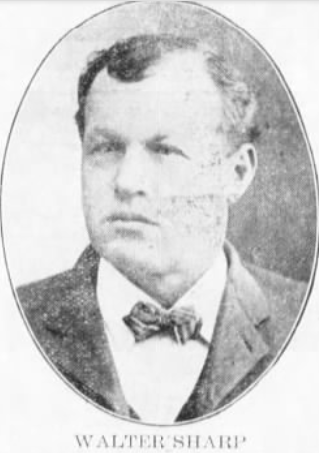
Walter Sharp, builder of many of the famed Cowley County stone arch bridges, wrote extensive articles in the newspapers; in fact, he even worked for a newspaper in his young days.
In several of his articles he described several aspects of how Cowley’s stone arch bridges were built, ranging from historical information to detailed accounts of the construction process. In this series we will quote several of his accounts, beginning with how Butler, Cowley, and Greenwood counties began to build stone bridges in the first place.
The Stone Arch Bridge Era Begins
“Forty years ago, the writer was a resident of Marion, Kansas; E. W. Hoch, Editor of the Marion Record was a strong advocate of the stone arch bridges and to him is due the beautiful and lasting stone arch bridge that spans Mud Creek between the business and resident portions of the City of Marion.
“I built a number of stone bridges in Marion County at this early date, and in 1892 came to Cowley County, and built piers and abutments for a steel bridge over the Walnut river in Cowley County and in the year 1895 I received a letter from the County Clerk of Butler County offering to pay for my time and expenses to come to El Dorado and figure with them on stone arch bridges. At that time the steel bridge trust had a firm hold on the bridge business in Kansas. The result was a contract for a stone bridge three miles east of El Dorado over Bird creek. The first stone bridge in Butler County and from that time on the steel trust wasn’t doing much business in Butler County.
“During the next five years I built 15 stone arch bridges varying in size from 20 to 50 foot spans and had also become a resident of El Dorado.
During this time the County commissioners of Greenwood County were somewhat worried about the treatment they were getting from the steel bridge fellows and they came to Butler County and spent two days viewing Butler County [stone] bridges and they took the fever and I went back to Eureka with them and planned a stone arch bridge of four thirty-six spans over Fall river, six miles above Eureka. Bids were called for and on the day of letting sixteen Steel Bridge Companies were represented. The steel bridge fellows offered to pay a big price if I would quietly slip away and go back home and stay there, but it didn’t turn out that way. The contract was signed up and the bridge was built, and upon completion, the Norwegian Farmers in that Fall river district got up what was perhaps one of the greatest bridge picnics ever held in the State. All business was suspended in Eureka, everybody shut up shop and went to the picnic and they came from everywhere.
“E. W. Hoch of Marion, Kansas made the address; 5000 people were there; the Eureka band furnished the music; the merry-go-round went round; the three stands did an immense business; one of the main features was the picture man who made and sold pictures of the crowd on the bridge.
“This bridge was hit with a full-fledged cyclone about three years after it was built. The floods, the wind and time have made no change in the Fall river bridge.
“Perhaps you will not understand what Ed. Hoch could say interesting at a bridge picnic; this is just one of the things he said, only I think he said something about a thousand years hence when people then on earth would perhaps navigate the air and might not need bridges.
“I built a total of ten stone arch bridges for Greenwood County in the year 1901. Another Board of County Commissioners made a journey to El Dorado to see the stone arch bridge man and view the stone bridges. They spent two days in Butler and Greenwood counties. The Cowley County Board was composed of Arthur Swain, Dan Pierce and Chas. Howard. Cowley County had by special act of the legislature gotten the right to levy a special bridge levy that brought about $10,000 for bridges. The board was afraid of the bridge trust and was convinced that the stone arch was what Cowley County wanted and not the tin bridge. Arthur Swain said the only thing for them to do was to steal the bridge man, which they succeeded in doing and in just 30 days bids were opened in Winfield for the first stone arch bridge three miles south of Wilmot. There were only fourteen steel bridge companies here. They kicked just as hard in Winfield as they did in Eureka, but with the same result. This bridge was completed, also a 54 foot span three miles north of Cambridge. By this time Chas. Howard Commissioner, from Arkansas City, wanted a bridge over the Walnut river seven miles northeast of the City. Plans were made and bids were called for[. This] time there were only ten Steel Bridge Companies represented. They could build a steel bridge for[ ]$600 less than the stone bridge, but the board liked the stone bridge best and in Sept., 1902 the bridge, was accepted by the Board, at a monstrous bridge picnic held at the bridge. Business in Arkansas City closed for the day. The band and all the people went to the picnic; patronized the stands, made speeches and had a fine time.Walter Sharp, “A Story About Good Roads,” The Wichita Eagle, October 24, 1920.
“My home for years has been in Winfield, 90 per cent of all the bridges built in Cowley County in nearly 20 years I have had the contract to build, the good and the bad of it all I have had my share in. You will get a better idea of it when I tell you that the bridge levy brought in from $10,000 to $25,000 per year, a fair average I think would be about $15,000 per year for 20 years or about $300,000 of County money used in new bridges, and there has just been one steel bridge built in 20 years. Someone who is good with figures ought to figure what it would cost Cowley County to replace all the bridges built in the County in 20 years had they been all tin bridges instead of stone and concrete.”
Comments on the Above Account
Interesting things to note about the above account: E. W. Hoch, who is mentioned repeatedly, also served as a two-term Kansas governor, from 1904 – 1908; Kansas governors received 2-year terms in those days. Hoch was known for his interesting speeches and his strong views on Prohibition, as well as his (unsuccessful) attempt to set up a state-run oil refinery in order to break Standard Oil’s monopoly in Kansas.
Well worth seeing is our series of articles on the history of Butler County’s stone bridges; these are complete with maps showing the locations of Butler’s stone bridges, both past and present, and give the size and builder’s name where known. In regards to the stone bridge over Bird Creek in Butler County: This was not Butler’s first stone arch bridge. The county erected a culvert in the early 1880s, but the first real stone bridge built by Butler County was a 20′ span erected over a branch of the Whitewater in 1894 by Eli Warren; it was something of an experiment, and 20′ is right at the cutoff between a small bridge and an oversized culvert. However, the double-16′-arch Bird Creek Bridge Walter Sharp built was the first major stone bridge in the county, and there is but little doubt that the success of this major structure played a large role in guiding Butler’s future bridge building. At least in Butler County, Walter Sharp did not build a 50′ span until 1903; this was the ill-fated Whitewater River Bridge near Potwin.
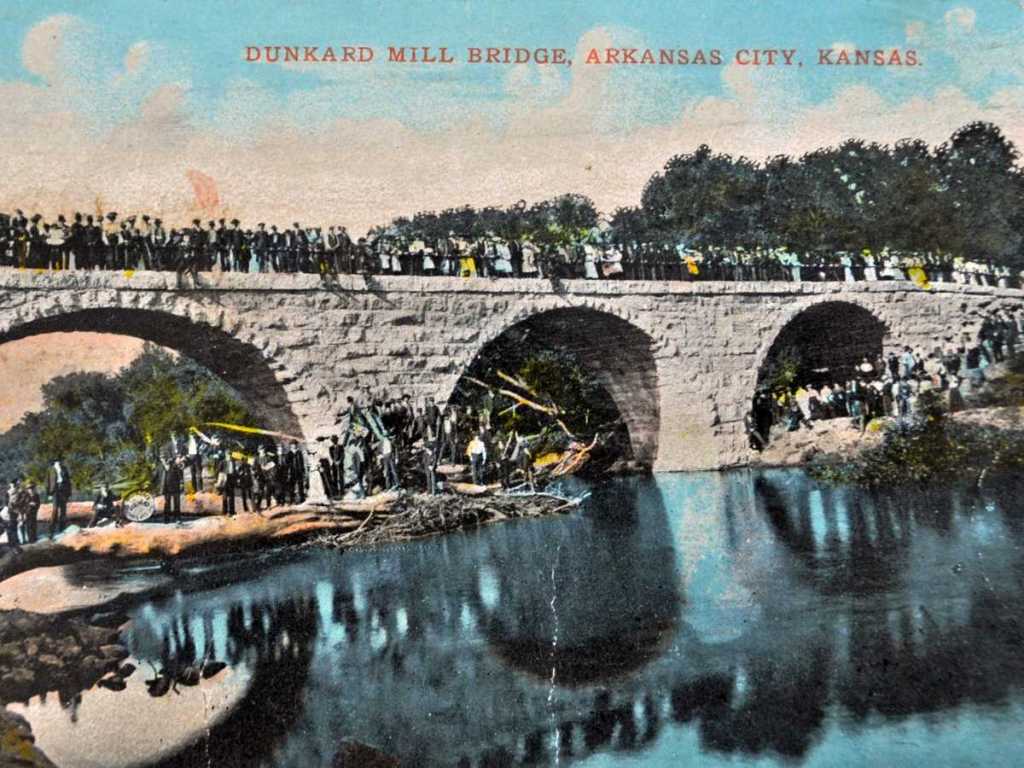
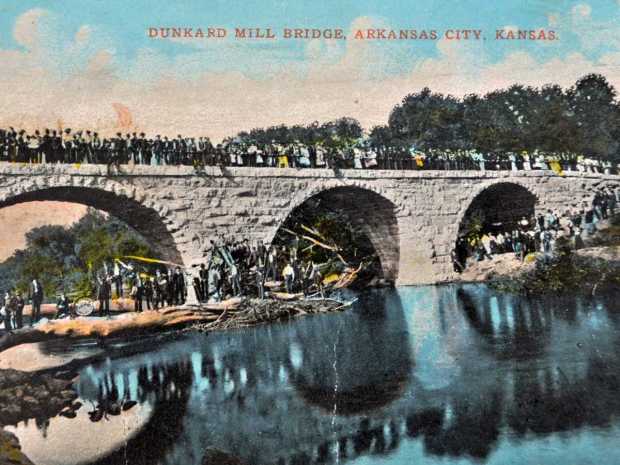
The Dunkard Mill Bridge (which was the bridge referred to as being over the Walnut River near Arkansas City in the above article) was completed in 1903, not 1902. It was a major success, and, though no longer extant, extensive ruins of this massive bridge are still visible just off 252nd Road, under the current Walnut River bridge.
In the next post we will quote an article by Walter Sharp that focuses more on the specific details of Cowley’s early stone arch bridge building efforts.
 Stone Arch Bridges