
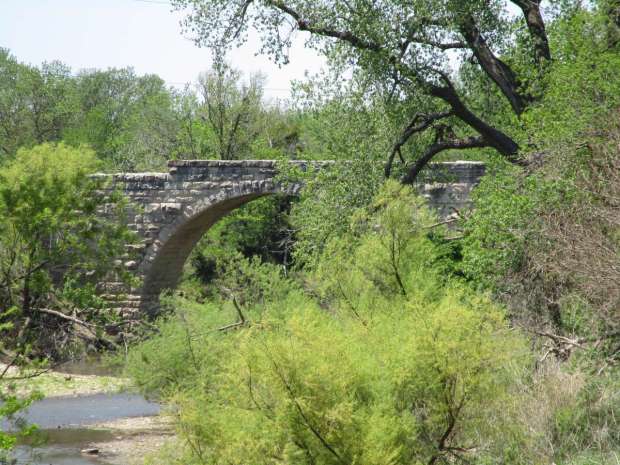
The Clements Bridge is a massive double-arch bridge in Chase County, and stands out as likely being the most famous stone arch bridge in Kansas. The following well-researched account on this structure was kindly prepared for us by Michelle Lindsey of homesteadontherange.com.
The History of Clements Bridge
Just southeast of the remnants of the town of Clements in western Chase County, an attractive stone arch bridge curves over the Cottonwood River. This bridge, nestled in a peaceful area somewhat off U.S. Highway 50, boasts two 56-foot arches.
Although closed to vehicle traffic, Clements Bridge is a favorite place for visitors to the area to stop and take in the natural beauty of the surrounding Flint Hills. Despite its present quietude, there was a time when Clements Bridge held great promise for the economic future of Chase County as the gateway to a fledgling railroad community.
Acme Quarry & the Rise of Clements
Clements started its existence as little more than a trading post called Hunt’s Station. However, the Santa Fe Railroad arrived at the station in 1881, and the following year local resident Joseph Crawford platted a town named Crawfordsville. From this modest beginning, the town quickly came to life. One of the earliest arrivals to Crawfordsville in the way of business was L.P. Santy & Co., which consisted of the partners L.P. Santy, D.Y. Hamill, and John Emslie.
Louis P. Santy, known locally as Phil Santy, was a young man noted for his hustle and practical business sense, but also his “social disposition.” That he was an enterprising man is attested by numerous appearances in various periodicals. The Strong City Independent, as one example, carried a series of advertisements for his restaurant and boarding house in 1882, and on December 1, 1888, his patented fire escape was featured in the Scientific American.
Santy’s young partner, D.Y. Hamill, or Dave, also had a solid reputation, plus some previous experience in stone bridge work. Shortly before work began on Clements Bridge, he constructed another bridge near the town over Silver Creek. Of this structure the Chase County Leader said, “D Hamill, one of our best business men, has the contract, so we know it will stand the test of any freshet that may come.”

John Emslie of Strong City was one of the first stonemasons at work in Chase County. A native of Scotland, Emslie emigrated to Canada in 1836 while quite young. There he learned the mason’s trade before moving to Kansas in 1862. His first work in Kansas was as a contractor for the stonework on the Kansas Pacific Railroad. In 1872, he moved from Leavenworth to Chase County, where he supplied the iconic Chase County Courthouse with limestone from his Cottonwood Quarries. The Strong City Independent wrote:
To his efforts more than all others, are the people of Chase county indebted for the magnitude to which this great industry [stonecutting and masonry] has been developed, and a source of so much profit to the county—affording to our laborers such a vast field for remunerative employment.
Santy and Hamill started Acme Quarry to capitalize on the native stone characteristic of the Flint Hills region. Acme Quarry quickly gained a reputation for its high-quality limestone, and the limiting factor in its growth soon proved to be the number of railroad cars that could be obtained for shipping the stone out of Clements. Much of this stone was sent to the neighboring states of Missouri, Nebraska, and Colorado. Stone from Acme Quarry was in high demand for railroad construction.
The company grew rapidly. The large number of workers employed at Acme Quarry, combined with the presence of the Santa Fe Railroad in the community, attracted other businessmen to the area. Clements was platted in 1883. The following year, the erstwhile Crawfordsville post office was renamed Clements after the auditor of the Santa Fe Railway, H.G. Clements. By 1886, Clements boasted a population of about 250 people.
Some began to hope that Clements could even rival the larger towns of Cottonwood Falls and Strong City—provided that a bridge was built at a critical point to provide easier access to the community.
The Demand for a Bridge
As an 1886 article in the Strong City Independent humorously noted:
The country is being fenced all over our county, and the old fashioned way of taking bearings and striking across the open prairie to a given point is about played out, and now that the people are compelled to travel mostly on section lines, it necessitates the building of more bridges than it did when they could go where they pleased.
This same article proceeded to weigh in on the question of whether iron or stone would be the best material for future bridges in Chase County. The Strong City Independent was a firm advocate of stone in bridge construction, listing among its advantages longevity and the fact that a stone bridge could rely solely on local labor. In the words of the Independent, “We would like to see the county commissioners make an order that hereafter all bridges should be built of stone wherever it is practicable. We believe the people would endorse such an order.” The Independent also noted with characteristic enthusiasm, “In conclusion let us build bridges; at least one every year until we have all our streams bridged….”
But even before the Strong City Independent article was written, a petition was presented to the Chase County commissioners asking for a bridge over the Cottonwood River near Clements at Patton’s Ford, named for local pioneer John Patton. Accordingly, the proposition was submitted to the people of the county for a vote during the general election of November 3, 1885. By the end of October, Chase County newspapers were filled with support for the bridge. As one example:
Be sure to recollect that a bridge is badly needed at Clements, and then see that the ticket you vote reads “For the bridge.”
Indeed, the Chase County Leader even went so far as to state:
Remember that to vote for the Clements bridge will be a Christian duty.
These and many other brief pieces to the same effect were undoubtedly prompted by the fact that throughout 1885 the water in the Cottonwood River had risen so high that the surrounding countryside was nearly cut off from the railroad at times. During the worst flooding there was reportedly no way to cross the Cottonwood anywhere between Cedar Point and Elmdale except in a skiff.
Furthermore, a bridge at Clements was expected to be fairly inexpensive, as the high banks of the Cottonwood River at Patton’s Ford would serve as natural approaches.
In the November elections, the majority of Chase County residents voted for the bridge. Not surprisingly, Clements Precinct was unanimously in favor.
In April 1886, the Chase County commissioners ordered the construction of a stone arch bridge over the Cottonwood River at Clements. The county clerk was directed to advertise for bids in July that same year. Accordingly, notice was given in the local papers to contractors that sealed bids would be received for the excavation and masonry of Clements Bridge at Patton’s Ford. The work was to be performed according to plans and specifications on view at the county clerk’s office. The bids were to be opened on August 3. The commissioners reserved the right to reject any or all bids. Who drew up the aforementioned plans is unknown. Some writers have speculated that it could have been John Frew, the county surveyor and subsequent originator of the plans for the approaches.
When the bids were opened on August 3, the bidders were P.E. and C.R. Lane; David Barrett and Alex Winton; David Rettiger and Bros.; and L.P. Santy & Co. Most of these companies bid on a per-cubic-yard basis, although the Lanes bid $8,888 for the completed bridge. However, none of the initial bids satisfied the county commissioners. The project was re-advertised.
In early September, the contract was awarded to L.P. Santy & Co. of Clements. Santy & Co. were to receive 90 cents per cubic yard for excavation below the water, 30 cents per cubic yard for excavation above the water, and $7.25 per cubic yard for masonry. The estimated cost for this work was $12,000.
The company was to furnish everything required for the completion of the bridge.
Click here for The Story of the Clements Bridge: Part 2.
 Stone Arch Bridges