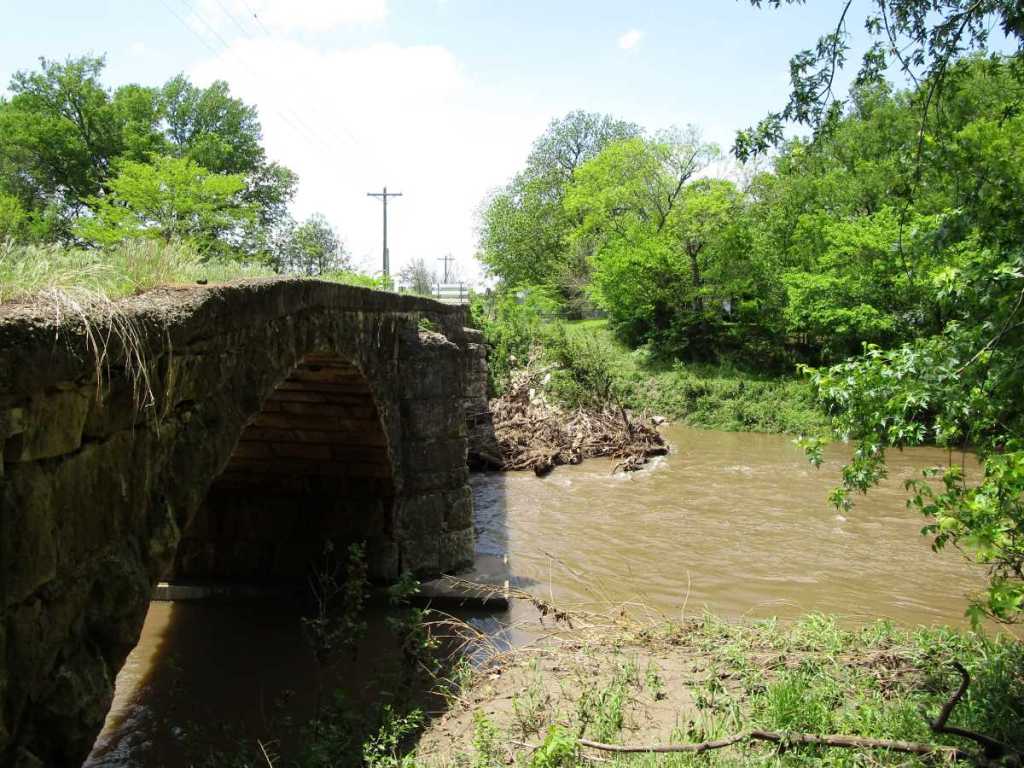
In 1922 Walter Sharp, famous for building the majority of the stone bridges in Cowley County, Kansas, wrote a series of newspaper articles entitled “A Story About Bridges.”
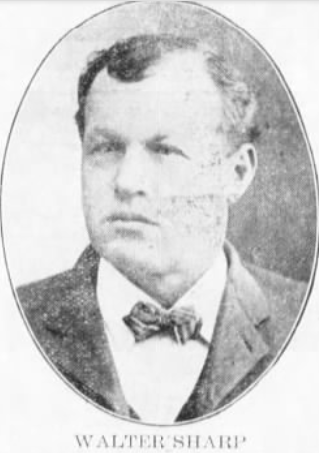
In the first of these articles (each article was originally given a chapter number) he describes first how Cowley went about planning their stone bridges and what often followed when the bridges were completed. Later, he went on to honor Cowley commissioner William Huston, a major stone bridge advocate, and then discussed the events leading up to the end of the stone arch bridge era in Cowley County. In this series of posts, we quote Walter Sharp’s interesting story on Cowley’s stone bridges.
Chapter 1
“All day Sunday, April 9th, a large number of people visited the West 9th avenue bridge, Winfield, and watched the men push the drift away as the river continued to rise. Many people thought the drift would, in spite of the men’s efforts, take out the bridge; while others condemned the county board for accepting plans that had so many legs and peakholes to catch drift.
“There are just five men in Cowley county who know all the inside history concerning the building of the Ninth avenue bridge: Mr. J. M. Bradley, the three county commissioners and myself. The other four men had their part in the job, while I had nothing to do with the building or planning of this bridge, and I feel that it is due the public, the county engineer and the board of county commissioners and especially, Mr. J. H. Crotsley, that I tell this story to the public. And while I am doing it, I wish to say as many nice [things] as I know how to say about William M. Huston, know the county over as ‘Billie’ Huston, who was the father of the Ninth avenue concrete bridge, and of Mr. Crotsley, who succeeded Mr. Huston and carried his dream to a successful conclusion.
“Billie Huston was commissioner of Cowley county sixteen years. It will be necessary for me to go back to the time when Huston was elected, now 18 years ago, in order that you may understand the real situation. At that time there was no state engineer in Kansas, and the Steel Bridge Trust was pooling and robbing the counties right and left. The county board was composed of Billy Huston, Tom Clover and Chas. Howard, and they fought the Steel Bridge Trust with the stone arch bridge. At that time the cement bridge was unknown and the automobile hadn’t made yet made its appearance in Cowley county. The county commissioners personally went to the bridge sites, taking along Jim Bradley and the writer and there on the banks of the stream figured out the kind of a stone arch they would build, after sounding for bed rock, finding a stone quarry suitable, and consulting with the farmers in that particular site, as to high water stages, etc. At that time the county board had to go to the livery stable and hire a team and in distant parts of the county it sometimes took two days to make the trip, but the county board got the bridge that in their judgment seemed best and a bridge that suited the fellows that wanted a bridge.
“When all this information had been obtained, Mr. Bradley would make the plans, which he did at no extra expense to the county, bids were called for on those plans and specifications, produced by the fellows most interested, and when the contract was let, these same farmers that assisted in making these plans secured a job, getting out and hauling rock that lasted from sixty days to six months. The county board and county engineer did their own inspecting; their rule was to see that the bridge must set on bed rock, they must see the arch ring grouted and must see the bridge under construction as many other times as possible. So that on the day of acceptance this county board knew just what Cowley county was paying for, and usually some nearby farmer’s wife would want to entertain the county board with a real dinner.
“In some mysterious way Ed. Greer would find out about this dinner and would get into the spring wagon and go too, and the next issue of the Winfield Courier would have a fine write-up of a permanent stone arch bridge that would last a thousand years, giving location, size and cost, and thus people would learn all about it. Mrs. James Kirk is good natured and easy to get along with and I am going to risk telling you about her dinner upon the completion of the three 50-foot span stone arch over Grouse creek, six miles below Dexter. You wouldn’t think to look at Ed. Greer that he was a big eater, but how could you blame a town fellow that lived from a paper sack from eating more than he ought to when he sat down to a table like that — there was a large platter loaded with fried chicken, hot and juicy, another platter of big slices of cured ham; another of eggs fried in ham gravy, mashed potatoes and chicken gravy; hot rolls that would almost melt in your mouth, also fresh butter just churned, butter milk, tea or coffee with real cream, then there were black berries, peaches and cream, three or four kinds of jellies and preserves, then plenty of cherry and gooseberry pie; then we had two kinds of cake. After dinner Mr. Kirk took the other fellows down in the cellar and gave them something. I don’t know what it was. Ed. Greer and I didn’t go; we weren’t able.“Stories we read in the Saturday Evening Post and the Ladies Home Journal have a place where they skip ten years. This is a good place in my story to spin ten years. These county officials have had a good dinner and are down cellar, so I will just leave them there and go ahead and tell you about the Ninth avenue bridge.”
Walter Sharp, “A Story About Bridges,” The Winfield Daily Courier, May 8, 1922.
J. M. Bradley was county surveyor in Cowley at the time the stone bridges were being built until he retired due to failing health. The Kirk Bridge described is the triple-arch Esch’s Spur Bridge near Dexter, which bridge is in danger of being replaced or simply failing if left unrepaired (see Esch’s Spur Bridge: Its Legacy).

In a upcoming post we will continue with chapter two of Sharp’s story.
 Stone Arch Bridges