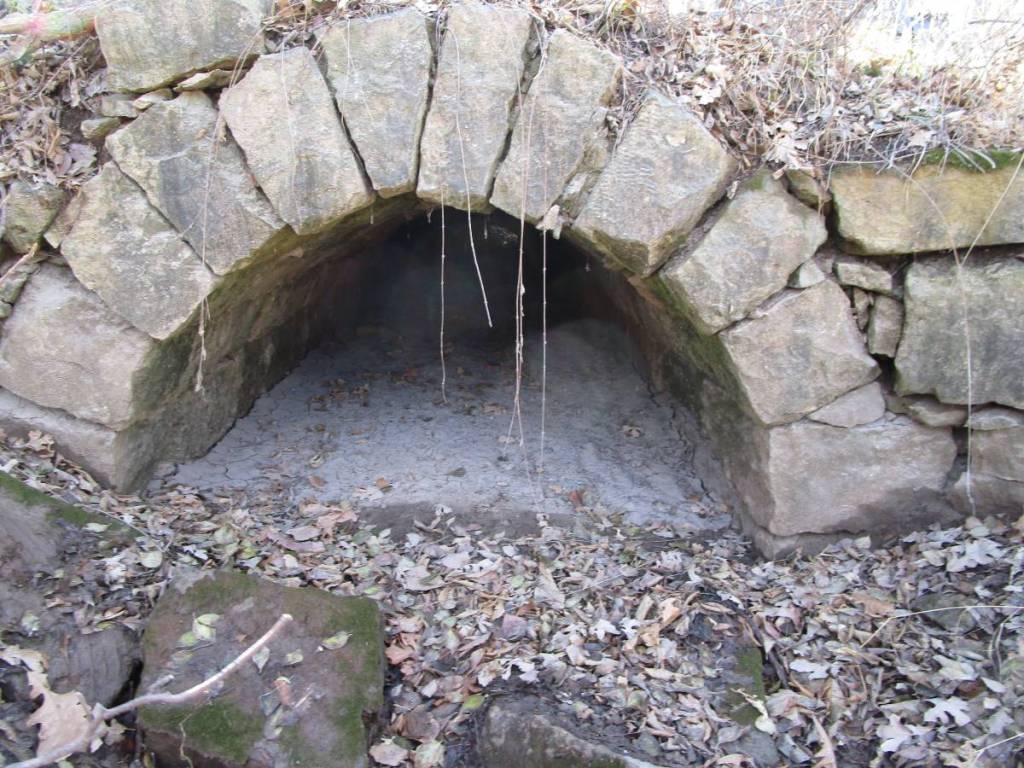
Gothic arches are more commonly associated with European cathedrals than stone arch bridges. However, the pointed Gothic arch had its day in stone arch bridge design, and can be seen on some early medieval stone arch bridges in Europe, as well as some in the Middle East; it is said the Gothic arch originated in the Middle East. Arguably the most surprising feature of a Gothic arch is that it is quite easy to build, and, in fact, this type of arch has certain characteristics that make it a remarkably forgiving choice of arch shape.
The Gothic Point
The classic characteristic of a Gothic arch is the point. The reason for this distinguishing feature is due to the way the arch is drawn. The basic Gothic arch has two identical radii, neither of which are located at the center of the span. These radii are longer than half of the span, and can be located anywhere relative to both ends of the arch. So, for example, the equilateral Gothic arch consists of two radii, one starting at one end of the arch, the other at the other end. Thus, the length of each of these radii are equal to the span of the arch. The arc is drawn until the radii meet each other at the top of the arch. At this point where they meet, the radii leave a distinctive point, which, in the actual arch construction, results in a triangular keystone.
A Variety of Possibilities
Other Gothic arches can be drawn with the radii at different points, but the radii are always longer than half the span. The closer the radii are to mid-span the lower the rise and the slighter the point. Radii longer than the span result in the lancet arches seen in medieval windows. Just as the Roman arch has the lower-rise segmental arch counterpart, it is also possible to build a segmental Gothic arch; this is basically a Gothic arch where only a section of the whole curve is used. Finally, just as there is a three-centered basket-handle arch, which consists of two rounded ends and a long, low curve at the top, so can a Gothic arch be drawn. Thus, you would end up with a pointed top and two rounded end curves. This is called a Tudor arch, and is occasionally seen in stone arch bridges as well.
The Thrust of a Gothic Arch
The pointed arch does have some surprising advantages. Its shape is surprisingly close to a catenary, making the Gothic arch much more suited to free-standing than a Roman arch; the line of thrust tends to stay within the arch (though the point can be a weakness). This trait is part of the reason that Romanesque architecture tends to be heavy and bulky and Gothic architecture tends to be light and airy; the Roman arches in the Romanesque architecture needed more bracing to ensure they did not buckle, (see On Roman Arches for more details), while the Gothic arch tended to be inherently stable.
Though the Gothic arch tends to be stable when free-standing, it is not a good shape for larger spans, unless the arch is made quite thick. The loading of a stone bridge due to the fill needed to make a level roadway is such that most of the weight is on the sides of the arch with relatively little at the top. This is the opposite of the ideal for a Gothic arch; due to the point, the Gothic arch carries weight the best at the top and the worst at the lower parts of the arch where the curves are relatively shallow. That’s not to say a Gothic arch won’t work, it just means that the arch will need to be thick. Solid backing to help brace the side curves is also advantageous.
The Gothic Arch is a Forgiving Structure
One of the main advantages of the Gothic arch is the relatively large amount of settling at the top it can withstand without being at risk of collapse. The point can settle down considerably, even down into more of a flattened curve, and the Gothic arch can still be stable, if less attractive. This is helpful if the formwork is weak or the build quality is poor.
One final advantage of the Gothic arch is how it is easy to build. A novice arch builder often finds when turning, say, a Roman arch, that the curves were inadequate at the lower parts of the arch. If the angles are not steep enough at the lower portions of the arch, what you will find is the two halves of the arch do not meet up quite right, and you have to use a triangular keystone to close the arch… much like a Gothic arch.
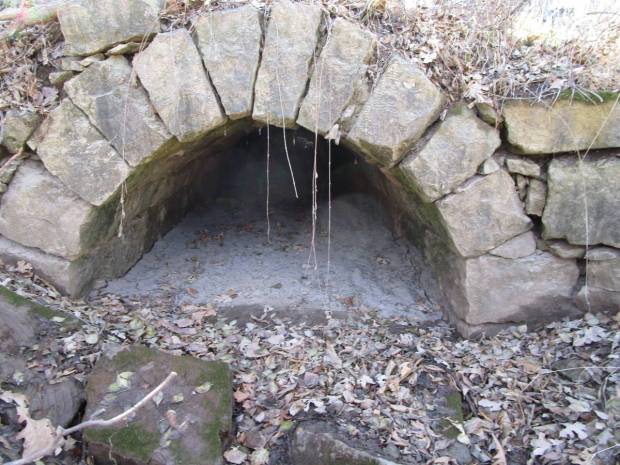
A Gothic arch, therefore, can come more naturally to build, and the point at the top takes up much of the necessary curvature of the arch, all of which translates into the Gothic arch being simply an easy arch to construct. As surprising as it may seem, the Gothic arch is a rather good choice for first-time arch builders.
 Stone Arch Bridges