
Stone arch bridges need to drain. Water accumulation can cause freeze-thaw damage, which essentially amounts to rapid erosion, when it comes down to it.
Stone Deterioration and Hard Mortars
Stone deterioration is arguably the worst result of water-related damage. Since stones are the main components of a stone arch bridge, it follows that stone deterioration can turn the structure into a disaster that, unless the problem is checked in time, may only repairable by entirely replacing large portions of the stonework.

One cause of stone deterioration can be excessively hard mortars. The hard mortars hold in moisture quite well, which can deteriorate softer stones at a rapid rate. The solution, of course, is to repair and repoint with softer mortars; in general type N mortar is about as hard as you would want to go. For soft, chalky stones, type O mortar is a much safer choice. Stone deterioration seems to be most common in bridges composed of sedimentary rocks.
The Drainage Problem
As can be seen, choosing suitable mortars is an important piece of insuring adequate drainage to a structure, as a hard mortar traps moisture against the stones. However, as important as choosing the right mortar is, there is always the possibility of a stone arch bridge becoming waterlogged, regardless of the mortar used. When one considers that many stone bridges are essentially hollow boxes filled with dirt, it becomes obvious that if the “box” is filled with waterlogged dirt, all sorts of strange things can happen. Some signs of waterlogged fill include bulging walls, collapsing spandrel walls (with possible damage to the arch in the process), blowing out of small pieces of the arch, and, of course, stone deterioration caused by all that water being held within the structure. And while draining the stone bridge is best carried out in the design phase, in a maintenance program, one might have to still deal with bridges that are suffering from waterlogging due to the original design.
Allowing Water to Run Off
The “hump” seen in some stone arch bridges naturally allows water to run off. Whereas a bridge that forms a sort of valley in the road would fill up with water easily, which then would soak into the fill, if the bridge rises above the road the water can run off the arch before it soaks in.

A bridge can be rather easily modified to achieve a curved deck that allows water to run off; this is a surprisingly easy solution that can help mitigate water problems considerably, as long as some authenticity can be compromised. All that is usually needed is another layer of stone on top (concrete can be used, but is less authentic-looking), and then careful addition of the fill. To date we have seen two bridges in Butler County, Kansas, that have been modified this way. An added benefit of this scheme is that the extra fill helps distribute the weight of vehicles better, allowing the bridge to handle loads with greater ease. And, if enough fill is added, the bridge’s weight limit can even be increased in some cases.
There are a variety of other solutions to help drain the roadway, the key, of course, being to keep water from pooling on the bridge. In the end, what modifications to make will need to be determined on a case-by-0case basis. Roadside gutters, rerouting of approaches down which water flows, and improved drainage ditches along the road are some examples of alternative solutions; again, what to use depends on the circumstances.
Draining the Fill
The fill itself can be drained, too. Historically, one reason bridges were built with solid backing was because it is much harder for the fill to be waterlogged if it is solid masonry. These days concrete is often used to replace dirt in stone bridge fill. Concrete tends to serve basically the same purpose of the solid backing.
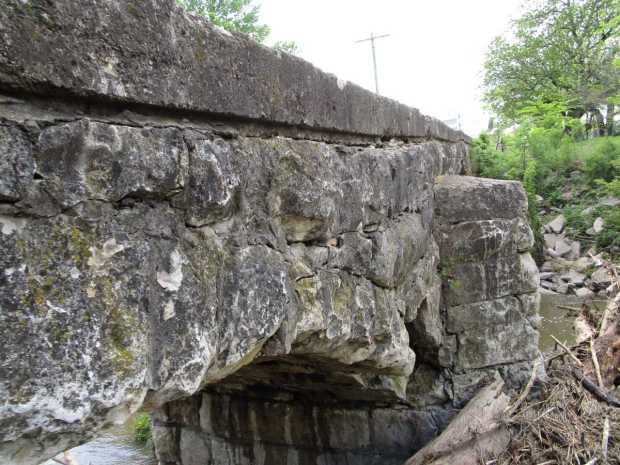
But even if the fill is loose material, it still can be drained. Drain tile such as is used around house foundations can be installed, but care is needed to ensure it drains the water to some place safe; if the drain tile happens to dump water over the top of the arch, for example, a catastrophic failure can occur. Another scheme used historically that can be easily implemented is to build drains into the arch itself. Sometimes a stone bridge was built with small gaps left in the arch for water to drain out of. If these are not draining they can be cleaned out. If no drainage was provided for, small holes can be drilled into the arch that are lined with a pipe to achieve the same effect. The pipe is usually mortared in, but be sure the pipe is not steel or iron; rusting iron expands, which, when placed into masonry, can cause all manner of damage in the immediate area.
 Stone Arch Bridges