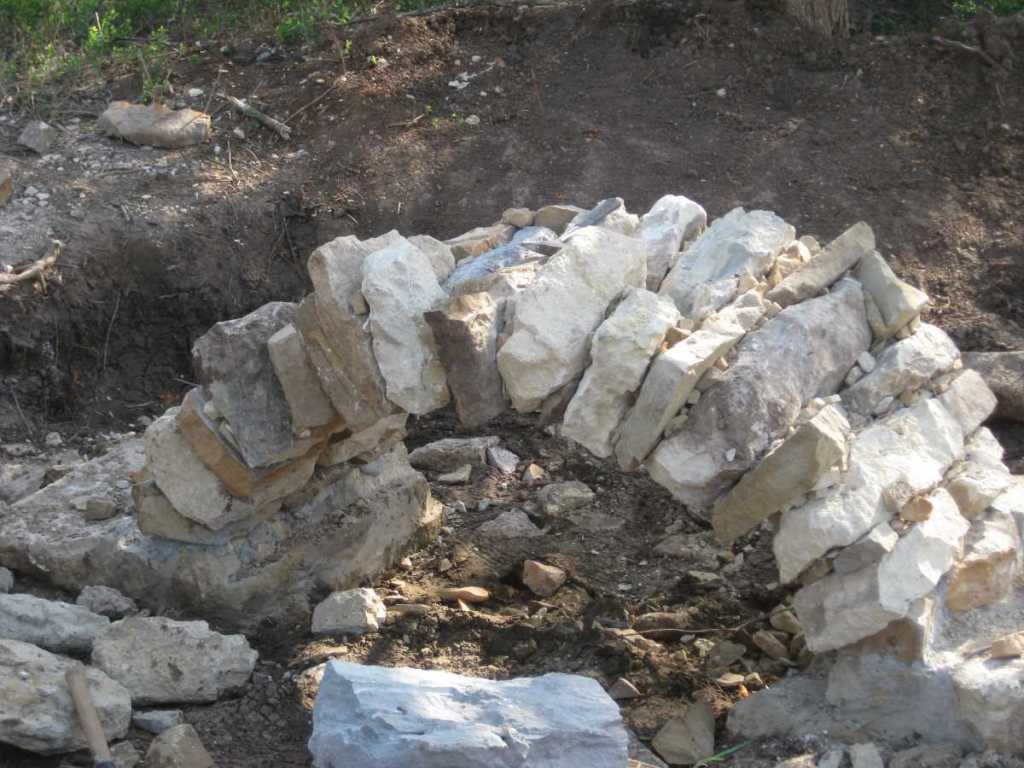
It is an interesting but true phenomenon that it is in some ways easier to build a larger structure than a small one. One problem encountered when building stone arch culverts is that it is rather difficult to build a small arch efficiently. In other words, while the arch can certainly be built, the amount of material required may be disproportionately large for a small structure. The question then arises: What sort of design can we build that will make the most efficient use of material?
A Historical “Solution”
In the southern Kansas area where we are located, the historical local stone arch bridges frequently used a simple expedient for achieving a cost-efficient stone arch culvert without resorting to large, low-rise spans or long approaches to prevent there from being a hump in the road. The solution? Make the arch small! Thus, you will find areas where there is now a full-fledged bridge (20′ waterway or more) replacing what once was a mere 6′-span stone arch culvert!
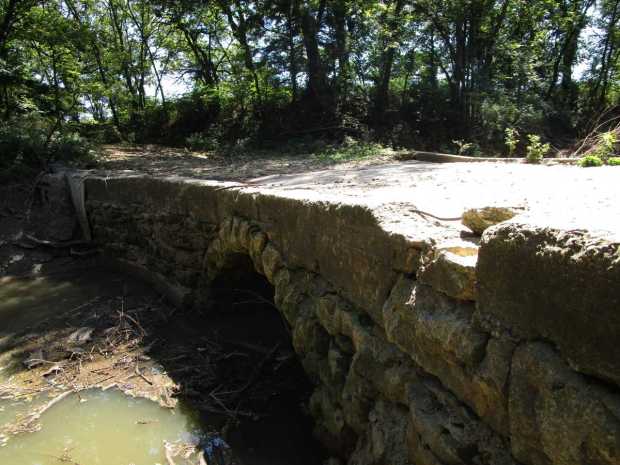
Yes, it saved money, at least up front, but was it a success? Hardly. Making the culvert too small is not a good long-term solution, though it still may not be practical to build it large enough to carry a 500-year flood without overflowing, either.
Low-Rise Arches
Generally, it is safe to assume that most streams to be bridged are wider than they are deep. This is unfortunate, as arches work rather well with deep, narrow gorges, but are not nearly as suitable for low, swampy areas. If the arch towers over the surrounding landscape, long approaches are required to make a usable grade, and long approaches require much material. Thus, it follows that a more efficient structure will use a low-rise arch. But there is a catch here. Low-rise arches require large abutments to resist the thrust. Thus, the low rise-arches will need more solid masonry to stand stably. This can hardly be classified as efficient. An exception to this rule is if the arch springs barely above foundational bedrock. If this is the case, the abutments need not be large as the thrust is transferred quickly to solid rock below.

Subgrade Arches
A tempting possibility is to build a Roman arch, which does not need massive abutments, and set it below the soil. In other words, only the top part of the arch is even showing; the rest is underground, sprung barely above the foundation level. This scheme actually can work, and has some obvious advantages from a scour-risk standpoint, but there are some serious drawbacks. For one thing, if part of the arch is underground, the span will need to be longer to achieve the desired waterway than would be the case if the arch was sprung at streambed level. Longer spans mean thicker arches, and thicker arches mean more rise, which, for a small culvert, may be enough to mitigate the advantages of subgrade construction. Construction will be harder, too.

Not only will removal of the falsework be more complicated, but, if the hole fills up with water, the water will need to be drained. Furthermore, if mortar is used, the arch joints thoroughly cleaned out of all deposited mud. If you are planning on building the arch then coming back and grouting the joints, the cleaning of the arch could be quite an undertaking.
A Compromise
A good compromise solution is to build a segmental arch, say a 130-degree segment of a circle, and arch theory shows why this choice of arch shape is efficient. A Roman arch actually does possess a horizontal thrust. The thrust of the arch will leave at about an angle of 25 degrees or so. This is because the thrust line is a catenary, while the Roman arch is certainly not. Ideally, the Roman arch should be built thick enough that the thrust remains within the middle third of the arch. Where this is the case, no outward thrust will be noticed if the arch is simply resting straight on the ground. If the Roman arch is on tall piers, this thrust can become manifest.
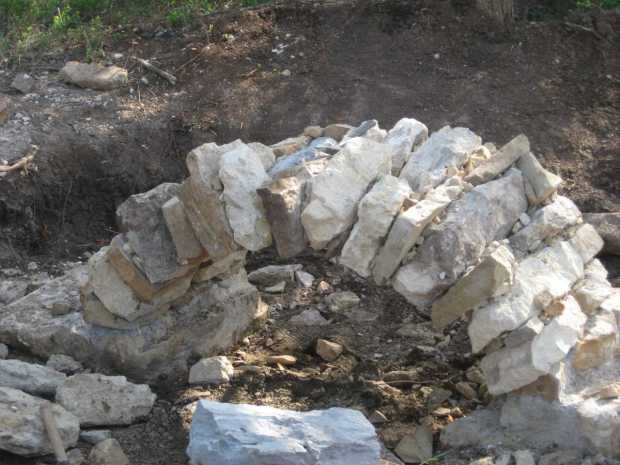
A 130-degree segment of a circle actually tracks the line of thrust closely. It has two skewbacks of 25 degrees each. Curiously, a properly sized 130-degree segmental arch will be found to be stable if resting on the ground, even if there is nothing placed behind the skewbacks. The idea, then, is that a 130-degree segment of circle possesses but little more thrust than a Roman arch, and yet has less rise (1/3 versus the 1/2 rise-over-run of a Roman arch). Thus, a 130-degree segmental arch can be built using abutments only slightly thicker than required for the Roman arch, yet there will be less rise and hence the approaches won’t need to be so drastic.
 Stone Arch Bridges