
A stone arch can only stand if the arch is complete. Once complete, the arch tends to be an incredibly stable structure. However, since it is usually composed of a myriad of stones, a stone arch is an incredibly unstable structure until finished. Naturally, this poses a problem for construction. The solution, of course, is some form of temporary falsework, which is removed when the arch is completed (see A Critical Part of Arch Building: The Centering).
A Bridge for a Bridge
The falsework itself is actually a bridge when it comes down to it. After all, a 50′ span-stone arch bridge may very well put a load around 100 tons on the falsework! Until the arch is closed, the falsework must carry the weight. And, of course, if we are indeed building a bridge, the falsework should also be able to span the stream without being demolished in a flood. Water diversion is a possibility (though in most cases there probably are serious problems with this scheme), but no matter how you look at it, the falsework for the arch needs to be well planned. Be aware that should the falsework fail, a very dangerous situation can occur, especially for larger spans!
Many Design Possibilities
There are many design possibilities for the falsework, the key being to make sure it is round. Wood is a common option, with plywood being a superb choice for spans 8′ and under. Rebar can be bent and braced into a curved shape, though (if this matters) it tends to form a catenary curve if left to itself. Thin PVC pipe can also be used, though is best suited for short spans. Soil can be heaped up to make a form, or one can use 55-gallon drum halves for a 2′ arch.
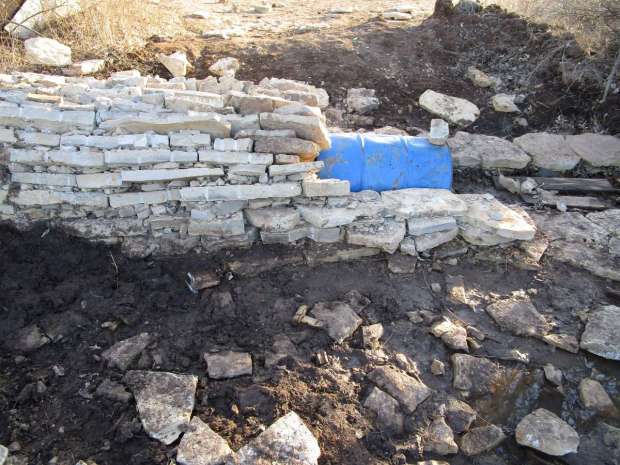
Even wickerwork like a basket has been used historically! The list goes on and on, but the key is to achieve the correct shape, and ensure the form is strong enough to support the weight without deflecting excessively or collapsing. If necessary, the form can always be supported in multiple places beneath.
Removing the Falsework
Removing the falsework is something that also needs to be planned for. For small bridges we have repeatedly used a pair of 2X4s or 2X6s set up on the 2″ (or, rather, the nominally 2″) end. The curved form is set on top of these and not fastened to them in any way. When finished, these boards are easily tipped over and removed, allowing the form to drop down, where it can be slid out. Alternatively, a pair of wooden wedges (like oversized door shims or maybe even real door shims, depending on the size of the project) may be used, one stacked on the other with the tapered ends facing opposite directions (again like a door shim) to achieve a flat surface upon which the form is placed. When the arch is finished, the wedges can be slid out, again allowing the form to drop out where it can be removed.

A soil form is easily removed by excavating away the dirt below the unfinished arch, but unless you are very sure your design and construction are top-notch, this method leaves some things to be desired; if something fails while you are excavating the dirt, the results are liable to be unpleasant at best. One key to safely removing the falsework is planning it such that you are not directly under the finished arch when the forms are removed.
And if Things Get Stuck….
While the possibilities of the formwork are limitless, it is always important to remember we are talking about massive amounts of weight suspended in the air. And, despite some of our best planning, sometimes things go wrong, and rather than merely drop and slide out, the formwork simply becomes jammed into the arch. When this happens things are apt to be unpleasant. About the only solution is to arm oneself with a small hammer, maybe a saw, and a crowbar and start dissecting the formwork. Extreme care will be required to prevent damage to the arch, especially if the arch is mortarless. It may even be desirable to finish the bridge completely before attempting formwork removal, as the extra weight of a completed bridge helps stabilize things.

Wooden forms can be fairly easily dissected with care and patience; the important thing is not to rush this task. Burning out the wooden form can and has been done by some builders, but the excess heat can so easily damage something that it is best to avoid this if at all possible.
In the end, the best way to prevent a jammed form is careful planning. Experimentally, the higher up the form is propped the easier it is to remove; in other words, to use an above example of supporting the form, propping up the form on a 2×6 will result in easier removal than with a 2×4.
One other consideration is for long forms. Long forms tend to be tricky in many cases to slide out of the arch, so building long forms made up of multiple removable sections can be useful. However, center sections may require one to crawl under the bridge to slide it out, therefore plan accordingly. Speaking from experience, crawling under a bridge to remove the form is no fun, especially when we are talking about wriggling one’s whole length on one’s stomach under a two-foot-span arch with soggy conditions beneath.
 Stone Arch Bridges