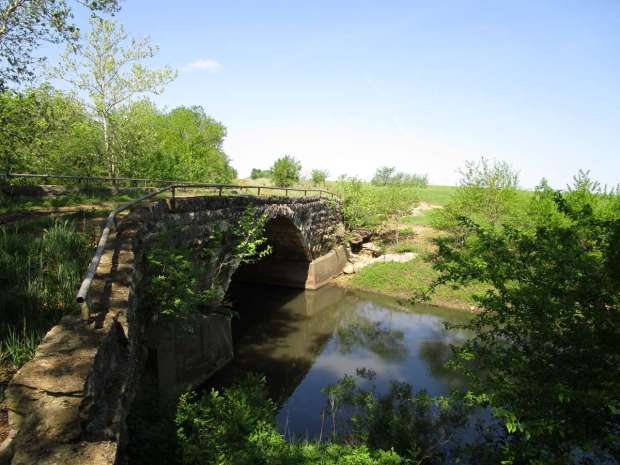
The Flint Hills of Kansas are famous for its natural prairie landscape and their rolling hills. Throughout the region stone bridges can be found that are almost as much a part of the landscape as the hills themselves.
The Stone Bridges of the Flint Hills Today
The Flint Hills still have many stone arch bridges, though the highest concentration is in the southern part of the region. These structures blend beautifully into the landscape, and often show a distinctive touch as a result of the various builders’ construction methods; you can sometimes tell who built a given bridge by subtle details such as the size and shape and form of the stones used. Each bridge represents a unique piece of history in the settlement of the region, for good roads were crucial to the economy of the developing area.

Each county seems to have had its own general method of building a bridge, but it also becomes apparent where a county was copying another one. Thus, the stone bridges of Butler and Cowley are distinctly similar. Regardless of how the stone bridges were built, they invariably add a nostalgic touch to the roads.

One of the greatest features of the stone bridges of the Flint Hills is how they fit into the natural landscape. Built of the same material as the enduring hills themselves, they are at once a part of the region’s history and scenery. Though in time past the value of these structures were not appreciated and many removed to make way for more modern and wider structures, in more recent years the stone bridges of the Flint Hills have fortunately become increasingly recognized for their intrinsic heritage and value. Butler County already is showing a tendency to restore rather than replace its stone bridges, and perhaps an effort will be made throughout the region to better preserve the remaining stone arch bridges.

For the adventurous sorts, looking for stone arch culverts can be an enjoyable task; stone culverts are not regularly inspected and are therefore not nearly as well documented as their bigger cousins. Best of all, stone arch culvert hunting is a good way to see extensive areas of the rural landscape. And even if driving miles of back roads checking out every culvert is not for you, there are many well-known stone arch bridges in the Flint Hills that are easily accessed. So next time you are in the Flint Hills, appreciating America’s greatest prairie and its rich heritage, check out some of the picturesque and enduring pieces of American history that are still patiently spanning their respective streams like they have been faithfully doing for a hundred years or more.
 Stone Arch Bridges