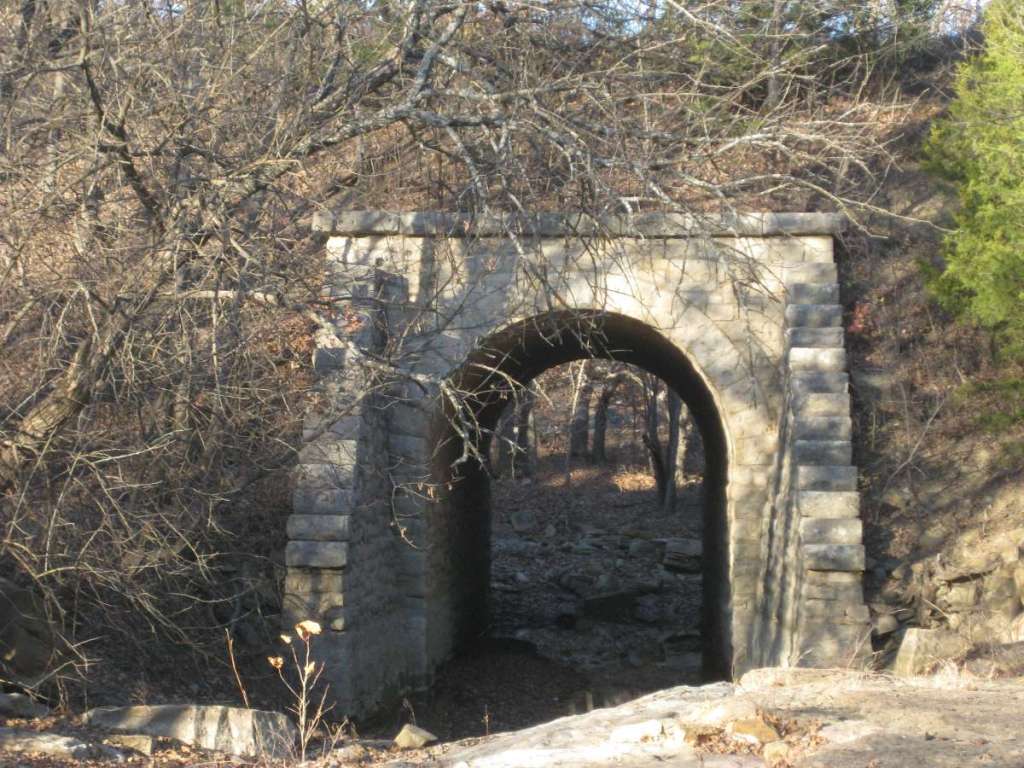
Stone has been used for many, many years to build some impressively durable bridges. Though there are several positively ancient bridges that use stone but not in an arch form, the typical form of stone bridge is the stone arch bridge.
Why Stone was Preferable Historically
Stone, ultimately, was a preferred building material simply because of its durability. Steel was unheard of when stone bridges first came into their own, and wood was hardly a durable building material; even the somewhat modern concept of treated wood tends to have a relatively short lifespan. While stone can and does erode, the process is fantastically slow in most cases. And stone does last; a surprising number of bridges built by the ancient Romans a couple of millennia ago still not only exist, but are used.
The Stone Bridge Resurgence of the 1900s
In the United States of America, there is one piece of stone arch bridge history that stands out. Stone bridges never were terribly popular in America, at least compared to Europe. Part of this was because, when the United States were young, wood was a quick and ready means to build bridges. Eventually, especially in the early to mid-1800s, stone bridges began to be built in some number, but iron and steel quickly supplanted stone as major building materials, and there was no demand for stone bridges. At least, this was commonly thought to be how stone bridge history played out in the US.
Actually, though, surveys of bridges in several states throughout the United States, such as Pennsylvania, Wisconsin, Minnesota, and Kansas, to name a few, have revealed a surprisingly high percentage of stone bridges from the early 1900s. These are not the WPA bridges of the ’30s, either. Though the WPA built stone bridges as works projects (stone bridges apparently were well suited for this purpose; they require little specialized material and a whole lot of manual labor) stone bridges had made a comeback even before the WPA days.
Stone Bridges in the Early 1900s
Extensive newspaper research may be able to conclusively clear up the mystery as to why stone bridges made a resurgence in the early 1900s, when, by all rights, steel should have been the material of choice.
American railroads, for instance, switched from stone to steel to stone again. The reason for this was the regular failure of steel bridges. The old steel bridges quickly became insufficient as railroad loads increased, leading to regular failures. These failures were not only expensive, but frequently cost lives. So, for both economic and public relations reasons, railroads began putting in stone arch bridges and culverts. Apparently the traveling public had concerns about what might happen if a weak bridge collapsed under them, so they preferred riding over structures with proven durability.
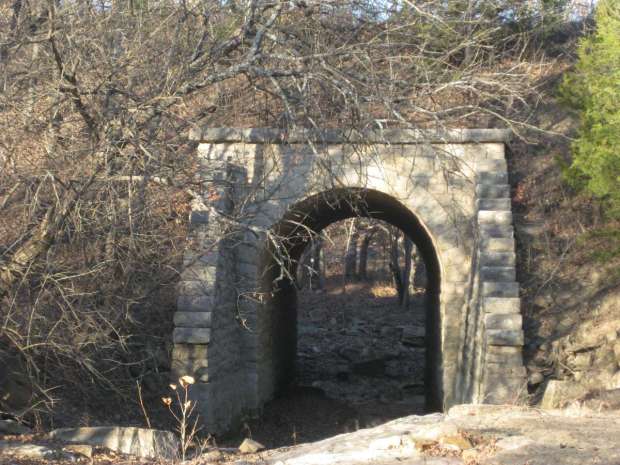
It is not quite so clear what prompted the building of so many stone arch road bridges in the early 1900s. The Good Roads Movement no doubt played into this; after all, better roads needed better bridges than could be had with wood. Furthermore, the permanent stone bridges could be more readily built with local resources than steel bridges. Also, at the very least in Kansas as well as Oklahoma, there was a revolt against the steel bridge companies. These companies had developed a form of monopoly, and were commanding ridiculously high prices for what at first seemed to be the only reasonable kind of bridge to build. In response, many localities switched to using their native stone.

Advocates of stone arch bridges also pointed out that stone bridges supported local labor, and tended to keep the money spent on the bridge within the locality where the bridge was built. Thus, building stone bridges helped to support the local economy.
In These Modern Days…
The fact is stone bridges tend to last longer than even modern bridges, prompting some interest in building stone bridges once again. Reinforced concrete wears out, and modern bridges have somewhat short lifespans. Formerly, concrete bridges were expected to last about 50–75 years, while now 100-year and 120-year bridges (at least in theory, we’ll know for sure in about a century) are being built. 120 years is really good, but, on the other hand, there are many stone arch bridges around in use that are several hundred years or even a couple millennia old.
And for the DIY Enthusiast…
For the DIY enthusiast, especially the one blessed with a rocky landscape, a stone bridge makes a remarkably satisfying project.
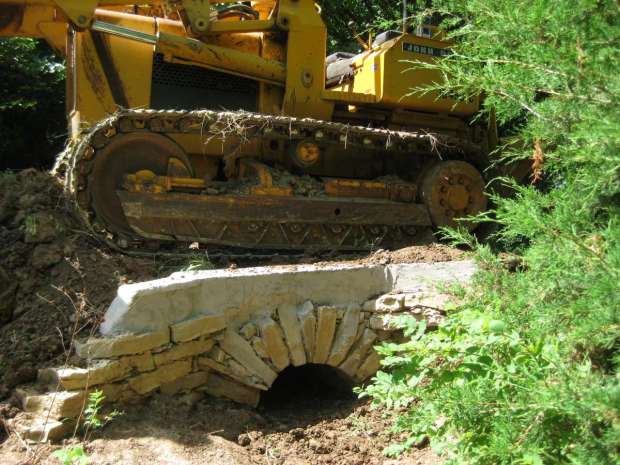
And, too, a DIY stone arch bridge can not only look really cool, but can be really strong too, if well built.
 Stone Arch Bridges