
One of the most important keys to successfully repairing stone arch bridges is understanding how and why failures occurred in the first place. While this may not always be possible, frequently a good guess can be had. The idea, of course, is to fix the underlying problems, not just the obvious difficulty, which may merely be a symptom of a large underlying issue. Merely patching the symptoms of a systemic issue can result in later catastrophic failures, or at the least necessitate frequent repairs.
A Practical Example
Perhaps the best way to demonstrate how the obvious problems can be caused by more subtle difficulties is to examine a realistic stone bridge failure.
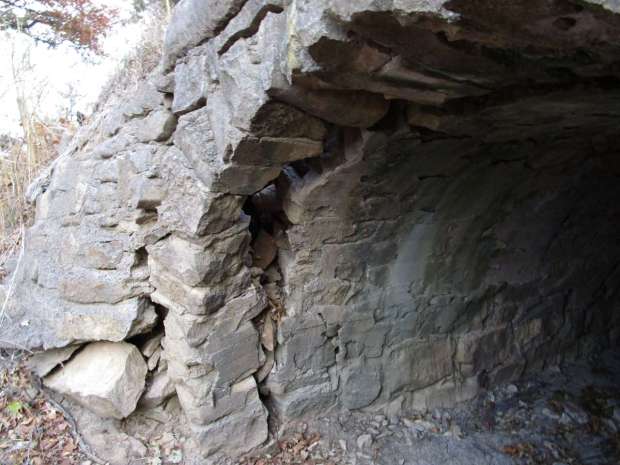
Examining the above photo shows some major structural failures. First, the arch ring is splitting off rather dramatically. Second, the spandrel wall behind the arch ring is caving in. While one could simply rebuild both failing elements, it is productive to understand why the failure occurred in the first place. Failures do not happen spontaneously; there is always an underlying reason. In the case of the above bridge one possibility would be scour, causing a settlement and delaminating of the arch and failure of the spandrel wall. Though this possibility would need checked into, it seems improbable for the following reasons:
- There are no obvious signs of scour, but be aware that scour holes frequently fill in with silt etc. after flood events.
- The arch ring has separated out more than down.
- The waterway is much larger than needed, evidenced by a (not visiable in the above photo) extension to the structure’s width by a notably smaller culvert pipe.
- The spandrel wall is collapsing well away from the water opening. Furthermore, its failure seems to have been more from bulging out at the base rather than simply being undermined; note how the bottom of the wall appears to have snapped out above the foundation level. Of course, water may be running along the foundation causing scour if the foundation is shallow, but again, note that the wall has buckled out at the bottom and fallen inwards.
Perhaps the key to the failure is in the wall buckling. A look also shows that the very hard mortar used has kept the wall a cohesive mass. As a whole, the possibility that suggests itself is that the wall was too thin to hold the fill, which is clearly of loose type as seen in the photo. That the wall is thin is obvious; note how proportionately thin it was relative to its height. The bulging wall could have pulled the arch ring out with it if it was well bonded to the arch ring originally. These kinds of failures are by no means unheard of. In the end, of course, a detailed ground examination would be required with probings to check for scour and other possible issues. Note how different the repairs would be depending on what caused the original failure. Whereas one could simply rebuild the structural elements as-is, if the bridge is being scoured they would fail again. If, on the other hand, the cause of failure was due to a too-thin wall, some means would need to be taken to prevent a reoccurring failure. Probably the best bet if authenticity was key would be to replace the fill with a more solid material; alternatively a wall within the wall to which the masonry wall was possibly anchored would be an option.
Reading the Signs
Every failure mode has its own sign. In masonry bridges, cracks or dislodged stones seem to be the most obvious signals of failure. Cracks in masonry always imply tension pulling the masonry apart, either in a shear fashion or in a straight pull. The question would be what caused the tension? In the above example, the tension appears to have been caused by fill pushing out on a too-thin retaining wall that was well bonded to the arch ring. The arch ring in turn tore free from the rest of the arch. The tension from the wall broke the arch free; this would make sense as the arch appeared to have a high percentage of running joints making delamination relatively easy.
Settlement (which can be induced by scour) also causes tension in structures and resultant cracks; see the photo below.

To sum up, an examination of the interplay of the forces that must have been present to cause a failure is important to successful long-term repairs.
 Stone Arch Bridges