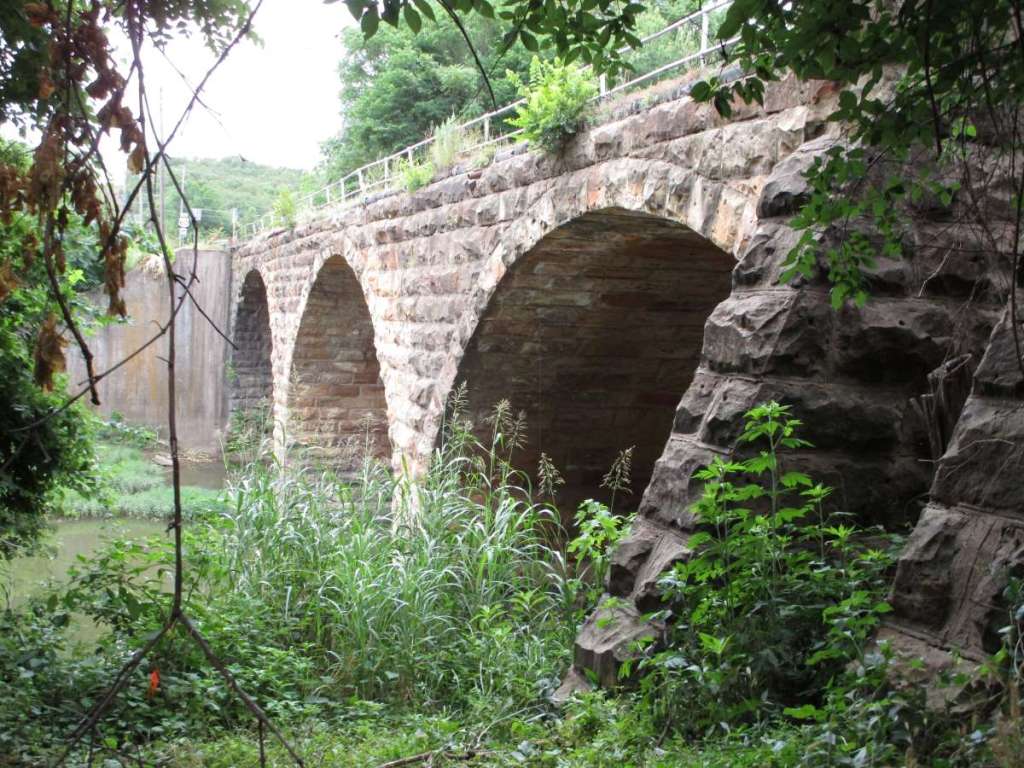
As surprising as this may seem, arguably the most common failure point in stone arch bridges (aside possibly from undermining problems) is failure of spandrel and approach walls. These walls are nothing more than simple retaining walls. A pair of them is used to hold fill and, on top of this fill, the roadway. However, these retaining walls are prone to various gradual problems, often ending up sliding out until they topple. Why are these walls such a weak point and how can they be better built or strengthened? In this post we will investigate this issue.
Economics Vs. Stability
As a broad design consideration, the retaining walls in a stone bridge, whether they be the spandrels or approaches, are often much too thin, and the reason is economical. For a straight-sided, freestanding wall, it is generally best to not go any thinner than 1′ of thickness for every 4′ of height. A wall that is too thin subject to being toppled easily if the center of gravity shifts; hence why a gravity wall such as is used in masonry needs to be built reasonably thick. 1′ thick for a 4′ high wall may not seem too thick, but the ramifications for a sizable bridge are huge.
For example, take a 40′-span Roman arch bridge. The height of the bridge ends up being 20′ plus the arch thickness and the depth of the fill over the arch. This means that the wall will have to be 5′ – 6′ thick if the 1 to 4 ratio is maintained. Not only does a 5′-thick wall use a lot of stone, but even worse the arch will have to be made wider to accommodate. If a 16′ roadway is used, then the arch will have to be at least 26′ wide! A more economical solution in some cases would probably be to build the whole bridge with solid masonry (just one thick stone wall) with but a thin layer of fill on top to make a good driving surface. Obviously, the expense of such designs can be considerable, though beyond a doubt they would make very durable structures. From this, it can be seen why builders often made the walls much thinner than the numbers above would dictate. As a compromise solution, some builders would occasionally add buttresses to the outside of the bridge, creating occasional points where the otherwise thin wall is heavily reinforced.
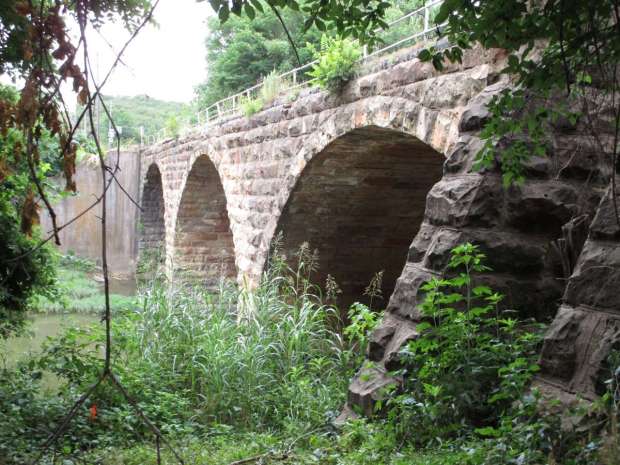
These buttresses really do work well, but cannot be used for the spandrel walls, only the approaches.
Enter the Fill
Adding the fill to a stone bridge and making the walls retaining walla changes things. The fill, thanks to gravity coupled with frost action, creates a steady force tending to push the wall over. Thus, just as a low-rise stone arch needs thick abutments to provide a heavy dead load to resist the thrust, so do the retaining walls need to provide a solid dead load to resist the “push” of the soil. A historic rule of thumb by a respected engineer was to build the base of the retaining wall at least one third as thick as the wall is tall, a 1 to 3 ratio. So, in our 40′ Roman arch bridge example above, the wall would need to be about 7′ thick. Obviously, this results in considerable expense. However, there is a possibility here: the rule stated above dictates that the wall be 1/3 as thick at the base as the wall is tall. Is it possible to build a wall that is thick at the base and thin at the top?
Tapering the Wall
Tapering the wall holds considerable potential. After all, the top part of the wall has to resist much less force than the bottom of the wall. Thus, the wall can be built after the pattern of a triangle, though typically the outside face is flat to keep the width of the bridge narrow. This means, of course, the triangle is hidden inside of the bridge under the roadway. The catch with this design is that enough weight still must be provided on top of the wall to ensure the stability of the bottom. (Yes, it is entirely possible for the bottom of the wall to be shoved out by the fill in spite of and at the expense of the otherwise stable top of the wall.) It is also advisable to build the triangle in steps instead of a slope. At least if the wall is stepped the fill can provide weight on the steps to help stabilize the wall. If the wall is truly sloped the fill will tend to exert more force against the wall; some of the weight of the fill pushing down against the slope of a triangle will tend to be converted into a horizontal force right at a point where additional horizontal force is not wanted.
Working With the Fill
Up to this point we have investigated “brute force” gravity walls where the mass of the wall is used to hold the fill in. In practice, performance of the wall can be greatly improved by using special designs that interact with the fill in order to help achieve a balance. Granted, these walls are still best built thick for long-term durability, but, that said, they are overall far more stable. The basic principle in this style of wall is to build the wall such that it has a tendency to lean into the fill. This helps counteract the fill’s tendency to push out. It is possible to build a leaning wall that rests against or even steps into the fill like a staircase, but as it is generally preferred for the outside face of the bridge to be vertical, this is rarely seen.
Leaning into the Fill
To build a wall that leans into the fill is not difficult. There are several methods, but for rubble work the simplest is to place the stones such that their natural slopes create a lean into the fill. This works because few stones are truly flat; they usually are tapered in some fashion. To build, then, the stones are placed such that the wider end is placed on the outside of the wall and the tapered end on the inside. This creates a decided slope against the fill. If the angle becomes too steep to be usable, place a stone with a decided taper such that the thick end is on the inside and the thin end on the outside, then continue building as before. The beauty of this method is the simplicity and the fact that the outside of the wall can be kept level.
An alternative solution is to build a wall that is flat on the outside but shaped like an upside-down triangle on the inside. Yes, this literally means that the top of the wall is thicker than the bottom! This does actually work, however. The wall interlocks with the fill and becomes a unit with it; the fill holds the wall up while the wall keeps the fill from pushing out. Some builders reportedly opted for a hybrid solution, shaped like an hourglass cut vertically in half down the middle. They built the base of the wall thick, tapering until roughly half its height was reached, then began thickening it again as they neared the top of the wall. The idea apparently was to make the wall thick at the base for strength, then create a tendency at the top of the wall for the wall to lean into the fill. This lean was not as important at the bottom of the wall due to the dead weight of the structure.
Stabilized Fill
Few builders seem to have actually built the approaches and spandrels as heavily stepped retaining walls. Though they may have used some “lean” into the fill, they typically relied on “brute force” gravity walls, which were often on the thin side. However, there were simple tricks that could be used to reduce the “push” of the fill against the wall.
Generally, the method used to reduce the thrust of the fill against the walls was to reduce the amount of soil in the fill. Adding assorted loose rock fragments in with the soil seems to stabilize the fill noticeably. Also, choosing better soil can help, too; generally silty soils are a poor choice, while clay can be fairly stable depending on its composition, though in the long run all but the hardest clay tends to expand and contract every time it rains and then dries out.
In our area (Kansas) many builders did not use fill at all, except for the roadway, but built drystack masonry in between the spandrel walls.

This helped enormously, though the relatively thin outer “skin” walls could be dislodged by impacts still as there was little to no bond with the interior masonry. Some later bridges used an expanded form of this concept, being built with stone “skin” and concrete interiors.
 Stone Arch Bridges