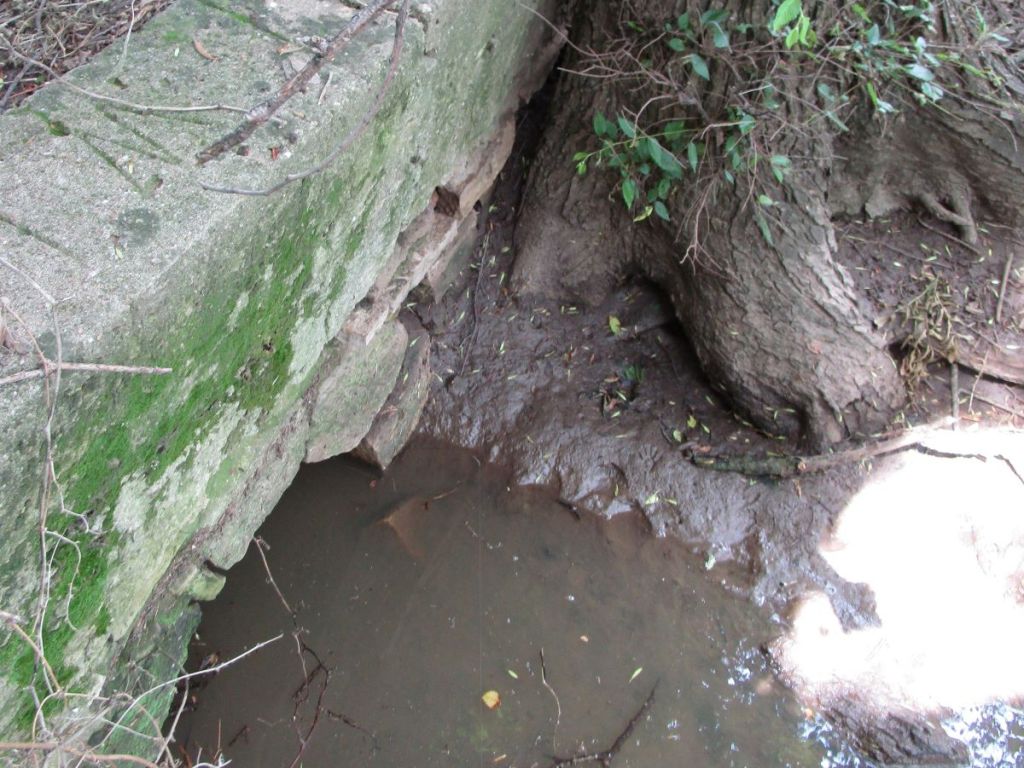
Fairview Township, Butler County, Kansas, is where stone arch bridges were first built in earnest in Butler. We recently found a tiny stone arch culvert we had overlooked on a dead-end road in this township. Though widened on one side, of crude build, and very tiny in span, this culvert is significant as the only remaining Fairview Township stone arch culvert known to date. This culvert is located on the Townada/Fairview township line, on Parallel Street, a short distance east of Parallel’s intersection with Santa Fe Lake Road. Though newspaper accounts are sparse, there is sufficient evidence to get a clear picture of who built this culvert and when.
The Culvert
This culvert is little used and has been widened on one side. The workmanship is crude but effective.

Rather overgrown and hidden beneath a tall concrete curb, it is very easy to miss or confuse with a concrete bridge. Indeed, during our initial survey of Fairview Township, we mistook this for a concrete culvert, but decided to revisit to double-check. As can be seen in the photo a large tree has encroached on the culvert, but, at least as far as can be told from the road, no serious related damage is evident. The mortar joints are very dry, but the arch stones were obviously rough-cut to fit, which is no doubt why this diminutive structure still stands.
The Builder
The one newspaper article we found pertaining to this culvert (and the one which set us on its trail in the first place) is a brief and somewhat tangential reference tucked into a listing of various Fairview news items.
“W. H. Harden and Milton Baker have moved the stone arch bridge near the iron bridge across the Whitewater at J. W. Robinson’s, to a point 250 yards further east.”
The Industrial Advocate (Butler County Democrat), “Fairview,” July 21, 1899.
This reference is not terribly precise, but J. W. Robinson is easy to trace. J. W. Robison (frequently called Robinson) founded Whitewater Falls Stock Farm in Fairview Township with his son J. C. Robison. This farm later became famous for its Percheron horses. A look at the maps show J. W. Robison owned several pieces of Fairview lands. However, a survey reveals only one likely spot where he owned land near a Whitewater River bridge with an east-west road. And that is the spot where we found this culvert. Is this the same culvert? It likely is, and if it isn’t it would be a remarkable coincidence. This culvert is, incidentally, within sight of a large old barn that is a remnant of Whitewater Falls Stock Farm’s glory days.
The reference to moving the culvert presumably refers to relocating the place where it was to be built rather than literally moving the culvert, as stone culverts aren’t exactly well suited to transportation. Probably this section of road tended to flood, so a small culvert was added more for allowing the area to drain than for spanning a specific, clearly defined channel, hence why there could be some options open as to the precise part of the road where the culvert could be placed. W. H. Harden was a well known stone mason of the area, and Milton Baker was also from the area. This culvert has been added to our Butler County bridge list, map number 42.
 Stone Arch Bridges