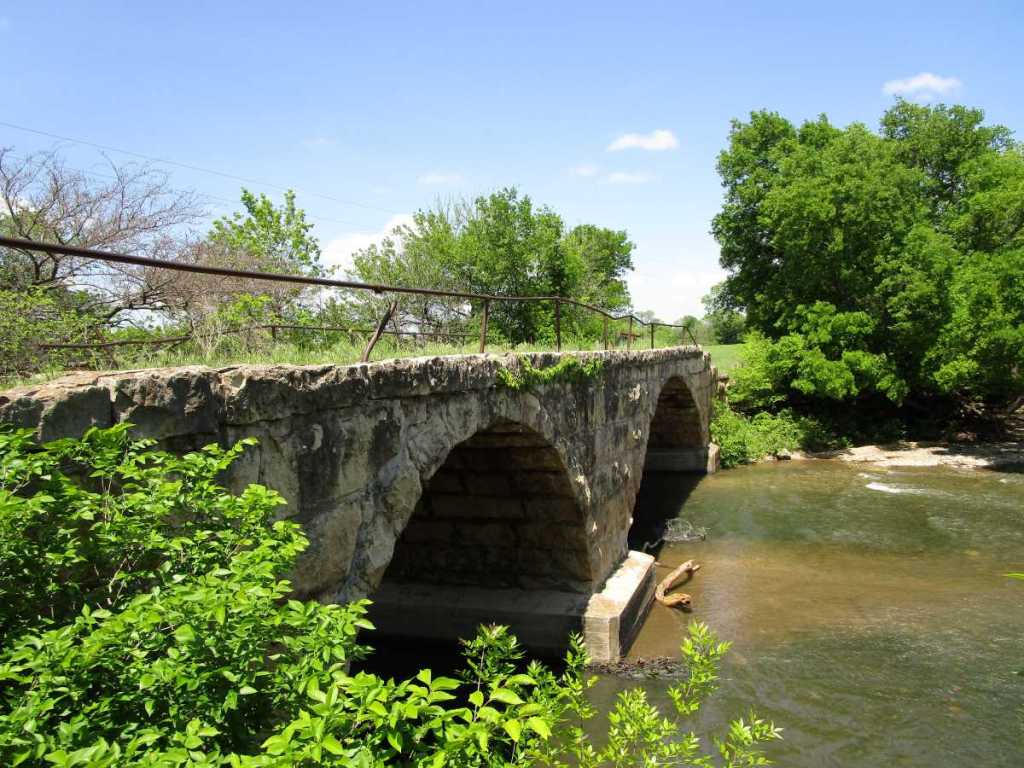
In a low-rise segmental arch, the forces at play are remarkably intense. However, the line of thrust of a low-rise segmental arch tracks rather neatly with the curve of the arch, making it a solid structure. That said, the low rise means heavy horizontal thrust at the ends. The necessity of resisting this horizontal thrust is further complicated by the fact that a low-rise arch is considerably more vulnerable to even slight movements of its abutments than higher arches. It will be found that the relationship of arch rise to tolerance of abutment sliding is nonlinear, with the result that the low-rise arches are disproportionately more susceptible to shifting than their high-rise cousins.
Forces, Forces
As seen above, the difficulty with a low-rise arch is simply that it produces a heavy horizontal force and, at the same time, it can handle only a slight horizontal shifting of its supports. So how is a low-rise arch built so it can stand? If the bridge is crossing a rocky gorge, a low-rise arch can work well if the stone sides of the gorge are used; then the arch is essentially built as part of the earth itself. However, this method is rarely an option. Thus, the answer is to add enough weight to the ends of the arch that it can’t slide out. Or, perhaps a better way to look at it is that enough weight is added to the ends that the horizontal line is “steered” downwards to a more vertical direction.
Another way of viewing the issue is that the abutment is thick enough that the line of thrust from the arch can be contained well within the thickness of the abutment on its way down to the ground.

If the ground below the arch is solid, the bridge will be stable if the abutments are thick enough to carry this thrust down to the ground.
The Stability of the Ground
Regardless of how you look at it, the fact is that the abutments are only as solid as the ground they are on. A slight settlement can be fatal to the stability of the arch. Thus, we come back to solid rock as the best foundation under the abutment. Soil foundations of any kind allow some settlement, especially under the enormous weight of a stone bridge. Furthermore, soil is far less capable of resisting horizontal pressure than vertical pressure, so a segmental arch set in soil will have to have heavy abutments to ensure most of the thrust is vertical. Unfortunately, the heavier the abutment, the worse settlement problems become. All this translates to that low-rise arches are far more suitable to areas where rocky ground is easily found. And yet, where solid rock is available to brace the ends of the arch into, a low-rise segmental arch can be a very strong, stable structure.
 Stone Arch Bridges