
Though concrete ended up generally supplanting stone when it came to building bridges, there was an interesting period of time when the two materials were used together. It would be hard to say what exactly prompted builders to use stone and concrete hybrid bridges, but evidence would suggest there were some doubts about the durability of concrete early on. Stone was a sure way to obtain solid performance, but concrete was far easier to use. Thus, builders opted to use some combination of the two, creating unique structures with unique characteristics. Incidentally, it has been said the Romans sometimes used this type of construction as well.
Stone Facing to Concrete Arches
One common method of using the two materials was to use stone as a facing to a concrete arch. This is not to be confused with a stone veneer such as is common on some later concrete arch bridges. The stone arch facing was intended as a structural element. Also, since a basic stone wall was easy to build (as compared to an arch) these structures often only had concrete in the center sections of the arches; everything else (arch faces, abutments, spandrels, etc.) was stone.
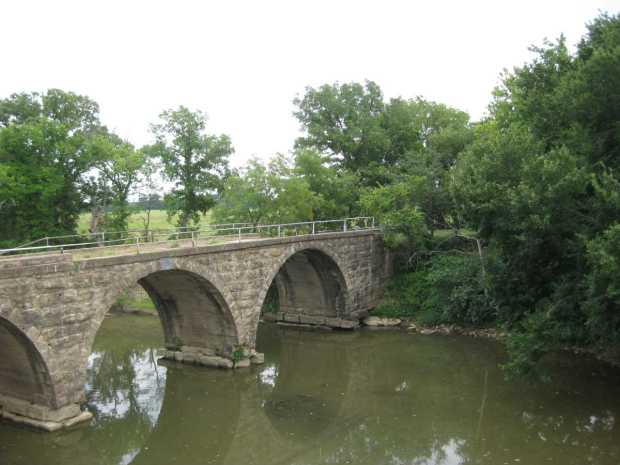
The only advantage the concrete provided was to greatly simplify arch construction, as only the stone faces needed to be cut.
Concrete Fill
Some stone arch bridges use stone for all exterior components (including the center portion of the arches) but still have concrete. Sometimes the concrete was used instead of stone for solid backing; other times it was used as the center of major components such as piers and abutments. Essentially, the stone walls were the facings for a core of concrete. This reduced the amount of cut stone needed, while ensuring the walls were thick enough. The idea on these structures appeared to be to make the bridge as thick and strong as possible while being economical. The strong stone made a good protector for the less-certain concrete inside. Especially in these early days of concrete, the quality of the concrete was highly variable, and builders were cautious with its use. Curiously, many Medieval buildings were built with a stone facing to a concrete (or, more accurately, lime mortar) interior. Again, the idea was mainly an economic one: Simply pouring in concrete between two stone walls to create a thick solid wall is much easier than cutting a massive number of stones to fit.
The Weakness of the Hybrid Construction
The stone/concrete hybrid construction has a peculiar weakness of its own above and beyond the typical problems of stone or concrete bridges. The problem is simple: Stone masonry is a living, flexible form of construction, able to shift over time and capable of adapting to settlement. Concrete, on the other hand, is not. Thus, if a concrete/stone hybrid bridge settles, it can tear the stone right off the concrete.
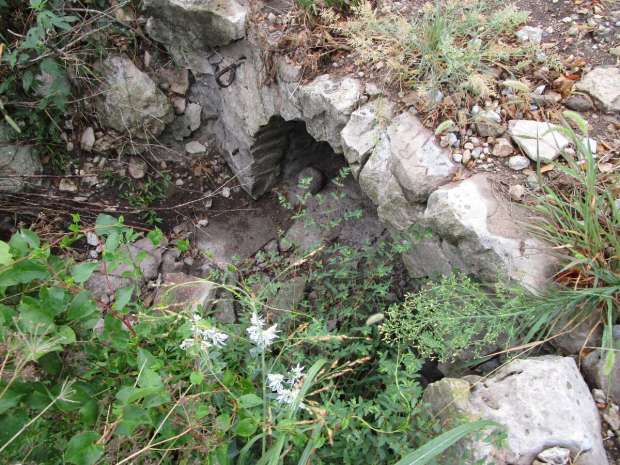
The stone tends to delaminate from the concrete. This is mostly a problem in concrete arches faced with stone. Bridges with a concrete fill can suffer the same problem, but, as long as the stone faces are thick enough, this is not an overly common threat. However, the maintenance personnel should be aware of the possibility of large, unstable sections of stone becoming detached from the concrete in these hybrid bridges.
 Stone Arch Bridges