
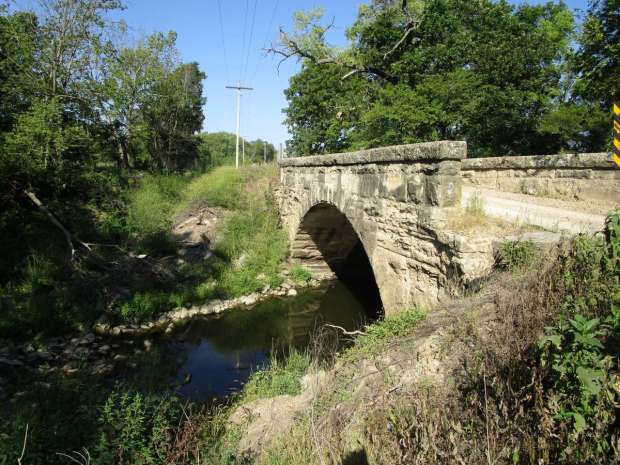
The modest single-arch Fox Creek Bridge connects the town of Strong City, Chase County, Kansas, to the well-known Tallgrass Prairie National Preserve nearby. The following well-researched account of this structure, which is listed on the National Register of Historic Places, was kindly prepared for us by Michelle Lindsey of homesteadontherange.com.
The Fox Creek Bridge
Connecting Tallgrass Prairie National Preserve with the town of Strong City in Chase County is a stone arch bridge over Fox Creek. The arch span of Fox Creek Bridge is merely 40 feet, while the total length of the bridge is 55 feet. Nevertheless, it is a picturesque little bridge, and one that has seen a great deal of history.
The Predecessors
The present Fox Creek Bridge was preceded by two short-lived structures.
The first bridge was completed in the spring of 1887. Although newspaper accounts of the day estimated it would not be finished until May 1887, it certainly could have been completed no later than that, as evidenced by a reference to a baptism at the site.
Unfortunately, this bridge was hardly built before it was deemed dangerous. In spring 1889, flooding removed the floor of the bridge, nearly causing several accidents. By all appearances, the flood damage was repaired by Pat Tracy and William Martin, as each man received $7 from the county for work performed on this bridge.
However, in 1890, the following appeared in The Strong City Herald:
The unsafe manner in which the Fox creek bridge is built, everybody knows. Coming east the traveler strikes the bridge downward at an angle of about forty-five degrees and on a very sharp curve, with a high bank on one side and a steep descent into the creek on the other.
After recounting several near-disasters that had occurred at the bridge, including those associated with the flood, but also two involving icy conditions, The Strong City Herald went on to comment:
The bridge is on a road which has as much travel as any road in the county. It is used by one-third the county to reach Strong City and Cottonwood Falls. There should be a safe and substantial structure across Fox creek, or some day the newspapers will have to chronicle a terrible death and the county will pay a much greater amount [in] damages than a bridge would cost.
For any accident which might occur by reason of this unsafe bridge, Chase county would be liable to pay damages. A bridge will cost less than a damage suit.
As early as 1889, the Kansas legislature authorized Chase County to construct three bridges:
- A bridge over Cedar Creek at Robert’s Crossing in Cedar Township for $4,000.
- A bridge over South Fork Creek of the Cottonwood River at A.Z. Scribner’s Ford in Bazaar Township for $3,000.
- A bridge over Fox Creek at Lantry Crossing in Falls Township for $3,000.
However, it was not until late the following year that Chase County approved the construction of a replacement. In an article subtitled, “At Last! This much needed Bridge to be Built,” The Strong City Herald noted:
The demand for this bridge has been an urgent one backed by an immense petition of tax payers. The old bridge is unsafe and immediate action was necessary. The REPUBLICAN and township board have labored hard to get the matter before the commissioners so that the bridge could be completed before winter.
This second Fox Creek Bridge was an iron structure with a 40-foot span built by Wilson & Hay of Marion. It was to be four feet higher above the river than the first.
Fox Creek Bridge was officially accepted and paid for in January 1891. The Strong City Herald reported that the structure cost only $300.
But very quickly after its completion, the second Fox Creek Bridge was put to the test. In a significant flood, Fox Creek overflowed its banks, cutting across several fields. The approaches to the bridge were slightly damaged. More flooding followed in 1896. This time, the approaches were so washed out that the bridge became impassible.
Although this damage was presumably repaired, near-disaster occurred yet again a year later when the nearby Lantry Sons warehouse burned down, the fire thought to have been caused by sparks from a locomotive crossing a switch. Although the warehouse and its contents were a total loss, dedicated firefighting efforts managed to keep the bridge from burning.

In July 1897, the county clerk was authorized by the commissioners to advertise for bids on a “stone arch culvert” at Lantry Crossing. Evidently it was determined to make the third Fox Creek Bridge something that was both fireproof and sturdy enough to withstand some flooding.
Click here to see Part 2 of this series.
 Stone Arch Bridges