
When building a masonry structure and cold weather hits, what do you do? Can you keep building, or will the mortar suffer? For that matter, what about historic structures? How did the builders cope with the cold and the mortar?
The Freeze Problem
The problem with building in cold weather is that unset mortar freezes. And when mortar freezes, the expansion of the water breaks all the developing bonds in the mortar. So, simply put, uncured mortar should not be allowed to freeze. In fact, even basic concrete needs 48 hours to cure before it can be safely allowed to freeze, so such a length of time is probably safest for mortar, although the first 24 hours of setting are the most important. Personal experience confirms that if mortar is still not quite hard yet and freezes, the bonds are destroyed and the mortar is little better than chalk when it thaws. However, if the mortar is at least hard if not fully cured when it freezes, the final product can survive and still be useful, but it does not seem to be quite as strong or durable as mortar that cured without freezing at all.
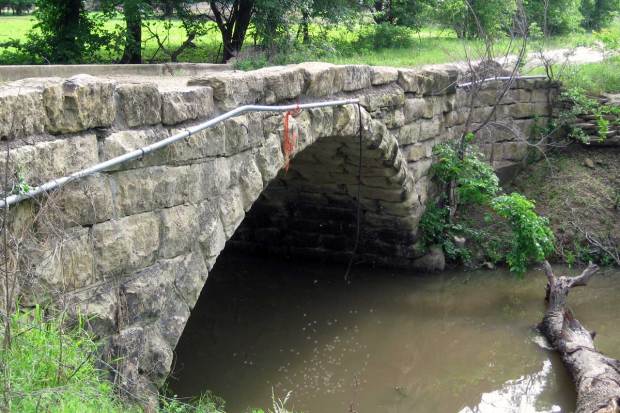
If at least somewhat set, there is a certain resilience (albeit a risky one to rely on) in mortar and concrete to freezing, even if not fully cured, and there are also tricks that can be used to extend the building season even into the winter months. Low temperatures, as long as they are above freezing, are no cause for concern. In fact, mortar sets up better, if slower, when it is cold, and is actually stronger for the cold temperatures when it is curing.
Keeping the Mortar from Freezing
In concrete pouring, additives (such as calcium) are added to greatly accelerate the curing process to try to beat the freeze. However, most masons are probably not going to have this luxury though it is worth pointing out that heavily lime-based mortars tend to do their curing faster than heavily Portland cement–based mortars.
In some cases, the wall can be heated to keep it from freezing, though these cases probably won’t include stone bridge building. Probably the best option for freeze prevention is the use of plastic to cover the structure. Plastic creates a greenhouse, in effect, greatly increasing the temperature inside the canopy. Furthermore, curing concrete and mortar produce heat, and the plastic helps retain this heat. So, for cases where the temperatures are not too far below freezing for too long, a plastic cover can be used overnight to keep the wall warm. Furthermore, heat can be added inside the canopy, whether this is from a barrel of warm water or an actual heat source. Cloths can be laid over a structure for further insulation. As an added benefit, the plastic helps hold in moisture, which keeps the mortar from drying out prematurely.
Historic Solutions
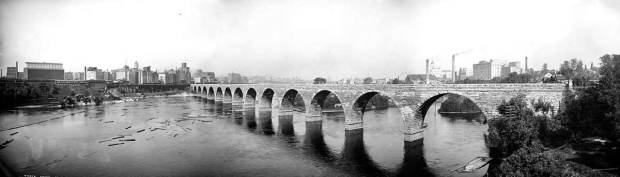
The fact is, work on historic structures may very well have been postponed during winter. However, one noteworthy exception is the Stone Arch Bridge in Minneapolis, Minnesota. Work on this structure continued even in winter. To keep the mortar from freezing, the water used was salt water, heated to boiling. The water (and thus the mortar) retained its warmth for some time, and the salt lowered the freezing temperature. That said, care must be used with this type of method, as it is a known fact that salt crystallization can readily damage stones, particularly if the stones in question are soft and porous.
In the southern Kansas area, where we are, many of the local bridges were built in winter, though, to be sure, southern Kansas winters are relatively mild compared to many areas. That said, we have consistently noticed that it appears as though the original mortar in the winter-built structures usually is totally leached out, whereas some (though by no means all) of the summer-built stone arch bridges still retain much of their original mortar. However, there could be other factors at play, for there apparently was rather considerable variation in the quality of the mortar itself in those days.
 Stone Arch Bridges