
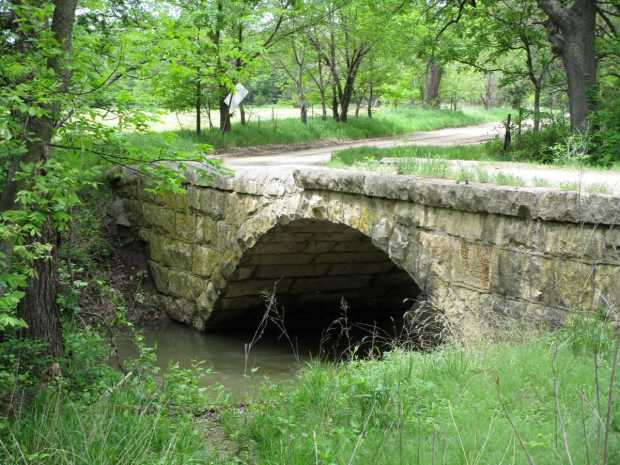
Cowley County, Kansas, has a strong heritage of stone arch bridges. Ingrained into the very making of the county itself, these scenic means of transportation played a key role in transforming a well-watered county with many difficult waterways to a successful farming and ranching area. Time has been hard on these stone bridges, and the enthusiasm with which they were received when new and the important role they played has been largely forgotten in many instances. They have been condemned in modern times as a heavy expense and inadequate for traffic, and have been gradually replaced; certainly a fair number of those lost were demolished rather than succumbing to time, and certainly a fair number of the ones that have failed largely failed due to a long-term lack of maintenance. And yet, those that remain still are a mute part of the county’s rich heritage, and have often withstood all manner of neglect, floods, and increasing loads, triumphantly remaining as the best of the best, and a tribute to their builders’ skill and foresight.
Building the Bridges
The stone bridges played an important role in Cowley’s economy. Not only did they provide a needed way to cross a stream, but their very building was a help for Cowley’s economy. Local labor built these bridges out of local stone, and local farmers found a healthy supplement to their income when a bridge was constructed in their area. These farmers took pride in their work, and is it any wonder that the completion of these stone arch bridges was often considered a holiday, worthy of the whole town turning out for? Thus it was that Cowley’s pioneers left their mark and played their part in making the county better for generations of their descendants to come.
A Local Gathering Point
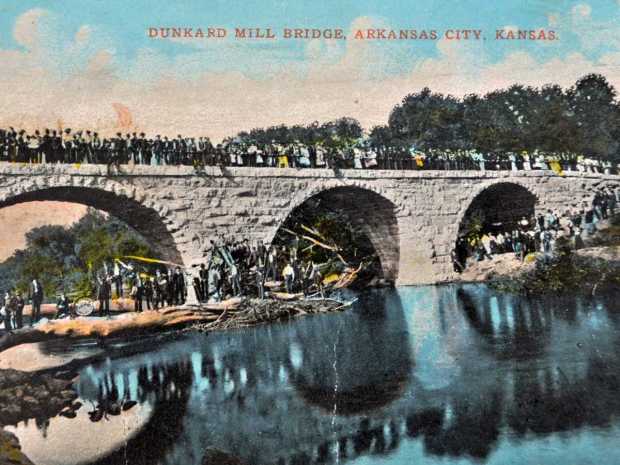
The local bridges were beyond a doubt scenic additions to the landscape, quite different than the drab and monotonous grey of today’s concrete bridges. As such, they became landmarks in the area for pleasant outings and get-togethers. These bridges quickly became local gathering spots, and were the scenes of all manner of community events, from baptisms to Fourth of July celebrations. Many of these bridges remain in people’s memories, even after disappearing, as places where some memorable event in their lives occurred. Stories abound surrounding noteworthy bridges like the picturesque H. Branson Bridge near Dexter (collapsed early 2000s, exact cause uncertain), the Silliman Badger Creek Bridge near Winfield, and, most noteworthily, the Jordan/Andes Bridge also near Winfield.

Time and the Bridges
Many of Cowley’s most famous bridges have vanished. The state’s largest stone bridge, the Dunkard Mill Bridge, succumbed to flooding in the mid-1940s, though its ruins still mark the spot where it once stood proudly over the Walnut River near Arkansas City. The state’s largest stone arch bridges, most of which were built in Cowley, all succumbed one by one to some combination of time, neglect, and progress. The longest stone bridge span, the H. Branson Bridge, collapsed in the early 2000s, nobody seems to know exactly why. The McCaw Bridge/Fox Bridge, which at 70′ had the second longest stone bridge span, succumbed to flooding in recent years; inspection reports show a steady deterioration of the foundations had been going on unchecked over a few years before the collapse. And so it goes. The Goodnight Bridge, which had the third longest stone bridge span in the state is gone save for a shattered remnant of an approach near the current bridge. Esch’s Spur Bridge, Cowley’s only remaining triple-arch bridge for years, survived severe damage from floods but, despite having been on the National Register of Historic Places, was demolished rather than repaired.
Rather than being widened, or at least bypassed and left as a tribute to their builders, other bridges were replaced, not because of major fault, but because of perceived inadequacies. A noteworthy example was the last known Abe Matheney bridge in Cowley County. Known as the Burnsey Bridge, and located near Floral, this unique single-arch bridge was demolished in the 1990s; it was said it wasn’t wide enough for farm equipment.

The Future of the Bridges
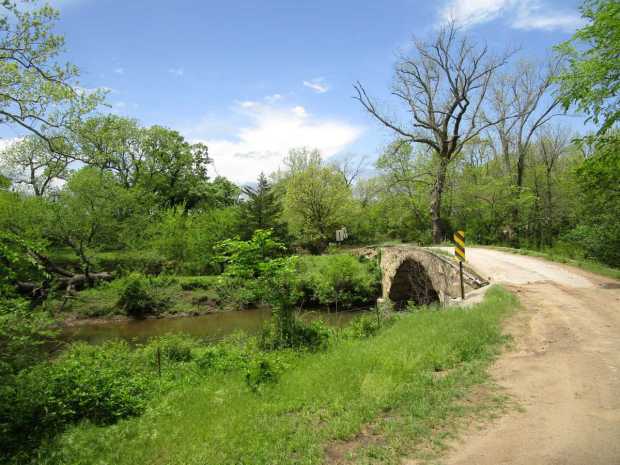
Though Cowley is designated the Stone Arch Bridge Capital of Kansas, the future of its stone bridges is uncertain. With the loss and abandonment of its stone bridges, there are other counties that may very well have a more just claim to the title, at least from a quantity standpoint. Cowley rose to fame for its large bridges, rather than the sheer quantity, as substantial as that was at one point. Other counties, such as Butler County, built more bridges (even now Butler has quite a few more true stone bridges, as opposed to stone culverts, in use than Cowley), but it was in Cowley that large stone arch bridges became the norm, with double-arch structures, record-breaking single arch spans, and otherwise enormous bridges becoming the norm.
Regrettably, it is these large bridges that have suffered the most with time, and many of the survivors are relatively small single-arch structures. However, Cowley still has a few remaining bridges of large size, though one of these, the Rock Creek Bridge is threatened with demolition. However, the double-arch Neer Bridge, which is also a marvel of engineering in its own way, is still extant, though it may need some routine maintenance in the near future to ensure its continued use. Also, the large Andes Bridge, which at this point is arguably Cowley’s most renowned stone arch bridge, looks good for many years to come.

Conclusion
As long as there are people who recognize the significance and beauty of Cowley’s stone bridges, some of the bridges will, no doubt, be spared for many future generations. The more interest expressed in them, and, most importantly, the more the local people advocate for them, recognizing their intrinsic worth and how they are part of the landscape rather than merely utilitarian structures, the more assured the future of Cowley’s bridges will be. Stone arch bridges are not being built in Cowley any more, and each one of these bridges demolished or allowed to fail represents an irreplaceable loss. Even if stone bridges were still being built, the historic associations of these structures would set them apart. Perhaps a time of greater appreciation of the bridges built by their predecessors built will come to Cowley, and the spirit of the stone arch bridges of Cowley County will live on strong for many more generations.
 Stone Arch Bridges