
As strange as it may seem, it is sometimes proportionately harder to build the small than the large. This principle also applies to stone arch bridges. It is not that a small arch is weaker or will have strange design challenges; rather, it is often harder to turn a small arch and, proportionately speaking, the small arch often requires a higher amount of material than would be expected.
Building Difficulties of Small Arches
A small arch requires relatively steep angles to achieve the arc. For a rubble arch, it will be found that this often necessitates the extensive use of shims and/or extra stonecutting. Furthermore, sometimes difficulty can be experienced in removing the centering, as the space under the arch is tight. All of this means that the builder should be prepared for these challenges.
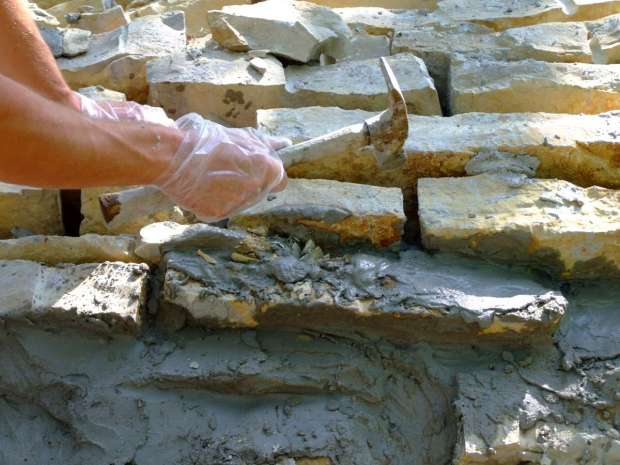
Using relatively low-rise segmental arches can help mitigate the number of gaping joints to fill, and propping up the segmental arch higher on the abutments can be used to leave a more adequate gap below for helping the centering removal.
In general, 3′ is usually considered about the smallest span practical to make for a vehicular stone bridge. That is not to say smaller can’t be done; we have built a couple of 2′-span stone bridges that carry vehicles. But these small bridges proved to be rather time-consuming to build, and in both cases removing the centering was a rather painful process that in one case resulted in a muddy expedition in very tight quarters to free a stuck arch form.
The Material Question
Small arch bridges will use a fair amount of material. This is because there are certain minimum sizes required; for example an arch is rarely built less than 1′ thick. A small stone bridge ends up being a rather compact mass of masonry with a relatively small opening. Of course, the small bridge uses less material than a larger one; however, the reduction in material is hardly proportionate. A township trustee of Augusta Township, Butler County, Kansas, when commenting about the economics of stone culverts put a range of 5 – 20′ as the most economical types to build.
 Stone Arch Bridges