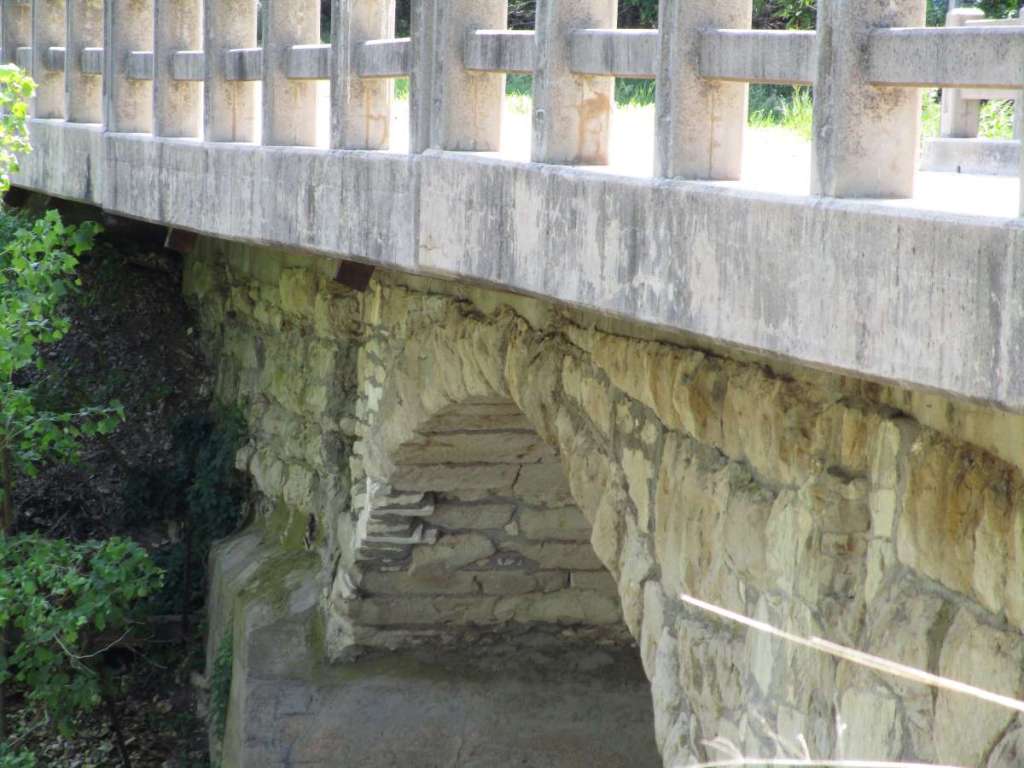
Broken stones in a stone arch bridge certainly need to be considered when evaluating damage, but as with many things in a stone bridge may or may not pose serious issues in and of themselves. Usually, the larger concern is what caused the stones to break in the first place. All that said, depending on how bad the breaking of the stones is, a repair to the affected area may be required.
Stone Size
The size of the stones used tends to define how a repair is best done. Generally, smaller stones are better candidates for replacement and larger stones for repair. This is because smaller stones are not only more easily worked in and out of a structure, but, because when small stones are damaged, they usually are damaged more or less thoroughly. Big stones, however, are extremely difficult to remove and replace safely without actually dismantling sections of a structure. Furthermore, big stones can usually break fairly extensively and still be serviceable as several smaller blocks. Often splits in large stones, if repaired at all, only need to be pointed up as if they were intended as a masonry joint. For severe damage of any kind, the practicality of stone replacement should always be considered, as any method of binding fractured stones has limited durability.
Tying Stones Together
To patch a broken stone, there are several tricks that can be used. Mechanical ties like metal rods or metal clamps can be used to bond broken pieces if required. Using a metal dowel to bind together a broken stone is an option, depending on where the break is and how it wants to fall off. With each of these options, the key to success is to determine how the stone wants to fall apart. A mechanical tie allows for some tensile forces, so its use is to hold pieces of a structure together. In general, mechanical ties, while having their place, are best avoided in masonry. Usually the damage is too slight to merit the use of a mechanical tie, or too advanced for a mechanical tie to provide much help.
Repairing Fractures
Many damaged stones are simply fractured. This is almost always a sign of freeze-thaw damage caused by a drainage issue, which needs to be rectified before the stones are repaired. Repairing a fractured stone can be done with grout to fill back in all the nooks and crannies, preventing further water infiltration. Grouting, however, only provides limited tensile strength. In severe cases, epoxy can be used, which binds the stones much better than mere grout.
Patching Missing Stone Pieces
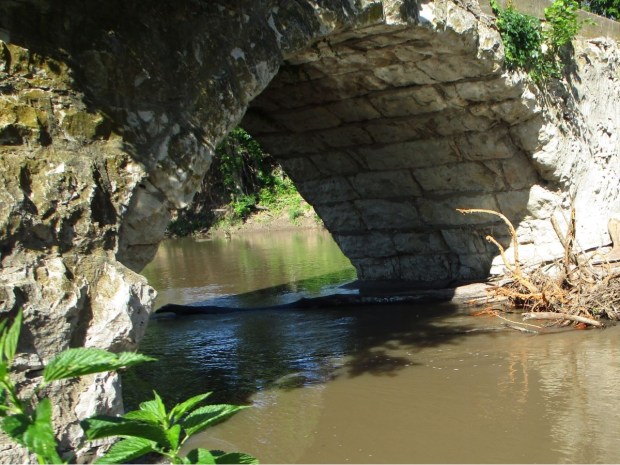
Sometimes entire pieces of stones are missing. In these cases, smaller stones can be slid into the break and mortared in to complete the structure.
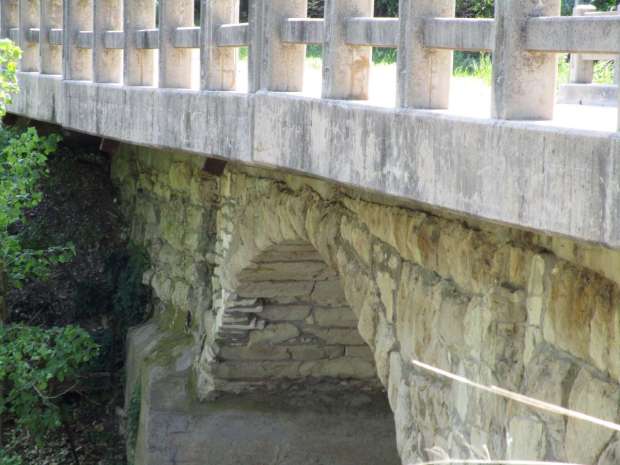
It is best, however, to use a few pieces large enough and cleverly trimmed such that they fit neatly into the gap. Such a repair can be quite durable, but the repairer needs to be aware that such a patch, while durable, is still weaker than the surrounding structure, so some form of protection may be required in high-impact areas such as bridge foundations.

