
Arches typically fail at points called hinges. These so-called hinges are points where the once-rigid arch ceases to be a solid structure, but has a flexible point. With enough flexible points, the arch becomes totally unstable, and can collapse easily, though sometimes the collapse may take years to occur. These flexible points are locations where the arch stones are carrying the line of thrust at the edge of their width, which causes tension on the opposite side of the stone, and hence an opening up of the joint. The hinge mechanism is actually a way for the arch to conform to the new line of thrust, but it is an unstable way, for the arch ceases to act like a solid unit, but instead behaves as a flexible mechanism.
Collapse Mechanisms
Three hinges are the minimum amount required for the arch to collapse. Three-hinge mechanisms are usually associated with segmental arches and arches with spreading abutments. Three hinges do not necessarily signal an immediate collapse (steel arches are frequently deliberately built with three hinge points to allow for expansion and contraction and to make the strength of the arch easier to calculate), but can cause further problems due to stone crushing, which will hasten failure. Four or more hinges means the bridge is completely unstable. Four or more hinges guarantee a serious structural problem.
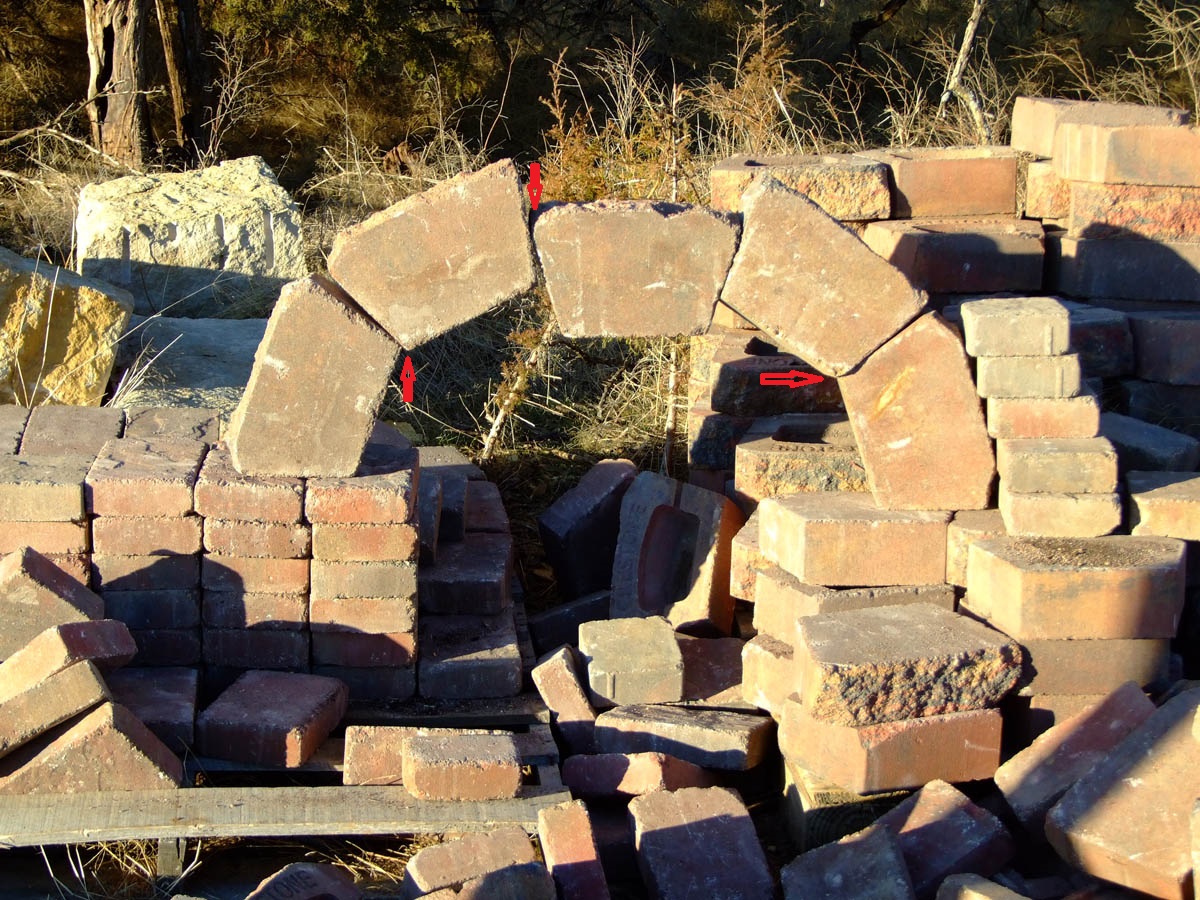
It is worth mentioning that many hinges are directly associated with overloading. Once the load is removed, the arch can often resume its former shape. However, these hinges are almost guaranteed to have resulted in damage to the arch and possibly other parts of the bridge, regardless of whether or not a collapse occurred. Thus, it is important that bridge load ratings be chosen where possible to ensure that hinges of any magnitude cannot form.
The Hinge Problem
Hinge points in a stone arch mean there is a tremendous amount of pressure on a very small section of the arch stones. This can lead to crushing, further aggravating the structural problems. Even for “stable” hinges, such as where there are only one or two hinges, this break in the arch will ruin the mortar joints, leading to water infiltration. Furthermore, an often overlooked aspect of hinges is that, depending on the nature of the hinge, backfill material and/or stone chips used in the joints can sift down into the hinge forcing the arch to remain in this distorted shape. Thus, hinges are not to be taken lightly in any stone bridge, although their behavior gives clues to how an arch functions.
 Stone Arch Bridges