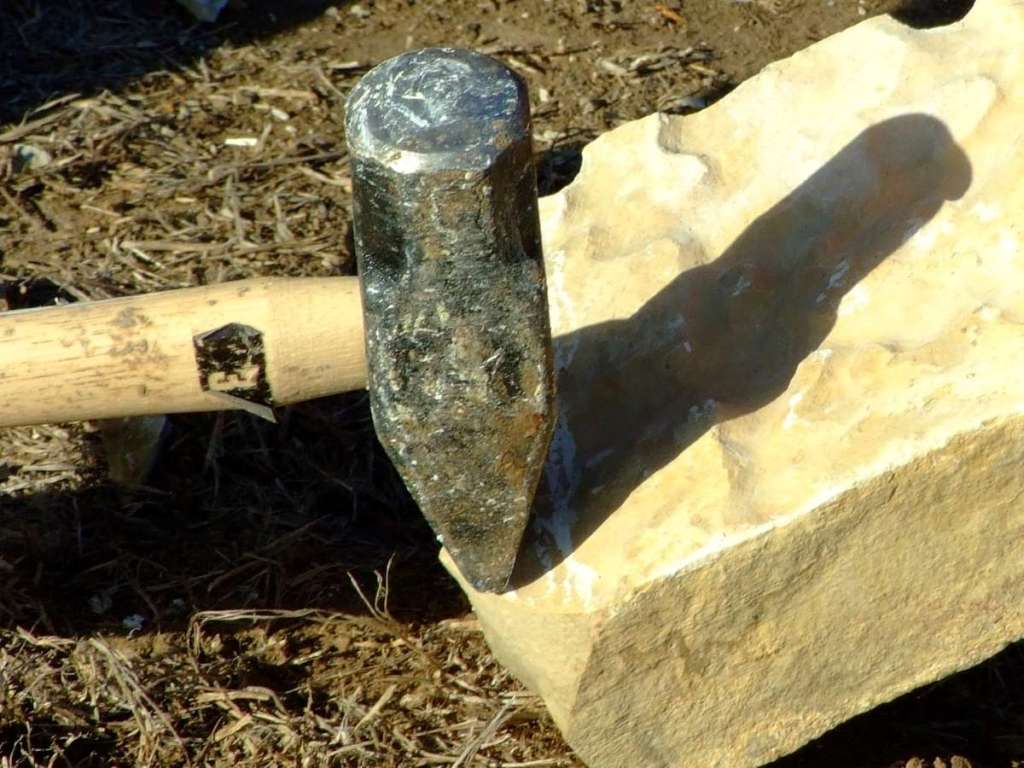
There is a bit of an art to choosing a hammer for stonecutting purposes. Even if the hammer is intended merely for striking another tool, such as a chisel, there are several factors that decide what type of hammer is preferable.
Weight
One of the key considerations of a stonecutting hammer is weight. There are several deciding factors here. First, and quite important, is that the weight of the hammer does the splitting of the rock, not so much the force used to wield the hammer. If you have to strike hard amidst a shower of stone fragments to make any progress on your stone trimming, your hammer is too light. On the other hand, for tool striking, lighter hammers are preferred, as a heavy hammer will make for irregular, damaging cuts. In the end, the exact weight of the hammer is a judgement call that depends on the type of stone, the size of the stone, and the usage the hammer is put to.
The Handle
Fiberglass or wood? Fiberglass enjoys a well-deserved reputation for durability, but there are certain advantages to wood handles, especially when used with chisels or wedges-and-shims. Fiberglass has little elasticity, and provides a solid, hard blow. This can work well with large blocks of stone where the hammer is being used to trim alone. For chisels and wedges-and-shims, the springiness of a wooden handle is important, for it sets up a vibration that helps cut the stone while limiting the amount of brute-force applied all at once to the rock. The result? Cleaner, easier cuts. The length of the handle is usually proportioned accurately to the weight of the head, but be aware that an overly long handle is not necessarily an advantage, as it makes it easy to apply too much force.
Blunt or Pointed?
Many stone masonry hammers come with both a blunt and a pointed end, but sometimes one has to choose between one or the other. The pointed end is great for fine trimming, such as notching or scaling off a millimeter of the top of a too-thick stone. However, for most trimming, you will use the blunt end. With the correct angle of attack and some practice, it will be found the blunt end of the hammer will do most heavy trimming with a surprising amount of precision. You can actually do quite a bit with a simple blunt sledgehammer, even if it is not a true stonemason’s hammer. For precise cuts you can come back with a sharp hammer and fine tune. It is worth adding that the size of the hammer defines how big of a chunk of stone it can remove, so starting with a large hammer and gradually reducing size is a way to achieve clean cuts simply.
 Stone Arch Bridges