
Building a barrier to protect people from falling off a bridge is probably a good idea for anything larger than a small culvert. The question becomes, what type of railing is suitable for a stone bridge?
Stone Walls
A stone wall is, obviously, a traditional barrier for a stone arch bridge. These walls can be built high or low, but the basic rule is that for complete stability (and stability is obviously important for a safety barrier) the wall should not be any thinner than 1′ thick for every 3′ of height. A mortarless barrier wall must be made thicker than this (double the thickness of a mortared wall is a good start here), and, furthermore, should be built with large stones to prevent it from being dislodged piecemeal. From an aesthetic standpoint, a stone barrier wall can be picturesque, or, for small bridges, look absurdly monolithic as its height is large as compared to the rest of the bridge’s proportions.

The designer should be aware that these stone walls are not impervious to vehicular impacts unless of substantial thickness or internally reinforced. A possible side issue for a solidly built stone wall is that the totally unyielding nature of the wall may prove to be hard on the occupants of a vehicle in event of collision.
Pipe Railings
Pipe railings were very common on more modern stone bridges, such as those built in the early 1900s. Gas pipe railings are easy to build, and can last a fair amount of time, but are not necessarily the most picturesque type of railing, though they still have a certain vintage appeal when mounted on the right bridge. Historically, the rails were sunk into holes drilled in the stones. On newer stone bridges, they were sometimes cast into a concrete curbing poured onto the bridge. Another option is to attach the pipe posts to a metal plate that is bolted to the top stones of the bridge.
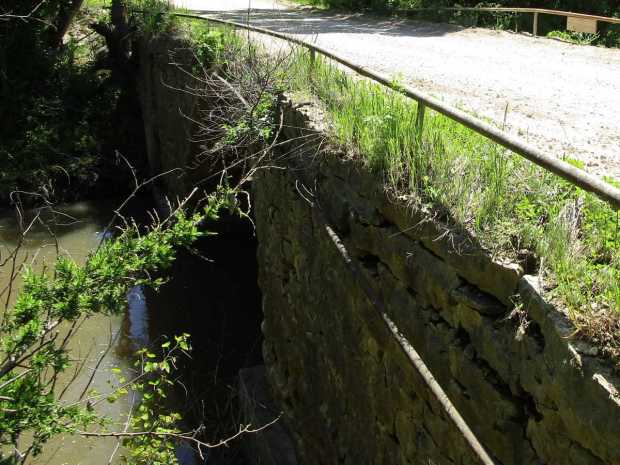
The designer needs to be aware that a gas pipe railing provides almost no barrier to vehicular impacts, and is good for pedestrians only. This type of railing can last awhile, but will rust and need to be replaced over time.
Cable Railings
One type of railing we have found on a few older bridges (stone and otherwise) in Cowley County, Kansas, is a cable railing. These railings consist of eyelets with a cable run through. This type of railing can actually be built to look reasonably good, but is likely less secure than a gas pipe railing.
Other Barriers
There are many modern barriers that can be used with a stone bridge. Concrete walls of some type are one example. Another is that stereotypical metal crash barrier seen on highways. Chain-link fences are an option for pedestrian bridges; in short, anything is possible. The difficulty is choosing something that matches the picturesque and, where applicable, historic character of the bridge in question.
Mounting a Barrier
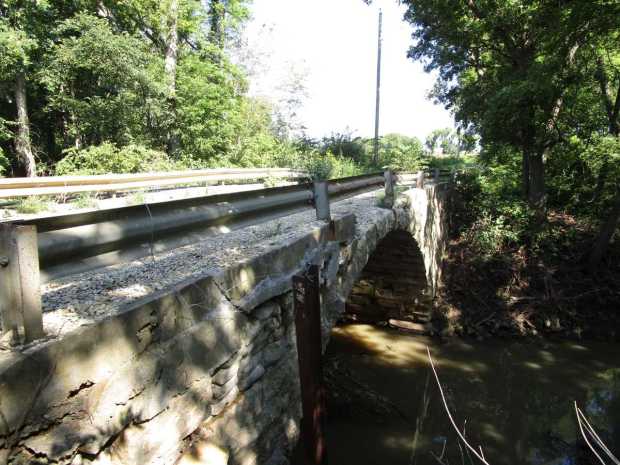
Mounting a barrier to a stone bridge is usually best done in one of two ways: Either the barrier should be directly attached to the stones, or it should be mounted to a reinforced concrete curb poured directly atop the bridge. For mortarless bridges, unless large blocks were used, relying on any one stone to mount a barrier is a risky proposition, even for pedestrian purposes. Mounting a barrier directly to an arch stone is also not a good idea, as a potential collision can than actually cause serious structural damage to the bridge if the arch stone is damaged or dislodged.
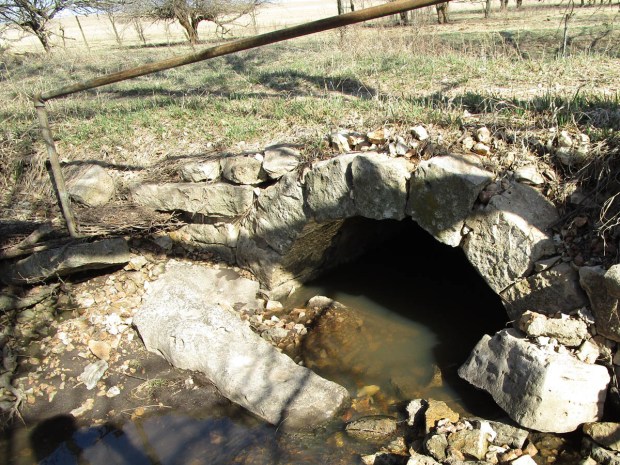
For a bridge built with small stones, especially those built mortarless, it is best to extend the support posts for the barrier down the faces of the bridge and mount it to several stones in the spandrel walls, though this method is admittedly not the most aesthetically appealing in the world. This is the advantage of using a concrete curb to mount a barrier; the solid nature of the concrete prevents compromise of the barrier due to dislodging of individual stones, and this concrete curb can be built with a low enough profile so as to blend in reasonably well.
 Stone Arch Bridges