We recently completed a stone arch bridge at Camp Quaker Haven, a Christian retreat located just outside Arkansas City, Cowley County, Kansas. This bridge replaced a shaky wooden bridge and was built using traditional masonry techniques such as were used in Cowley over a hundred years ago. While primarily a footbridge, it was built large enough to carry equipment as needed, and it carried a skid steer during the final stages of construction. The bridge is located in a hollow just below the large slide the camp features near the dining hall and pavilion, which functions as the primary hub of camp activities. Further pictures and information beyond what is told here can also be found on Camp Quaker Haven’s social media platforms.

Camp Quaker Haven’s Tradition of Stone
Camp Quaker Haven is an incredible ministry started in 1950 on top of one of the highest hills south of Arkansas City. Overlooking the Arkansas River, the camp features some incredible bluffs. The hillsides are strewn with stone, and from this stone the camp was originally built.
The original buildings consist of rubble masonry made of relatively small rocks obviously collected off the hillsides, and laid in semi-runny mortar. To create even interior surfaces, it appears that wood forms were placed on the inside of the buildings, and the stones butted up against this form with plenty of mortar. When finished, the forms were removed, leaving a “plastered” interior, the plaster being the result of the mortar pressed up against the wooden form; evidence of these forms remains in the outlines of the planks used visible on the interior walls of the oldest buildings. Outside the buildings, mortar that slumped excessively out of the joints was tucked back into the gaps between the stones by hand, as evidenced by the fingerprints visible in several places in the walls.
The Stone for the Bridge
In keeping with Camp Quaker Haven’s tradition of masonry, the new bridge was built of stone obtained from the camp. The only stone used from outside the camp was donated pieces of Silverdale stone from dismantled buildings; we used this stone for riprap and for a scour pavement under the bridge. The bridge structure itself is made only from the camp’s stone.
While the stone buildings around the camp used “fieldstones” gathered off the ground, we opted to quarry most of the stone for the bridge off the bluffs overlooking the Arkansas. From these bluffs we cut large slabs of stone the traditional way: feathers and wedges. Since the span of the bridge was to be relatively small (5 ft.), we preferred thinner slabs in the 4 to 8 inch range to make turning the arch easier. Then too these smaller sizes were easier to move by hand! However, we also cut some large slabs (some as thick as 15 inches) for the foundation and approaches. Also, where needed, we could delaminate these really thick slabs to bring them down to a more reasonable size.
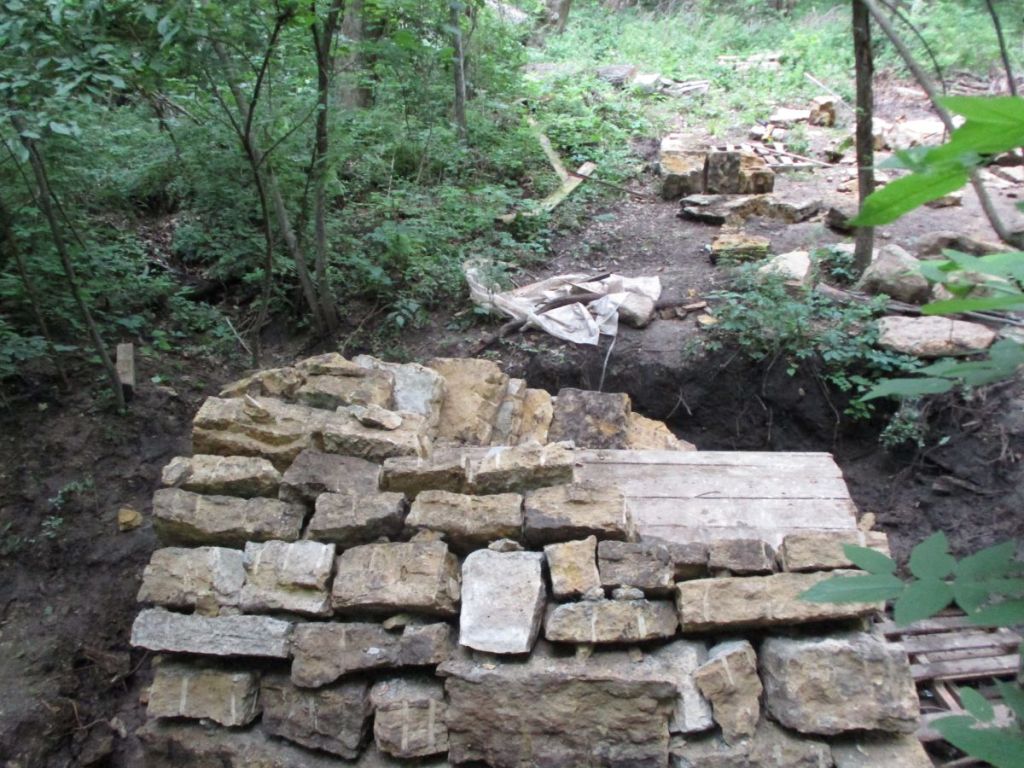
In a few instances we did use fieldstones from the nearby hillside. These stones we used mostly for backing. We also used a few boulders off the hillside and split them into smaller sizes as needed.
The Beginnings of the Bridge
The bridge had its beginnings on a memorable late-winter/early-spring day. Armed with pickaxes and shovels, volunteers at the camp from Friends churches joined forces with the builder and together we broke the ground for the bridge by hand. By lunch we had the old wooden bridge removed and a good start to a hole for the foundation. Given the small size of the bridge, it was decided it would be more efficient to simply dig a single hole to the desired depth wide enough for all the foundations. After lunch the progress slowed, due to the rocky nature of the soil.
On the same day the foundation was dug, we delivered the arch forms to the camp. The bridge was intended to be 9 feet wide, so we built two forms, one 5 ft. wide, the other 4 ft., which allowed us to simply stack them one into the other and carry them to Arkansas City in the bed of the builder’s half-ton pickup. The forms were built at a shop in Douglass, Kansas, with help from a good friend. The wood used was repurposed scrap lumber from old trailer decks. Two volunteers helped the builder unload, and then the arch forms sat near the bridge site waiting for the proper moment.
The story is continued in Part 2.
 Stone Arch Bridges