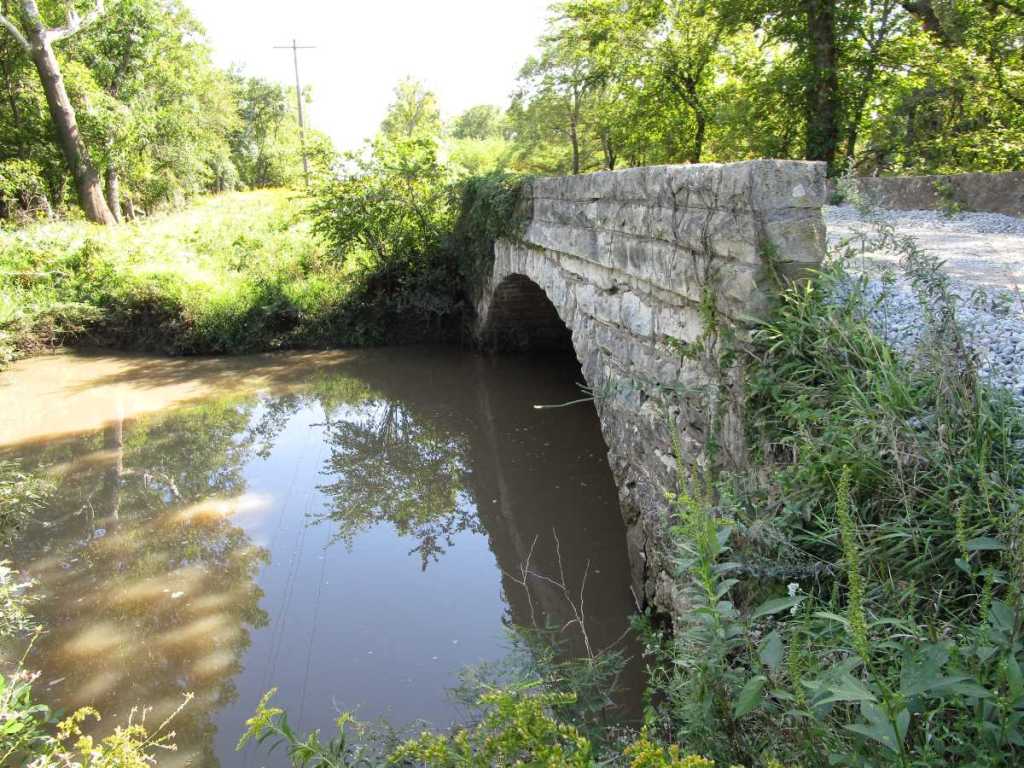
Like many masonry structures, a stone arch bridge is typically built by a proportional method; in other words, the size of one element of the structure tends to set the size of all the others. In the case of a stone bridge, the heart of the structure is, of course, the arch. And while there are many empirical rules to determine how thick various elements should be ranging from simple ratios to complex “formulas” of a sort, the fact is everything ends up being related to the arch.
The Flow of Design
The arch is the heart of the bridge. The first thing to determine is the size of the gap being bridged. From this the rise and span of the arch are found; generally this combination of numbers are set such that the arch is as rounded as possible while producing but a slight “hump” in the road. Designing this way allows for a stronger structure that uses less masonry.
From the span of the arch, the arch thickness is determined by one of (many!) ratios; for example:
Arch thickness = (square root of the span)/2.5
Once the size, shape and thickness of the arch is determined, the size of the abutments may be obtained, again usually by empirical rules. For example:
Abutment thickness = 1.35(y(tangent s’) + x(sine s’) + x(cosine s’))
Where y is the abutment height, x is the arch thickness, and s’ is the skewback angle.
Obviously, another factor that is critical here is how deep the foundations need to be for stability; this will set the total height of the abutment.
Once the abutments and arch are designed, the height of the spandrel walls can be obtained, with some extra added for fill on top of the arch. And from this height the thickness of the walls is found; a simple historic rule used was a ratio of 1/3 for the thickness to height ratio. Note, however, that the use of solid backing between the walls can considerably reduce the thickness required; how much is based on the builder’s discretion as well as how well built the backing is and how well the walls are bonded into the backing.
Finally the width of the structure can be found. The arch and abutments should be built wide enough to carry the desired roadway with an additional width to accommodate the two spandrel walls located on the edges of the arch.
One final consideration is approaches. For most applications, only minimal approaches are even required Sometimes, though, a longer causeway is needed. Then too, if the bridge has too much of a “hump,” longer approaches can be used to gradually build up to the total height of the bridge.
 Stone Arch Bridges