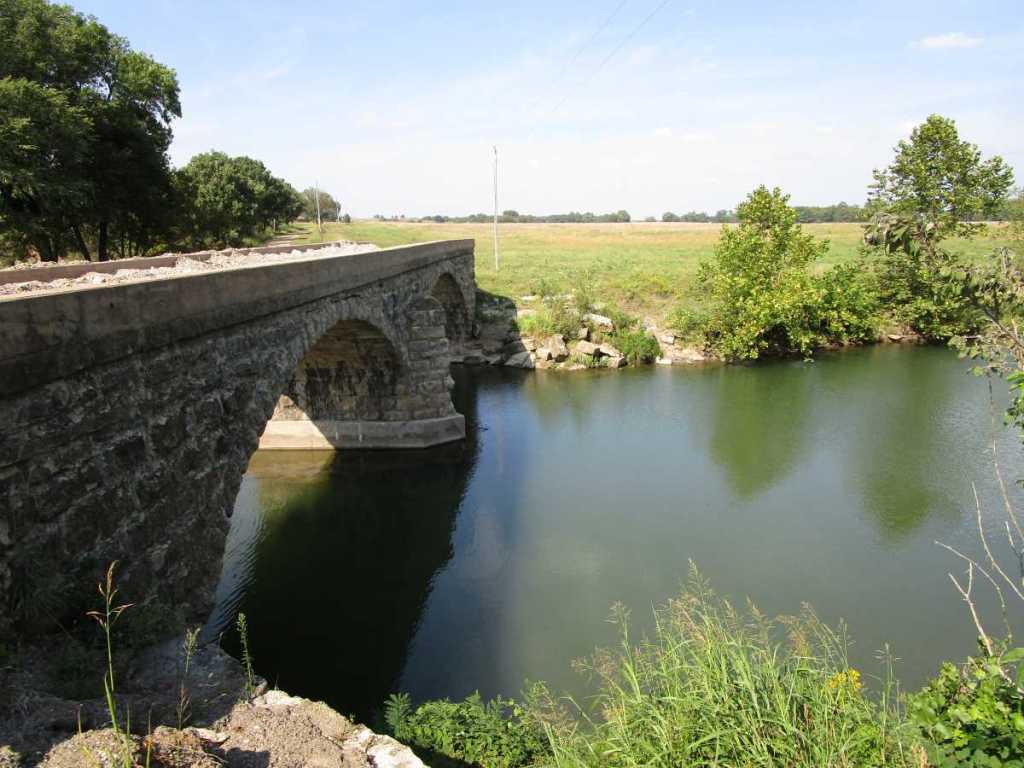
Segmental arches do have distinct advantages, most notably in the relatively low rise possible. However, there are some critical design aspects of segmental arches to be considered, as well as some peculiar advantages depending on where the bridge is located.
Using the Horizontal Thrust
As we have often pointed out, a segmental arch exerts horizontal thrust; the amount of this horizontal component increases the flatter the arch is, and becomes considerable once the arch is lower than a 90 degree segment of a circle (a rise-over-run ratio of about 1 to 5). This, of course, necessitates large abutments for stability.
However, there is a way to turn the thrust to advantage. If we are spanning a rocky-sided gorge, a long span, low-rise arch may very well be the most economical and solid choice. If skewbacks are cut into the rock walls themselves for the arch to rest on, the entire thrust of the arch is contained simply within the (presumably immovable) rocky walls of the gorge, all without the need for abutments of any size. And, because nature’s rocky walls tend to be vastly more solid than man’s stone abutments, the resultant bridge can be quite durable. This type of construction is a case where arches with arcs shallower than a 90-degree segment of a circle can be used to great advantage and with great durability.
The Arch Proper
A segmental arch still needs to be carefully laid and adequately thick, however. A low-rise arch is far less forgiving than a highly rounded arch. After all, a way to look at this is to view the segmental arch as a fraction of a much bigger arch. Think of it this way: for a given size of arch stones, the angles in the stones for a 50′-span, 90-degree segmental arch would be the same as those for a 70′-span Roman arch. For lower rises, this effect is even more pronounced. For a 50′-span, 60-degree segmental arch, the angles are equivalent to a 100′-span Roman arch. Couple this with the fact that a segmental arch is inherently less forgiving and tolerant of shifting than a Roman arch, and you see why great care is needed when laying the stones.

