The hillside quarry is the means by which many of the stone arch bridges of Cowley County, Kansas, were built, and remains the simplest way to obtain good stone for a project across the country. Natural outcroppings of sedimentary stone frequently appear in hilly areas, and neatly cutting this stone out is vastly easier than undertaking the more common “pit quarry” style of operation. Historically, this cutting was done with feathers and wedges.
Choosing What to Quarry
When choosing a stone to cut out of a hill, you need to start by looking for natural fissures or protrusions in the rock that clearly leave a free end to the stone. These natural fissures are everywhere, but may take some searching to find as they can be quite subtle at times. For the feathers and wedges to work, two ends of the stone need to be free. For rectangular blocks, the two opposite ends of the stone need to be free. It is possible to cut a stone with two adjoining ends free, but the final product will have triangular ends.
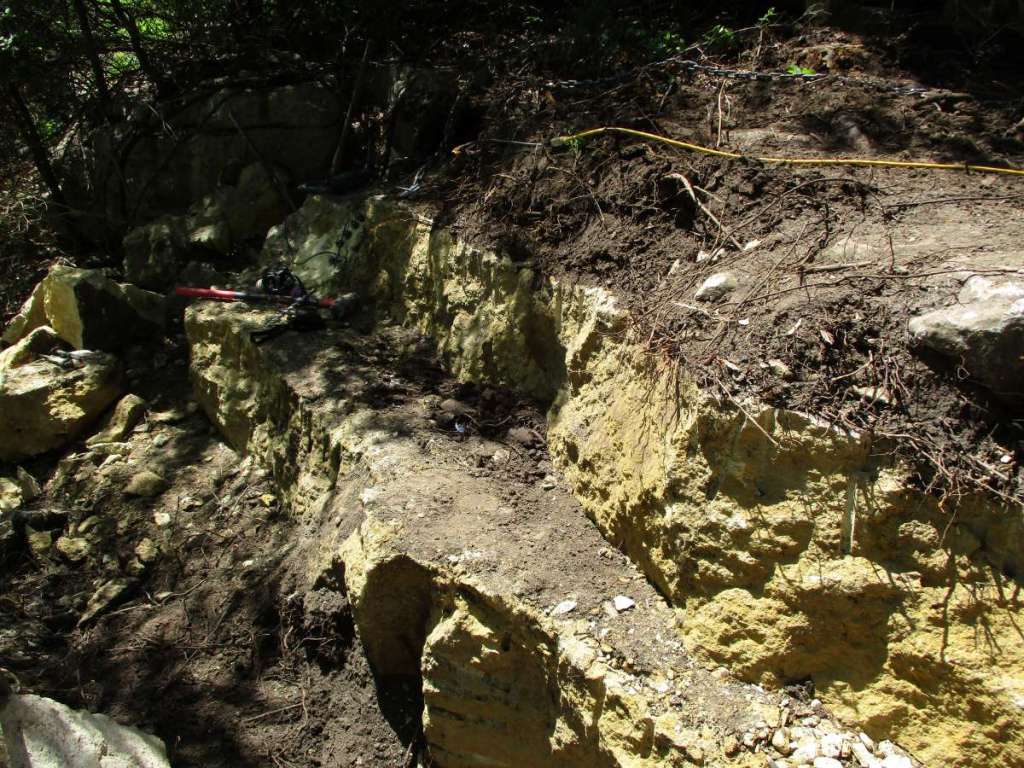
Sizing
The thickness of the stone is defined by the natural thickness of the layers of rock. The length of the stone is determined by natural fissures. This length can range anywhere from only a foot or two to enormous pieces ten feet long or better. Both the thickness and length can be shaved down once the stone is cut out of the hillside. The width of the rock being cut is defined by where the line of feathers and wedges are placed, though the max width is usually limited by a natural seam somewhere back in the hillside.
Cutting
Feathers and wedges are used to cut the stone. To cut, use a line of feathers and wedges, spaced about 6″ apart, and with a light hammer tap the wedges in until the stone splits. Once the stone splits, drive in at least one of the wedges all the way to spread the rock. Remove at least one feathers-and-wedge set to free up a drill hole that can be used as a prying point by inserting the pointed end of a pry bar. Shift the stone free. For obstinate stones that are in some fashion split yet firmly locked in place, it may be necessary to use large wedges (such as those used to split firewood) inserted into the crack to force the stone out farther. Heavy equipment can sometimes be used to move a stubborn stone as well.

