Weight rating a stone arch bridge is something that has baffled engineers for years. There are many variables at play, but the process is usually simplified by making several basic assumptions. In this post we investigate those assumptions and their limitations.
Assumption #1: Masonry Has Infinite Compressive Strength But No Tensile Strength
The first main assumption is masonry has infinite compressive strength but cannot handle tension. The tension piece may be a hair conservative, but is a good assumption, as, short of the stones somehow being pinned or otherwise locked together (unlikely, in most cases) the only tensile strength can come from mortar. Mortarless structures, obviously, don’t have this, and the condition of mortar is frequently uncertain in older mortared structures. And, overall, it is bad practice to rely on mortar to “glue” the stones together.
The infinite compressive strength piece is obviously not true, but the fact is that for most “normal sized” structures, the stresses on the stonework is but a tiny fraction of what the stone is capable of handling. It is worth pointing out that the weak point is usually the mortar, not the stones, but even then the mortar is usually significantly more than capable of handling the strains it will be subjected to.
Unfortunately, in practice these assumption do not take into account hollows in the masonry which will cause small pockets of tension which can break the stones under heavy loads, resulting in apparent compressing of the masonry. Yes, tension is not admissible, but short of a very thorough scan of the structure, how will we know where these hollows are? And, obviously, a bridge can stand with hollows in it and may perform quite well.

Assumption #2: The Abutments are Firmly Fixed
This assumption is a risky one, to some degree. Yes, the abutments are usually quite firm for the dead load of the arch, and even some live load. But how firm they are will depend on how they were built. Are they solid stone or not? Are there hollows above them reducing dead weight? How wide are they in practice? It is possible for the abutments to be rather thin, but to appear much wider since the approaches are often built as one piece with the rest of the structure. If the abutments are narrow and have dirt behind them, they are suspect, as dirt can and will shift, if but slowly, leading to possible weakening of the structure under heavy loads. Yet, overall, many bridges do have adequate abutments so this assumption is usable in many cases.

Assumption #3: The Stones Cannot Slide
This assumption is a rather risky one. Sliding failures are, in fact, not uncommon in stone bridges, though, granted, they are usually contained to small areas, not the entire arch.
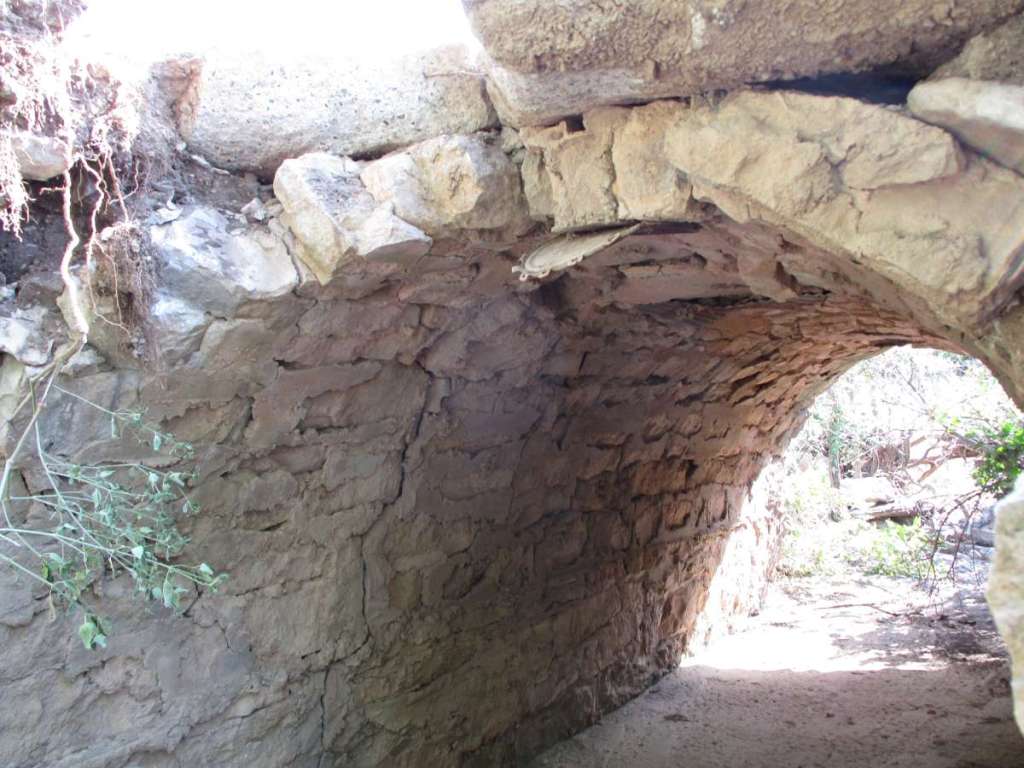
But one difficulty here is when hinges form. It is generally said that two hinges are safe, and sometimes hinges may form from settlement rather than overloading. This is usually true for ashlar arches; ashlar masonry is precisely cut to fit; if anything shifts, gaps (hinges) are almost inevitable, as the stones no longer fit. While some commentators on the subject contend that these gaps are harmless, they open up a possibility of sliding and rotating. The reason is because there are now pivot points in the arch, resulting in considerably less friction in the structure. Our experiments show that arches seem to be more likely to fail by sliding and rotating at these points of reduced friction rather than actual overloading and collapse of the arch.

Conclusion
In the end, rating a stone arch bridge is tricky, and, when it comes right down to it, arch behavior has never been adequately explained. While the need for simplification is understandable, with simplification comes risks, especially where the nature of arches broadly and of particular bridges specifically are not fully understood.

