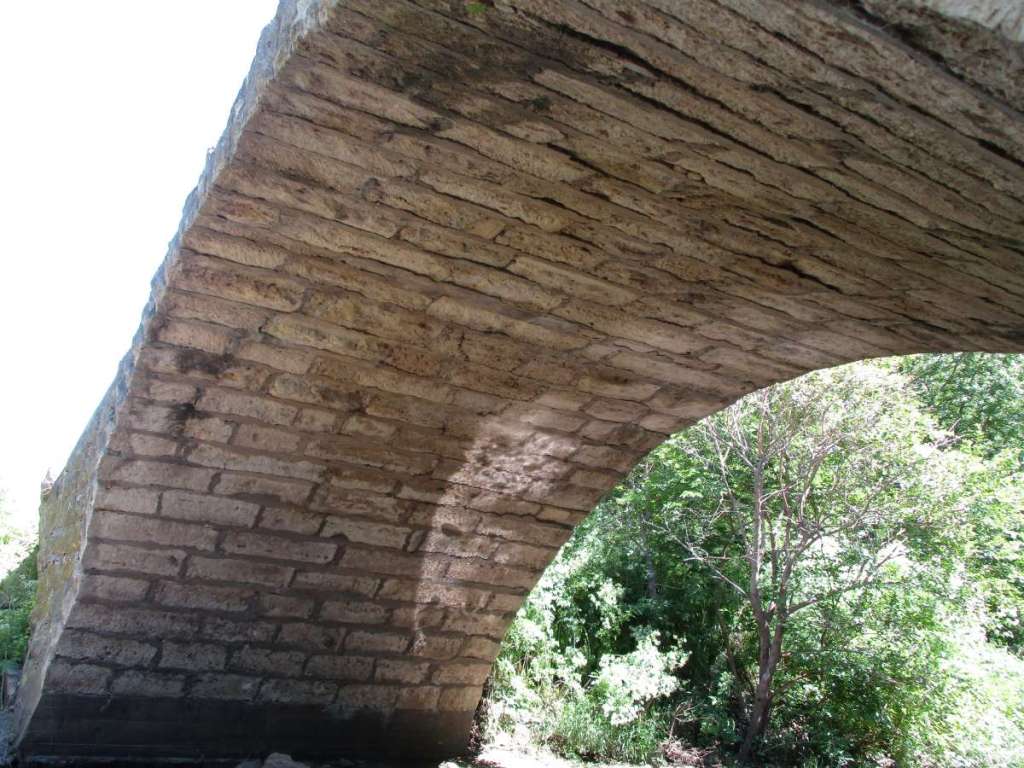
Soft stones are not preferred for a stone arch bridge. For one thing, they are more likely to compress under heavy weight and, more seriously, they tend to be vulnerable to the elements. If the builder has a choice, harder stones are vastly preferable to soft ones. But when the options are limited, there are some tricks that will allow a stone arch bridge built with soft stones to last for many years.
Drainage
First off, what usually makes soft stones fail is water. Water erosion and, more significantly, freeze-thaw cycles deteriorate the surface of the stone, causing it to flake apart and crumble. It will be found that mortarless designs are much easier on soft stones, as water that gets into the fill can simply drain right out again at the joints; water is much less likely to be retained within the structure. For this reason, when using very soft stones, mortarless work is highly recommended.
The Waterline
If the bridge is spanning a ditch that only carries water periodically, waterline deterioration of any kind is not likely to be an issue at all. But if the bridge is regularly exposed to water at the base, regardless of whether the water is flowing or simply pooling, damage to the stone from freeze-thaw cycles can become a serious issue. Flaring the base of the bridge at the waterline will provide some buffer against the stone deterioration as more of the cross-section can be safely lost before the bridge will be structurally damaged, but a far better option is to build the bridge of some other material at and below the waterline. If harder rocks can be brought in for the base, so much the better, but another option (though, admittedly, a somewhat less sightly one) is to use unreinforced concrete for the part of the structure regularly exposed to water.
Design
One concern is how well the stone will handle the compressive weight of the arch. Some stones, like slate and shale, actually will compress over time, which can result in failure of an arch. To counteract this, the bridge should be built with reasonably thick arches in order to reduce the overall pressure within the arch, and the use of small spans is recommended; use multiple arches as needed.

