
Butler County, Kansas, has numerous stone bridges. Up by Cassoday, in the beautiful Flint Hills, are located three spectacular stone arch bridges, all spanning the Walnut River. Each of these bridges is unique for different reasons. The northernmost was built in 1899 by Abe Matheney, and is one of the oldest and arguably most picturesque bridges in the county. The next one downriver was built by C. C. Jamison in 1908, and has the longest arch span in the county. The third one downstream was originally built by Walter Sharp in 1902, but was heavily modified by Abe Matheney in 1906. Consisting of two 36-foot arches, this is the largest bridge in the county. It also has been modified to carry a two-lane blacktop.
The 1899 Sycamore Springs Bridge
The picturesque Sycamore Springs Bridge was built by Abe Matheney in 1899. Consisting of one 36-foot span and a long approach, this bridge has retained its structural integrity well over the years, though at some point a concrete arch cap was poured atop the stone arch. This is a special place; take your time here.
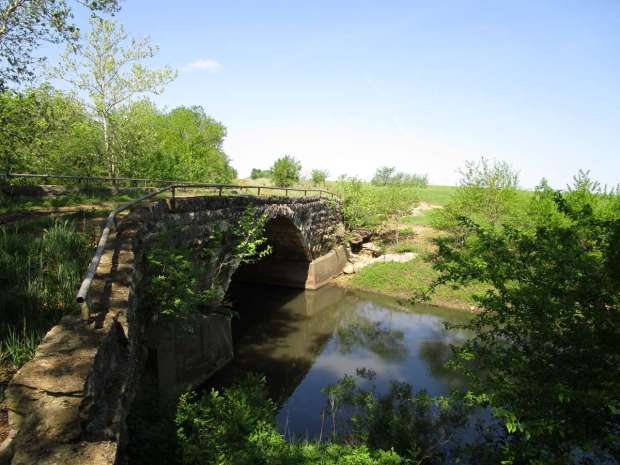
Set in a peaceful setting, this bridge, 120+ years old, is a part of the landscape itself. If there is one bridge in Butler County that stands out above the rest, this is probably the one.
The 1908 Diller Bridge
This bridge spans the Walnut River a couple miles downstream of the Sycamore Springs Bridge. This was Butler County engineer Buskirk’s first “scientific” stone bridge design. Buskirk was determined to design consistently good stone bridges that would have adequate waterway and would last. Buskirk designed this particular bridge with concrete at the waterline to protect against freeze damage; it was said the local stone was not very capable of handling frost action. This feature is obscured by the concrete scour aprons since added. The bridge was built by C. C. Jamison, and consists of one 45-foot arch. Recently, Butler County modified the bridge by adding another layer of stones atop. This increases the fill. The increase of fill not only helps it handle loads better, but (and this was probably the reason for the modification) allowed the county to give the bridge a curved profile on top improving drainage. Thus, rain will tend to roll off the bridge instead of soaking into the masonry, which is showing signs of freeze/thaw damage, no doubt related in part to the poor qualities of the local stone mentioned above.

The bridge was called the Diller Bridge after a local family; just to the south of the bridge in a field is a marker commemorating the history of this pioneer Butler County family.

The Diller Bridge is a big one. At 45′, it is the longest single-span stone bridge in the county, and the third largest single-span stone bridge ever erected in Butler; only a bridge over the Whitewater near Potwin and another over the same river near Augusta were larger. However, the Potwin bridge collapsed suddenly in 1915, and the Augusta bridge failed but a few months after it was erected, whereas the Diller Bridge has continued to withstand time and flood.
The Ellis Bridge
The Ellis Bridge was first built in 1902 by Walter Sharp, and is one of three known Sharp stone bridges in the county. Though Walter Sharp first built the bridge, Abe Matheney rebuilt the structure almost entirely, including adding a second full-sized span to fix the Ellis Bridge’s inadequate waterway. Thus, though one of the two arches was built by Sharp, almost all of the bridge was built by Abe Matheney. Actually, the Ellis Bridge has been modified since Abe Matheney’s time. A cantilevered concrete deck has been added, making it a two-lane bridge. Unfortunately, both the plaques that were mounted on the guard rails of the new deck are missing, but based on the styling, this modification was probably done sometime between the mid-1920s to the mid-1930s.

This bridge has suffered extensively from stone deterioration, but has been heavily rehabbed. True, some of the new masonry does not quite match the character of the original, but the county has managed to keep the bridge on the road and deserves credit for the preservation of this big bridge. In fact, one of the necessary repairs was done to the east arch, which clearly had lost some stonework, probably from debris impacts.
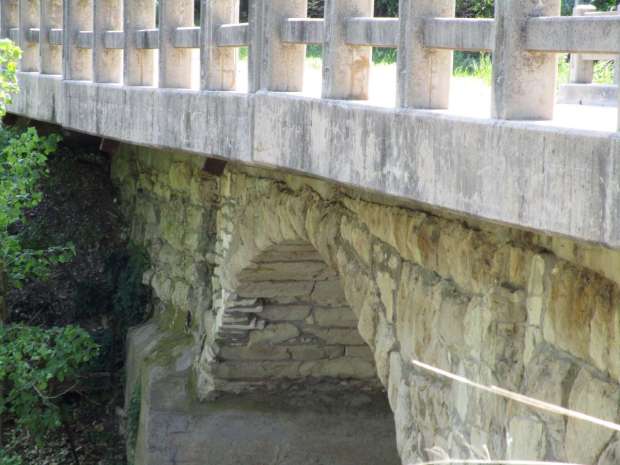
This damage was cleverly repaired with stone, smaller stones neatly filling in where the larger stone(s) in the arch were missing. Though the smaller stones do not match the originals, the repair was still overall a successful one, and the Ellis Bridge still looks good. The Ellis Bridge is the largest stone arch bridge in Butler County.
Butler County’s Stone Bridge Legacy
Butler County has many stone arch bridges; in fact it appears almost certain that Butler has more stone bridges (as distinct from culverts) than any other county in all of Kansas. It was said that Cowley had the most true stone bridges, but this county has lost several over the years, and, as can be seen by comparing the highway maps, which have bridges clearly marked, Butler is in the lead for stone bridges. While none of Butler’s stone bridges are exactly huge, they are interesting structures, with an interesting and, for the most part, clearly defined history.
Butler County was a pioneer county in stone bridge construction. Butler’s success in building stone bridges prompted other Kansas counties (such as Greenwood and Cowley) to follow suit. The well-known Walter Sharp also rose to fame building some of Butler’s earliest stone bridges. Of late, Butler County has been doing extensive work restoring and preserving many of its stone bridges, helping ensure their stability for years to come. A visit to Butler County’s stone bridges is certainly worthwhile to any stone bridge enthusiast. For a map and list of the Butler bridges, click here. The three Walnut River bridges in northeast Butler County in particular are worth seeing.
 Stone Arch Bridges