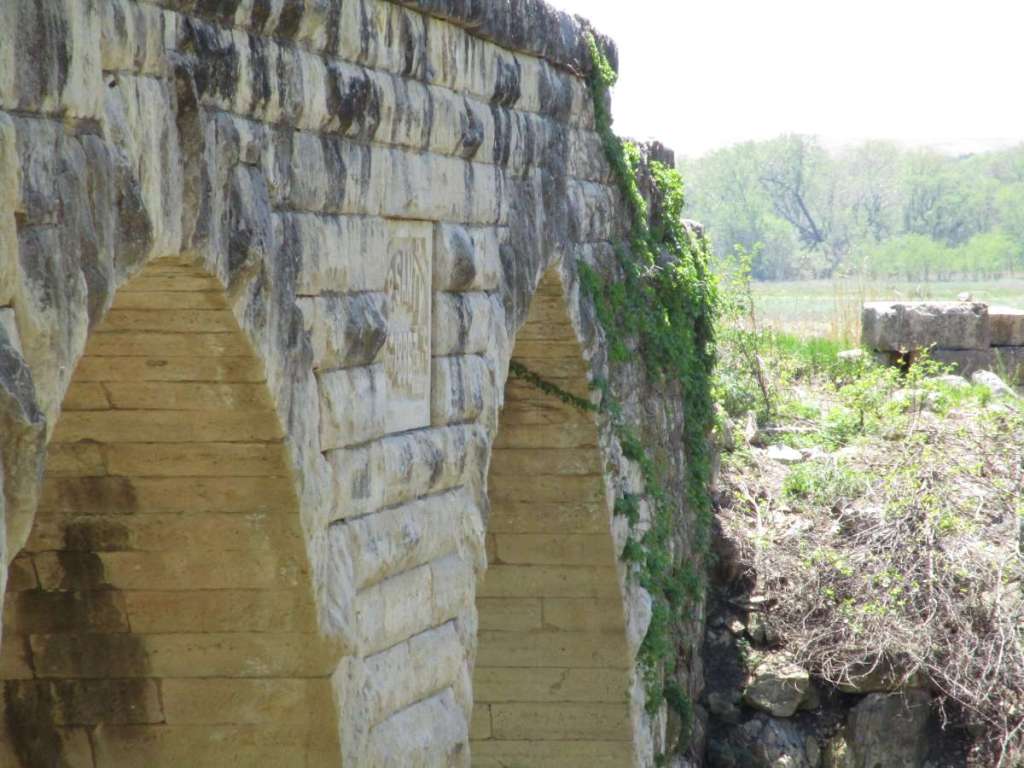
The Clements Bridge is a massive double-arch bridge in Chase County, and stands out as likely being the most famous stone arch bridge in Kansas. This is part two of the well-researched account on this structure that was kindly prepared for us by Michelle Lindsey of homesteadontherange.com.
Construction
It immediately became apparent that Santy & Co. intended to spare no pains in the construction of Clements Bridge. John Patton’s son Nelson Monroe Patton was foreman. William Dawson was the carpenter put in charge of the formwork. This formwork consisted of local walnut timber. Needless to say, the stone came from Acme Quarry and was laid in “cement,” or what we now refer to as mortar.
The Strong City Independent described the construction process in some detail in October 1886, praising Santy for “the artistic method and workmanlike way in which he is proceeding”:
They have the pier in the middle of the river about up to a level with the water, and it is built of the heaviest masonry possible, the stone for which are placed in position by a traveling derrick, suspended by two steel-wire cables about one inch in diameter, but capable of sustaining a weight of nineteen tons each. The cables extend from bank to bank at an elevation of some sixty feet above the water, upon which is the machine, built something like [a] hand-car, and from which the stones are hung in a pair of dogs beneath, and by means of which the immense rocks are removed from the cars and placed in position as rapidly as the masons can prepare for them.
(It is likely that this elaborate method of moving the stone accounted for at least a portion of the considerable expense of construction.)
Meanwhile, A.C. Cox was making the excavations for the abutments. The Strong City Independent noted that his work was down to the level of the water, leaving eight more feet of digging to do. The paper further predicted, “It is thought that the bridge will be completed by the 1st of May next, and ready for travel.”
While the work had proceeded quite quickly thus far, the arrival of cold weather in early December put the project on hold for a time. The abutments having already been completed, the bridge was deemed safe to leave to itself until spring returned.
On January 8 of the new year, John Emslie retired, and his partners purchased his interest for $11,660. Emslie had been considering retirement for some years prior, as he was over 60 years old and wanted to enjoy the fruits of his enterprise.
From this time forward, construction progressed slowly. A long pause with no news of progress occurred before the Chase County Leader promised on July 21, “Work will be commenced on the Clements stone-arch bridge the first of next month. It will be rapidly pushed to completion.” However, over a month later, the same paper reported, “Work begins on the bridge this week.” It was not until October 15, 1887, that a Strong City newspaper could report, “The north arch of our new bridge is completed.”
In a rather unusual move, the contract for building the wing walls was awarded separately from that for the rest of the bridge. The firm of Santy & Hamill won this contract in November 1887 for $3.65 per cubic yard. The decision came after a special meeting of the board of commissioners.
Likewise, the work of grading and filling the approaches was also awarded as a separate contract. Bids for this part of the project were opened on December 5, 1887. The contract was awarded to A.J. Penrod and J.W. Ray at 9½ cents per cubic yard. It appears that Penrod and Ray complied by filling the approaches with soil.
On Saturday, December 24, the Strong City Derrick reprinted an article that praised Clements Bridge as “one of the largest and most magnificent arched stone bridges in the state.” The article also reported that the bridge would be completed “this week.” Unfortunately, this expectation was not realized.
One of the final touches was the grading of the road over the bridge, which task W.P. Martin completed for $332.97. As the bridge crept toward completion, on January 5, 1888, the Chase County Leader noted, “A few days of good weather will enable the graders at the Clements bridge to complete their work and throw it open to the traveling public.” Further promises of an upcoming opening were made again on January 19, as The News-Courant printed, “The grading on the new bridge near Clements is almost completed.”
Completion
The precise date of the completion of Clements Bridge remains unknown. Despite the importance of this structure, it appears to have been opened to the public without any great fanfare.
The year of completion provided in the National Register of Historic Places (NRHP) nomination form is 1886. This conclusion was undoubtedly drawn from the plaque on the bridge. However, the official completion could have occurred no earlier than 1888, the work having been delayed as already described.
Why the plaque bears the year that the bridge was started, rather than the year that it was likely completed and opened to the public, is a mystery. This peculiarity would be easy to explain if the plaque were a later addition to the bridge, but the physical evidence is not consistent with such a hypothesis.
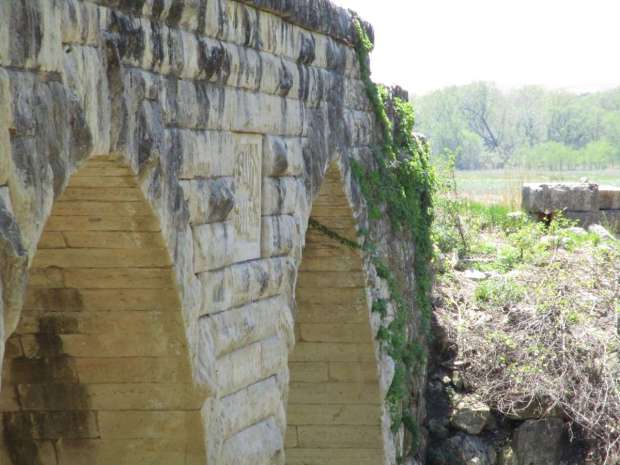
The plaque appears to be very well set into the stonework, suggesting that it is original.
Click here for The Story of the Clements Bridge: Part 3.
Click here for the previous installment of this series.
 Stone Arch Bridges