
Of all the areas in Cowley County, Kansas, Dexter saw some of the most extensive stone arch bridge construction. Even now, this area has numerous stone arch bridges and culverts to see.
The Stone Bridge Era of Dexter
Dexter is situated in the beautiful Grouse Creek Valley, and, like most of the Grouse Creek region, has extensive stone outcrops. It is hardly any wonder that many stone arch bridges were built here. The first major bridge in the Dexter area was the record-breaking Goodnight Bridge over Grouse Creek. Walter Sharp, who built many of these bridges, summed up the situation well in 1911:
“I have built four stone and two cement bridges near Dexter in the past five years and it would be hard indeed to convince the merchants and the business men, laboring men and teamsters about Dexter that these permanent bridges weren’t the real thing. I have issued checks to the amount of $10,000 in that one place in payment of labor and material — not a big thing but a whole lot better than building tin bridges where 98 per cent of the money leaves the country at once.”
Walter Sharp, “Rock Roads,” Winfield Daily Courier, September 16, 1911.
The Dexter area was home of many bridges, some record-breaking. The 75′-span H. Branson Bridge north of Dexter (collapsed early 2000s) was the longest stone arch span in the state. This former bridge was an incredible, picturesque structure over Grouse Creek.

The abovementioned Goodnight Bridge was also a record, it being the longest stone arch span in the state when built. This 64′ structure also crossed Grouse Creek.

Though not a record-breaking structure, the Hoyt Bridge north of Dexter was another picturesque bridge, spanning Plum Creek. This bridge was overdesigned judging from appearances, and probably would have survived the years if it hadn’t been in the line of K-15.
The Bridges Today
There are currently three major bridges left near Dexter, though there were formerly several more. The most spectacular is the triple-arch Pudden Bridge near Dexter, now in imminent danger of being demolished, either for its replacement or by nature if left unrepaired.

Also near Dexter is the big 1914 Crab Creek Bridge. This structure features a low-rise arch and is built with a sloped deck to accommodate the fact that one of the creek banks is higher than the other. A rather daring-looking structure, this is quite an interesting bridge.

The “Bridge North of Dexter” located at the northwest edge of town is an interesting structure. Widened on both sides with a cantilevered concrete deck, it looks like a concrete bridge at a glance, but a fairly sizable stone arch bridge is visible beneath, and can be seen, though with some difficulty. At this time it is difficult to say definitively when and why this bridge was built, but there is some admittedly thin evidence that suggests that it may have been built by the town in the early 1900s.

Though on private property, the Horse Creek Bridge is visible from Grouse Creek Road.
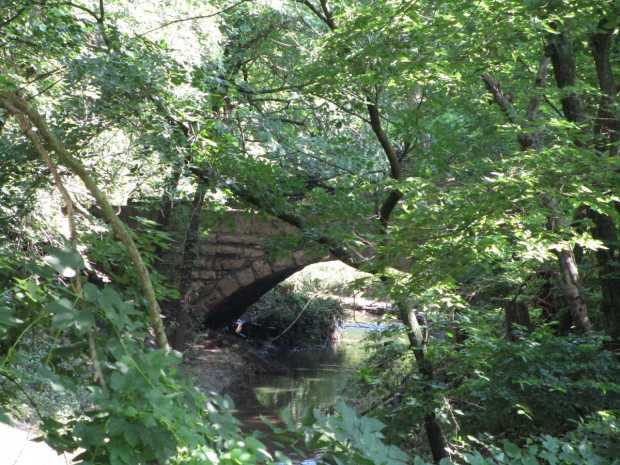
This overdesigned 1913 bridge was built by Walter Sharp.
The Culverts
There are many stone arch culverts around the Dexter area, mostly north and east of the town. Probably the most significant is the 1908 Plum Creek Bridge built by Lew Welch. Lew Welch was a Dexter stonemason and acted as foreman for Walter Sharp on numerous occasions, including during the construction of the Pudden Bridge.
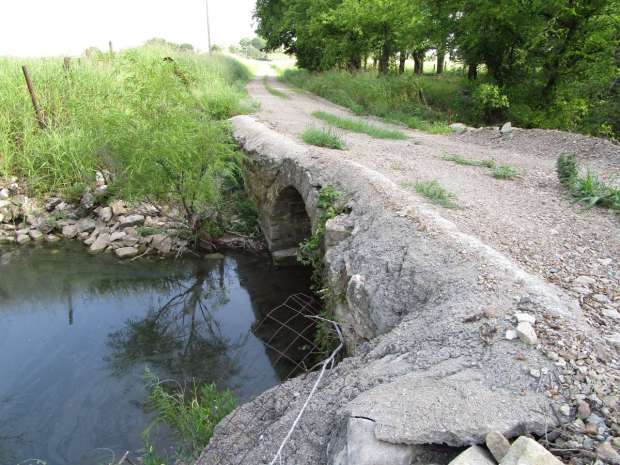
Not all of Dexter’s culverts are ordinary stone arches. Several are entirely of stone save for the center portion of the arch, which is concrete. The concrete arches are indeed faced with true stone arches, making the bridge look like a normal stone arch bridge, but the interior of the arch is concrete, making these structures unique hybrids.
Plan Your Trip!
If you like stone arch bridges of all sizes, Dexter is still the place to be in Cowley. A map can be downloaded on our Cowley Stone Bridge page. Touring the bridges is also a great way to see the picturesque countryside, for this area of Cowley is arguably the most scenic.
 Stone Arch Bridges