
As mentioned in last week’s post, we recently discovered the 1895 Peter Johnson’s Bridge high and dry in a road embankment near Leon, Butler County, Kansas.
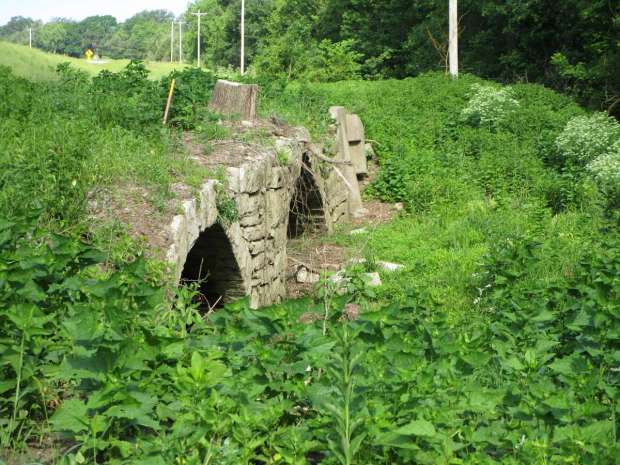
This double-arch bridge has a rich history, and is remarkably well documented. In this post we look into the story of this historic bridge.
A Tale of Butler’s Stone Bridges
Though Butler County had a stone culvert built as early as 1882, the first major structure the county proper undertook was a simple 20′ span near Towanda to see if stone bridges held potential. This bridge turned out well, so Butler once again let another stone bridge, this one a double-arch structure of two 16′ arches located east of El Dorado and spanning Bird Creek. The low bidder on this bridge was a group of contractors known as the Sharp Brothers, one of whom, Walter Sharp, would go on to become famous for his work building stone bridges.
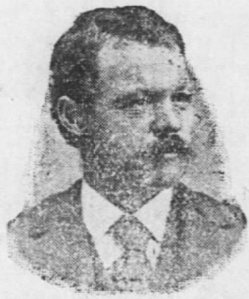
The next major stone bridge the Sharp Brothers would build was a (relatively) large structure: a 33-foot span over the Little Walnut River, near Leon. The work on this bridge and the work they were doing on the Butler County courthouse at the same time helped greatly to ensure the Sharps a reputation for good workmanship at competitive prices and guaranteed them more work down the road.
Building the Little Walnut Bridge
A new road was needed north and east of Leon, and an important part of this road would be a bridge over the Little Walnut River. From an early date, a stone arch bridge was proposed for the spot, and plans were drawn up for this proposed structure by Eli Warren, as well as another set by L. L. Kiser, whose father was the township trustee of Little Walnut Township, where the bridge was to be located. Early in 1895, the county commissioners decided on the location for the bridge, which would be built on the farm of a man known as Sam Hyde.
When the letting of the bridge on the new road near Leon occurred in early 1895, the Sharp Brothers won the contract for a single-arch bridge. The Sharp Brothers were doing extensive business in Butler; at this time not only did they have the contract for the Bird Creek Bridge, but they also were at work remodeling Butler County’s courthouse. They went to work on the new Little Walnut Bridge with a will, beginning construction in May of 1895. The stone for the bridge was quarried from the nearby farm of Peter Johnson, for whom the bridge was named.
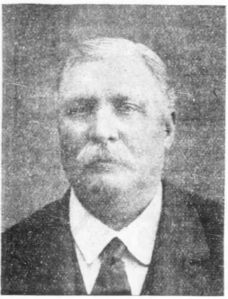
Peter Johnson was a successful farmer of Swedish birth who had lived in the Leon area for a number of years. The Sharps stated that the stone quarried from Peter Johnson’s farm was the best they had ever used. The work progressed with impressive rapidity, the keystone being placed in late June. By July 11, the El Dorado Daily Republican stated that Peter Johnson reported the bridge completed.
A Durable Bridge
The new stone bridge was a much more durable structure than the steel bridges having been primarily built heretofore in Butler. The Sharps humorously stated, “Driving over this bridge slower than a trot or driving less than 100 head of cattle over it at one time, strictly forbidden.” The irony in this statement was that the typical wood or steel bridge often required strict speed and load restrictions. The Walnut Valley Times published a thorough write-up of the bridge when it was accepted:
The board of county commissioners, Messrs. Ohlsen, Ellis and Stone came out from El Dorado last Monday and inspected the Stone Arch Bridge over the Little Walnut, 4 miles Northeast of Leon and 1/2 mile west of the Quito School House. Trustee Kiser and Township clerk Farrar were also there, as well as the Sharp [Bros]., builders, with the skilled [mechanics] whose hands had fashioned the structure. Of course Pete Johnson, who furnished the stone which is said to be the best bridge stone in the county, was there. And Sam Hyde, who boarded the hands and preempted the land where the bridge stands, was there. J. A. Griffith, who has labored and fought and kicked, in season and out of season for that bridge was there. Then there were several ladies, relatives and friends of the builders and others present, including photographer Ed. Stevenson.
The bridge is the largest of the kind in the county, the arch span being 33 feet. The contract price was $749 of which the county paid $600 and the Twp. paid $149. The coping and railing for the approaches will cost perhaps $25 more. The first cost is more than for an iron bridge, but there is no reflooring and other repairs and painting every few years. There is no crushing through it with heavy loads and in the long run, it is the cheapest bridge that is built. It looks as though it ought to stand a thousand years. It will be a great convenience to our neighbors up that creek and handy for every body who goes that way.
Leon Indicator, “The Bridge Accepted,” July 18, 1895.
The Naming Controversy
The first real problem with the bridge was not a structural one, but one of naming. When the keystone was engraved with a date plaque, it read as follows:
1895
SHARP BROTHERS, Contractors
COMMISSIONERS
Thos. Ohlsen, F. L. Stone, John Ellis
PETER JOHNSON’S BRIDGE
From reprint of plaque inscription that appeared in the July 5, 1895, edition of the Walnut Valley Times.
The difficulty? The bridge was not located on Peter Johnson’s land, but rather on his neighbor Sam Hyde’s land. However, Peter Johnson had aided greatly in the work, and it was his name that the Sharps put on the plaque. When approached with the objections of the people of the area over naming the bridge after Peter Johnson, Walter Sharp instructed the objectors to ask Peter Johnson if he would mind if the name of the bridge was changed. Peter Johnson is said to have responded “that as he did not solicit the naming of the bridge in his honor, he would not give a license to efface it.” The objectors had been wanting to name the bridge Quito Bridge, as Sam Hyde declined to have the bridge named after him, and Quito was the name of a townsite in the area. Peter Johnson stated that Walter Sharp had said that Peter Johnson’s name had been placed on the bridge because he had freely donated the stone to be used to build the structure. Walter Sharp himself said that they had put Peter Johnson’s name on the bridge without Peter Johnson’s previous knowledge. As a humorous compromise to the issue, the Leon Indicator proposed:
We move as a compromise, that any tax payer who will pay $1 into the county treasury for the privilege, be allowed to have his name carved on that bridge.
Page 3, Leon Indicator, July 11, 1895.
Vandalism
The naming controversy reached a head when someone cut the name of Peter Johnson right off the bridge. Around the same time, the bridge was damaged at the base, and rumors abounded that someone had set off an explosion at the bridge. However, the explosion theory was laid to rest after the commissioners, Walter Sharp, and Sam Hyde inspected the structure. Sam Hyde reported that the damage was due to flooding. The matter of the bridge’s name was not laid to rest, however. In 1898, shortly before the first Harvest Home Picnic of the area was to be held at the bridge, Peter Johnson hired a stonecutter to engrave his name back on the bridge. However, shortly afterwards somebody again cut the name off, whereupon Peter Johnson hired the engraver to come back yet again on the day before the picnic. Shortly after this followed some strong words aired in the newspapers on the topic representing both sides of the issue.
The Waterway Problem
Though the damage to the foundation of Peter Johnson’s Bridge, which resulted in the dislodging of some stones, was not caused by explosives as was first feared, it still represented a serious problem. The bridge was not founded on bedrock, and was being undermined. The commissioners had a stone scour apron added to the structure, but finally in 1900 the county commissioners awarded Walter Sharp the contract to add an additional 30′ arch to the bridge making it a big double-arch bridge. Naturally the increased waterway would help keep the bridge from being damaged in floods.
A History of Community Spirit
Despite the bridge naming controversy, the Harvest Home Picnic, first begun in 1898 at Peter Johnson’s suggestion to celebrate the stone arch bridge, proved to be a important community event in the area. Held every year, this event brought together the local community. Though the earlier events were held at the bridge, later ones were held in other locations in the area. And, as time passed, the ill feelings about the naming of Peter Johnson’s Bridge were forgotten. From The Walnut Valley Times:
More than 1,000 people were gathered in the Peter Johnson grove down on the Little Walnut, 4 miles east of Leon, Wednesday, August 10. The occasion was the Twelfth Annual Harvest Home Picnic.
The gathering was the largest in the history of the organization. The day was most glorious, bright and sunny, but cool. The rain had made ideal conditions….
A pleasant feature was the frequent recall of the name of Peter Johnson who really was the originator of this Harvest Home organization. His body lies in the little cemetery near by and memories of the big, warm hearted Swede, the kind friend and neighbor were frequent and sincere. This annual meeting and greeting[ ]is credited to him. The stone arch bridge across the [Little] Walnut for which Johnson labored so successfully is still known as the Peter Johnson bridge.
Seeing the abounding pleasure and interest in this long-lived organization brings the query, why not have many others like it annually to promote good feeling and general friendliness and neighborliness?
The Walnut Valley Times (Daily Edition), “Thousands Enjoy Big Harvest Home Picnic At Johnson’s Grove,” August 11, 1910.
Continuing Building Bridges
It would seem that the three early major stone bridges in Butler, namely the 1894 Stearns Branch Bridge near Towanda, the 1895 Bird Creek Bridge near El Dorado, and the 1895 Peter Johnson’s Bridge, helped to set the course of the future. Many stone bridges were built in quick succession in Butler County over the following years. Walter Sharp built many of these early Butler bridges, and quickly gained a reputation along with the bridges. By 1899 the Greenwood County commissioners were visiting Butler County to see if the stone bridges were as good as they were said to be. In 1901, the Cowley County commissioners followed suit and examined Butler’s stone bridges to see if they should build stone bridges as well. And, of course, once they saw how successful Butler’s stone bridges were, the commissioners of these counties began having stone bridges built, and Walter Sharp ended up doing the work.
Conclusion
Peter Johnson’s Bridge no longer carries the road, but still stands partially buried in the road embankment. It no longer spans anything in particular, but remains a historic example of an early Butler County stone arch bridge, and one with a rich history. As the second Sharp bridge in Butler, the 4th stone arch bridge built by the county proper, and a landmark structure in the course of events that set the course of bridge building not just in Butler but in other counties, like Greenwood and Cowley counties, there can be no doubt that Peter Johnson’s Bridge is a significant historic structure. Perhaps it will find its way onto the National Register of Historic Places as it is a major part of the area’s road history.
References
- A Very Early Stone Arch Culvert in Butler County.
- The Walnut Valley Times (Daily Edition), January 10, 1894, Page 4.
- Butler County Citizen, “An Outing,” May 24, 1894.
- Walnut Valley Times, January 11, 1895, Page 3.
- The Walnut Valley Times (Daily Edition), April 27, 1895, Page 1.
- “Butler County’s New Courthouse,” Walnut Valley Times, September 13, 1895.
- Butler County Citizen, April 26, 1894, “Road Notice.”
- The Augusta Journal, “Leon Locals,” March 29, 1895.
- Walnut Valley Times, “From Wednesday’s Daily,” January 19, 1894.
- The Walnut Valley Times, February 2, 1894, Page 4.
- El Dorado Daily Republican, July 17, 1895, Page 4.
- The Walnut Valley Times (Daily Edition), “Leon,” February 25, 1895.
- Walnut Valley Times, “From Friday’s Daily,” April 19, 1895.
- The Walnut Valley Times (Daily Edition), May 28, 1895, Page 4.
- El Dorado Republican, “The Old Must Die and the Young May Die,” November 8, 1907.
- El Dorado Daily Republican, July 11, 1895, Page 4.
- Leon Indicator, June 27, 1895, Page 3.
- The Walnut Valley Times (Daily Edition), July 11, 1895, Page 4.
- Leon Indicator, July 11, 1895, Page 3.
- The Walnut Valley Times (Daily Edition), “Leon,” July 15, 1895.
- The Walnut Valley Times (Daily Edition), July 16, 1895, Page 4.
- Walnut Valley Times, September 9, 1898, Page 4.
- Douglass Tribune, “Leon Notes,” July 25, 1895.
- The Walnut Valley Times (Daily Edition), July 25, 1895, Page 4.
- The Walnut Valley Times (Daily Edition), “Harvest Home Picnic,” August 16, 1898.
- Walnut Valley Times, “From Wednesday’s Daily,” August 19, 1898.
- El Dorado Republican, “Monday,” August 26, 1898.
- Walnut Valley Times, “That Bridge,” September 2, 1898.
- Leon Indicator, August 1, 1895, Page 3.
- Leon Indicator, “Fatally Defective,” July 25, 1895.
- El Dorado Republican, “County Commissioners,” February 23, 1900.
- Walnut Valley Times, “Commissioners Proceedings,” August 10, 1900.
- El Dorado Republican, “Leon,” August 3, 1900.
- Walnut Valley Times, “First Picnic Was For Stone Bridge,” August 11, 1911.
- The Augusta Daily Gazette, “Revive Butler County Picnic,” July 18, 1921.
- Walnut Valley Times, “A Modern Butler County Bridge,” June 17, 1898.
- Walnut Valley Times, “From Monday’s Daily,” June 17, 1898.
- The Walnut Valley Times (Daily Edition), October 11, 1902, Page 4.
- El Dorado Republican, “Like Our Stone Bridges,” April 21, 1899.
- The Augusta Weekly Gazette, “Local News,” November 1, 1901.
- The Walnut Valley Times (Daily Edition), “A Stone Arch Bridge,” June 23, 1900.
- Winfield Courier, “A New Bridge,” December 5, 1901.
- See also: Found: Butler’s Historic Peter Johnson’s Bridge and Stone Arch Bridges of Butler County, Kansas: Builders and Locations Part 1.
 Stone Arch Bridges