
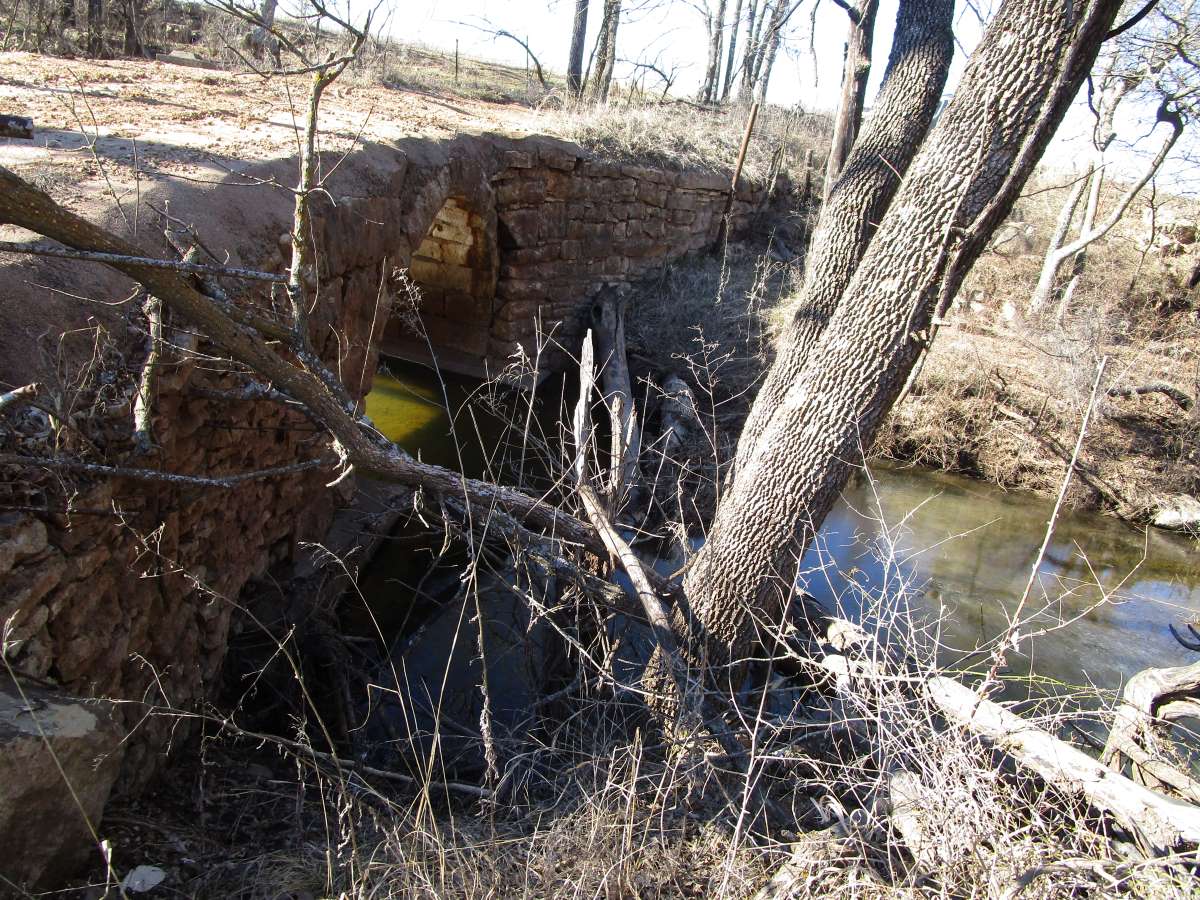
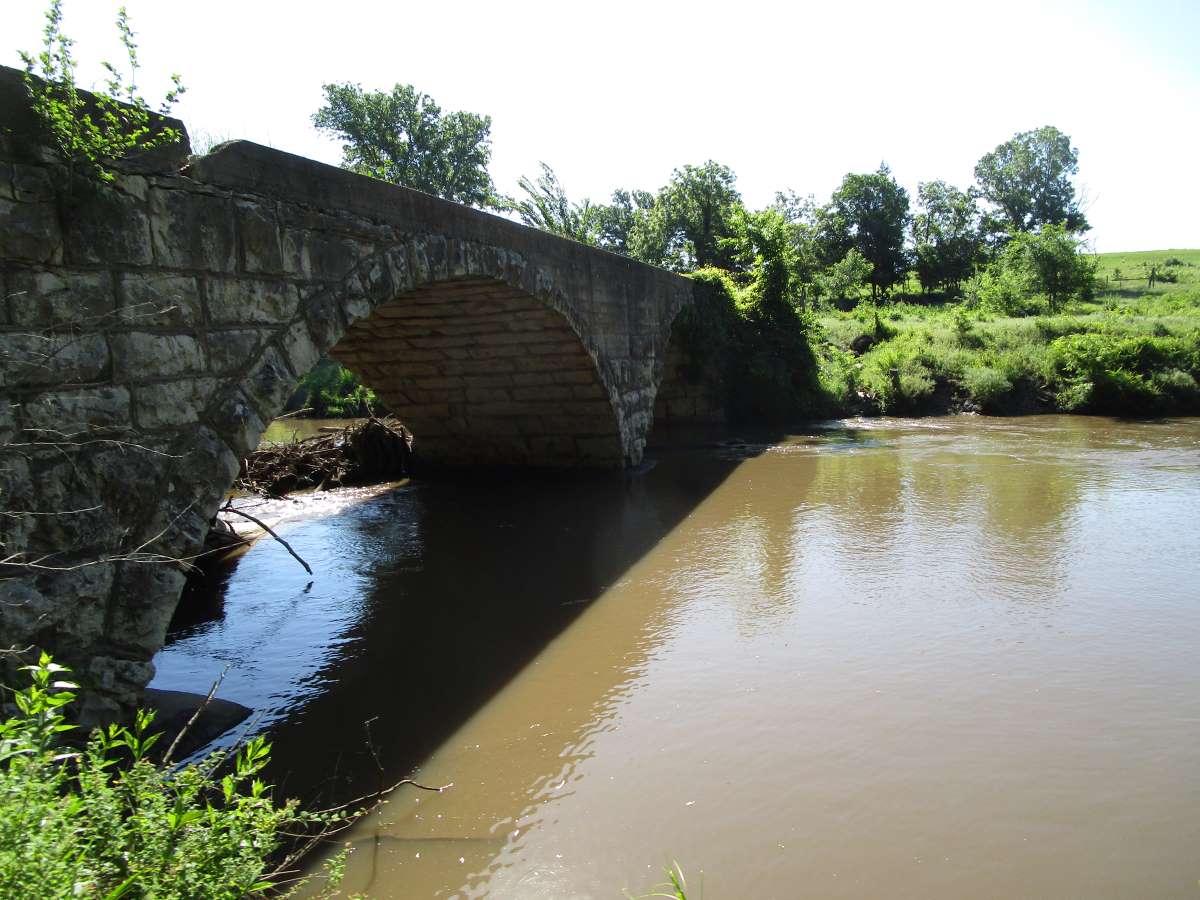
The Stalter Bridge in Cowley County, Kansas, merits some investigation. This small and narrow stone arch bridge has been on the Cowley County bridge tour for years, and little is known about it. While we were unable to find a definite reference to the bridge, we have found plenty of circumstantial evidence that, coupled with a close look at the bridge itself, provides strong clues as to who built it and roughly when the bridge was built.
A Township Bridge
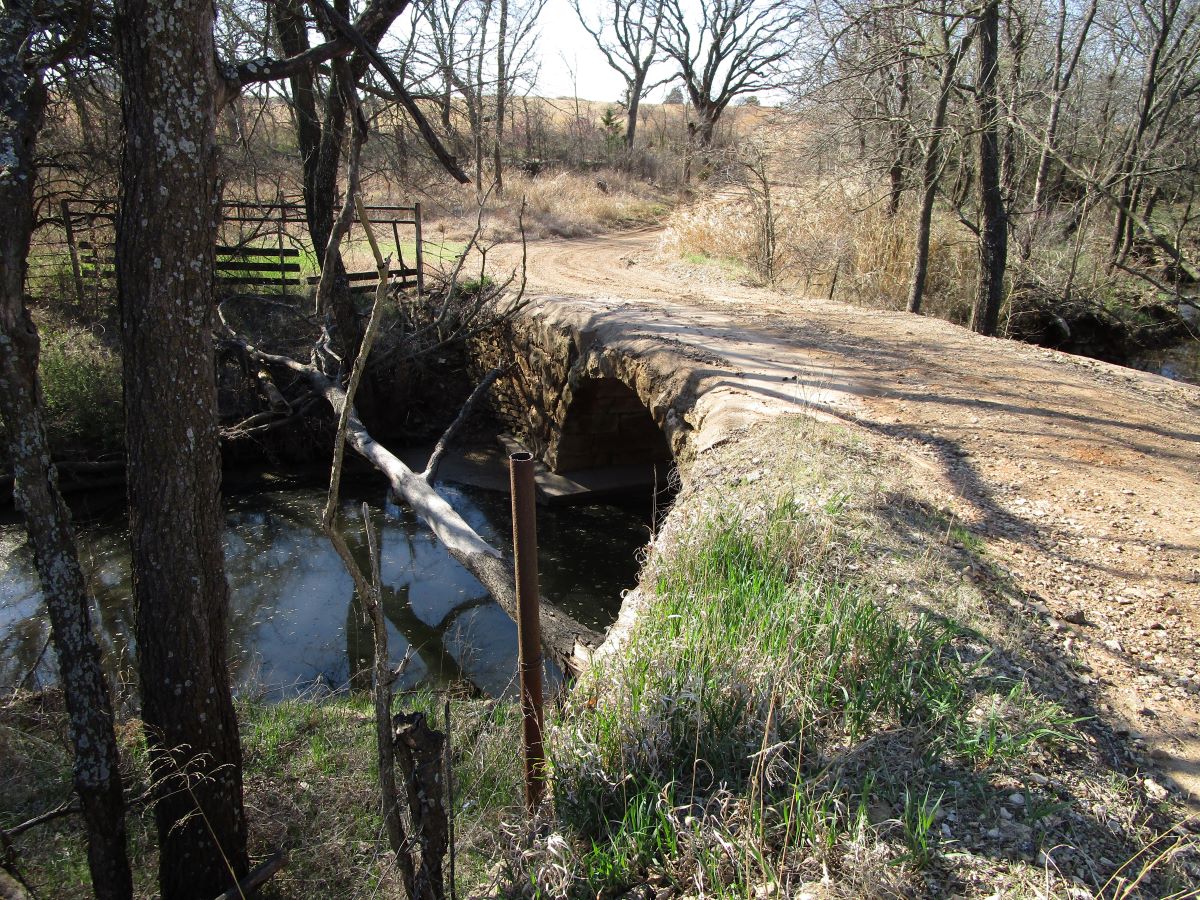
There can be little doubt that the Stalter Bridge was a township-built bridge. The narrow width alone is sufficient evidence of this; the county used a 16-foot width standard for its stone bridges, while townships, probably for economic reasons, preferred to skimp a little bit on the width.
As anyone who has driven on the bridge can testify, the Stalter Bridge is a little on the narrow side, and does not even have curbs!
Rock Creek Township Culverts
The Stalter Bridge is technically a culvert, and most culverts were built at a township level. The question is, who was most likely to build culverts in Rock Creek Township, where the Stalter Bridge is located? As it happens, the newspapers have a clear answer: Abe Matheney. Butler County stonemason Abe Matheney built his first bridge in Cowley County near Rock, over Rock Creek where US 77 now is. This bridge was such a success that Abe Matheney was hired by Rock Creek Township later on to build more culverts along the line of US 77 in the vicinity.
Abe Matheney’s Work
The question is, does the Stalter Bridge look like an Abe Matheney bridge? Actually, it does. There is a similar bridge on a private farm in Cowley known to have been built by Abe Matheney that bears a distinct resemblance.
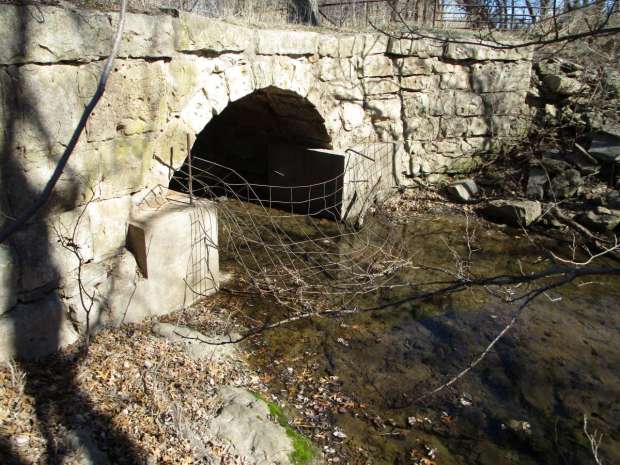
Also, there is a known Abe Matheney bridge near Beaumont in Butler County, Kansas, known as the Thomas Jefferson Smith Bridge that is very similar. (See our Stone Arch Bridges of Butler County, Kansas page.) There are tooling marks on these Abe Matheney bridges showing that Abe Matheney used toothed chisels to shape the local limestone; the Stalter Bridge also bears these marks.
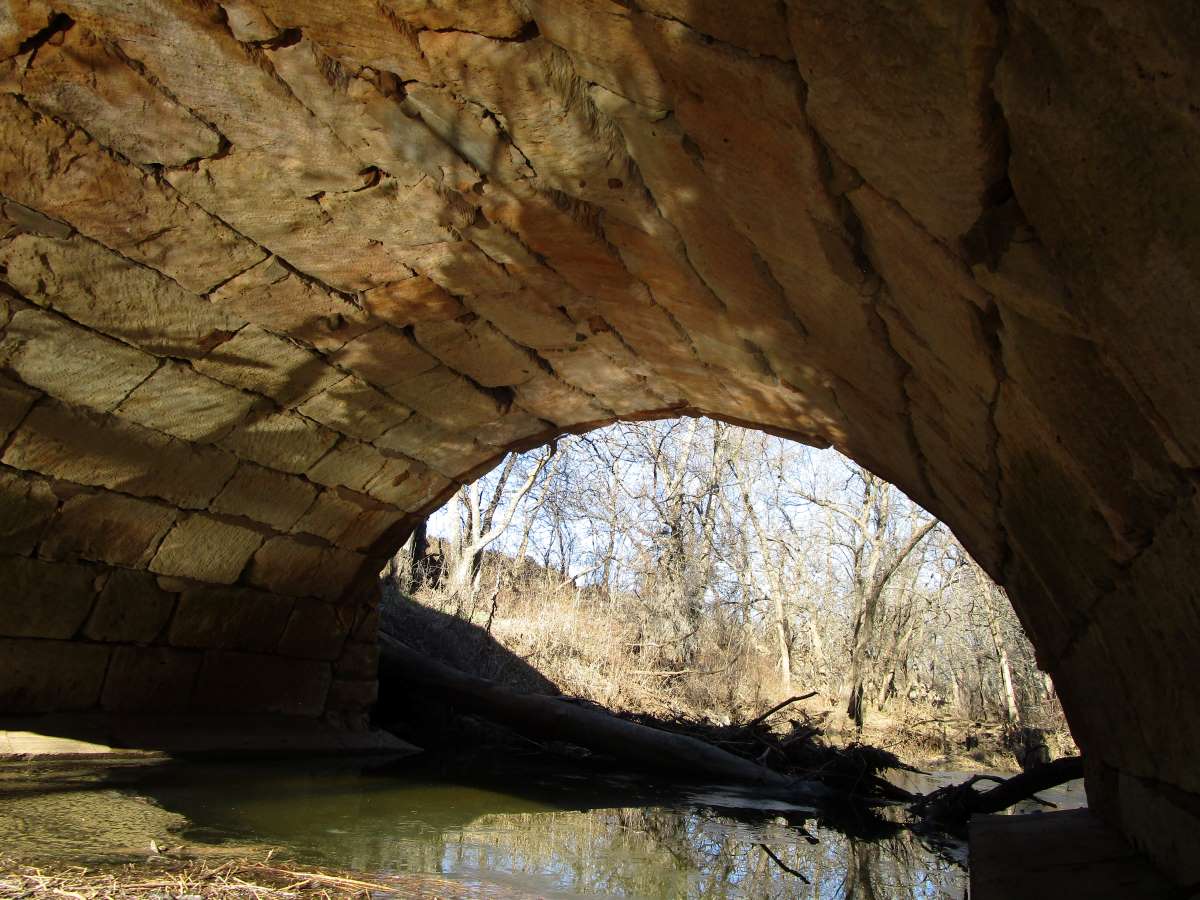
There can be little doubt but that the Stalter Bridge was built by Abe Matheney.
Can We Put a Date on That?
While we cannot put an exact date on the Stalter Bridge, we can guess it was probably built in the time between 1905 – 1908, probably at the later end of this range. Abe Matheney was doing a lot of culvert work for Rock Creek Township at this time; in fact the 1907 township expenditure report found in the November 28, 1907, edition of the Winfield Courier reveals he built three stone bridges/culverts in this time frame. Could one of these bridges have been the Stalter Bridge?
Alterations
The Stalter Bridge has been heavily altered over the years, as evidenced by the dry-stack stone masonry in the approaches. One interesting possibility is that the bridge may have once contained a second arch. The evidence for this is on the east side on the south approach of the bridge, where there is a small section of original stonework in the spandrels made of big blocks stepping out around the curve of the arch. However, this same stonework also steps out in a rounded fashion into an area filled in by crude masonry clearly added later. Could there have been another arch here? It is impossible to say; the alternative would be a long running joint in the masonry, though this running joint would be unusual inasmuch as it is curved.
The west side of the bridge does not show evidence of a second arch, which is not necessarily surprising as this masonry may not be original; it looks like there is evidence of concrete used as mortar in places, suggesting a relatively recent repair.
The Rock Creek Bridge
As a tangential aside, the double-arch Rock Creek Bridge located about a mile from the Stalter Bridge is not an Abe Matheney bridge. This 1909 structure was built by Walter Sharp, and was considered one of the most scenic bridges in the county when built. The Rock Creek Bridge is currently open to traffic, but is suffering severe stone deterioration, primarily on the eastern arch.
Cowley County has been discussing replacing this little-used historic bridge with a modern structure, along with the damaged triple-arch Pudden Bridge near Dexter.
 Stone Arch Bridges