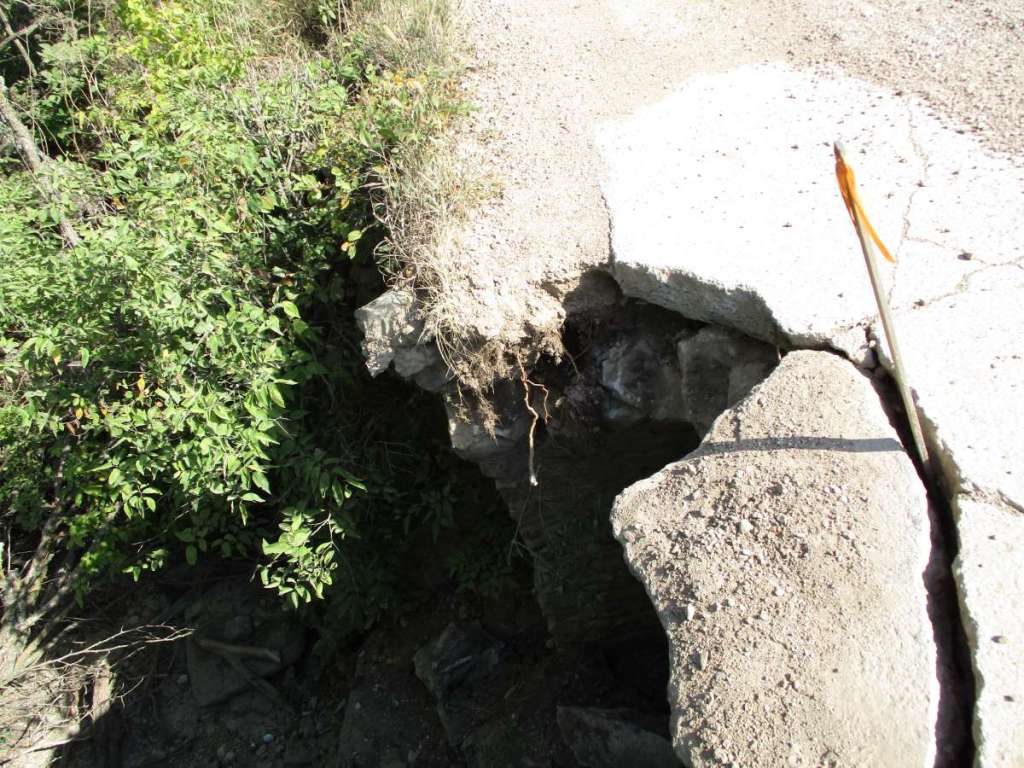
One of the stone arch culverts we found near Dexter in Cowley County, Kansas, has recently been damaged. Located on 251st Road right by the intersection with 176th Road, this structure is a true stone arch of moderate size. It is map number 20 on our Cowley stone arch bridge page.

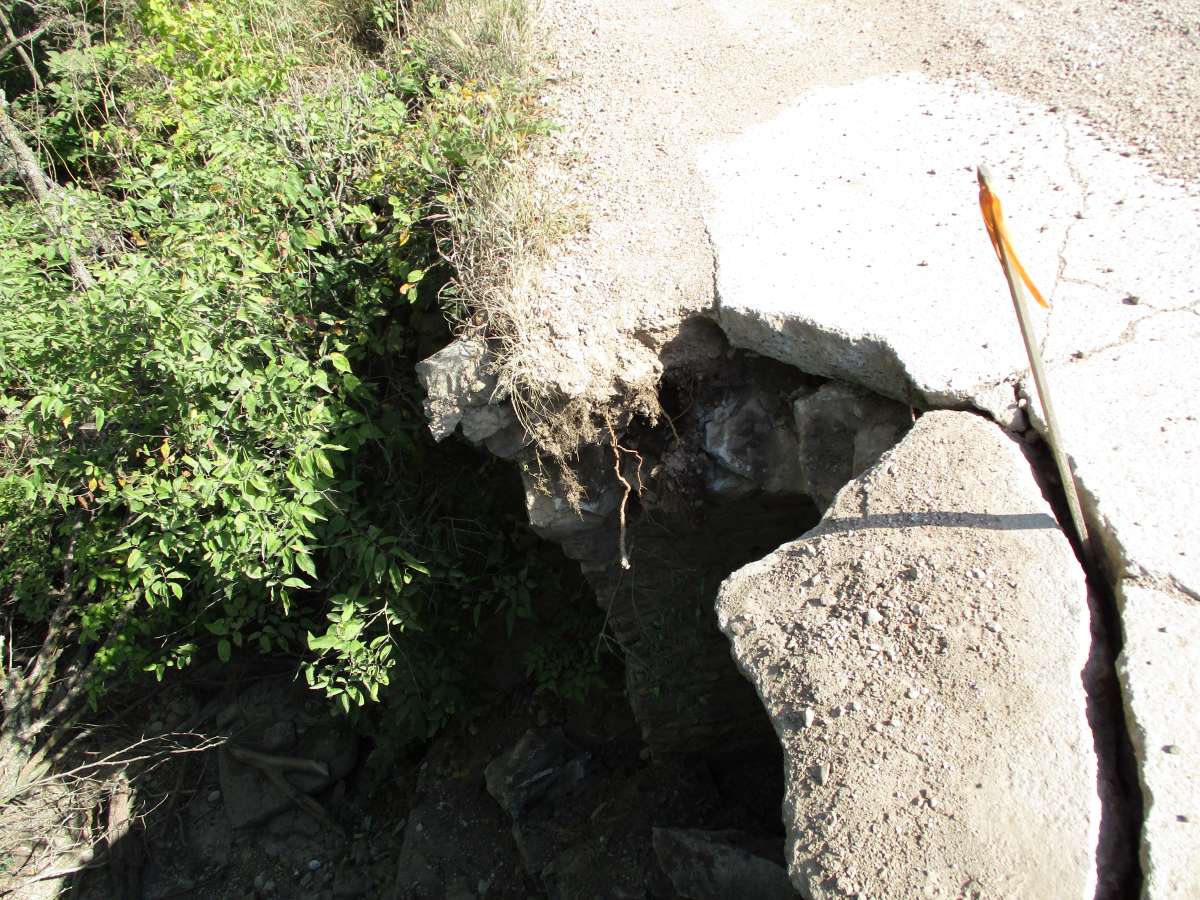
The downstream facing of the arch has caved in, rendering the structure unsafe for use, and at the time of this writing the culvert is closed to traffic.
Update: This culvert was demolished rather than repaired, and has been replaced with a metal arch culvert.
Examining the Culvert
The amount of damage is actually rather limited, but it is enough to make the road unsafe as the roadway and possibly some of the culvert near the collapsed section is unstable. The collapsed part of the culvert has fallen under the culvert. The culvert has a very thin arch of only about half a foot in thickness. The stones are quite small pieces as well. A look under the culvert shows several repairs made with concrete; it appears that there have been several instances of stones punching though the arch creating holes in the road, which were then filled with concrete.

Analyzing the Collapse
It appears that a heavy load placed near the edge of the culvert was the immediate cause of the collapse. A look at the damaged portion of the culvert shows a settlement crack, as if this piece of the arch was already delaminating from the rest of the structure; this is further confirmed by a slight bulge of the walls. A look at an old photo of the culvert (see the first photo in the post) shows the face of the culvert was no longer in in line with the rest of the structure, suggesting it was leaning outwards. It appears that the arch was weakened in this specific area by settlement as evidenced by the distinct lean in the arch and walls, and weakened overall by the gradual deterioration of the mortar. This coupled with the fact that the arch is quite thin allowed heavy loads and vibrations to collapse the arch.

The Future of the Bridge
It is unclear at this time whether the culvert will be repaired, perhaps with another concrete patch, or simply replaced. A patch will probably gain some more usefulness out of this structure. Rebuilding with stone (using the fallen stones as much as possible) is the ideal option here, of course, but a thorough repair would also involve some careful re-pointing of the masonry. This culvert is built like several other stone arch culverts near Dexter and is one of the larger ones in the area. Punching like this is a common problem with many of the low-quality stone arch culverts in southern Kansas. We found one instance near Udall where the top of a weak stone arch culvert had been replaced entirely with concrete placed on top of the remains of the stone arch.

The cause for these failures is generally low-quality masonry coupled with loss of mortar over time. For a structure composed of small, loose-fitting stones, mortar integrity is of the utmost importance.
 Stone Arch Bridges