
We recently discovered a little-known stone arch bridge (bridge, not culvert) in Butler County, Kansas. This bridge is partially filled in, being located high and dry in a road embankment on the blacktop Flinthills Road, about five miles south of Rosalia. This bridge formerly spanned what was called Kentucky Creek and is a single-arch structure with one 24′ span. Much of this bridge is in the road easement, though visitors should be aware that part of the structure appears to be on private property, judging by the remains of a barbed-wire fence on top.

A Township Bridge
The Old Kentucky Creek Bridge was built by Rosalia Township in 1910. The one reference to this bridge we found is simply a call for bids:
Sealed bids will be received to 2 p. m. of Monday, October 31, at the township hall in Rosalia for the construction of a stone arch bridge 16 feet long, 24 feet wide and 8 feet high across Kentucky creek, five miles south and one-fourth mile west of Rosalia; also one across [Nicholas] creek, one-fourth mile west and four and three-fourths south of Rosalia, 16 feet long, 16 feet wide and 8 feet in height.
Specifications may be seen at the home of C. M. Auten, township clerk.
The board reserves the right to reject any and all bids.
—J. W. Delts, Trustee.
“Bids Wanted,” Walnut Valley Times, October 21, 1910.
No trace of the nearby Nicholas Creek Bridge referred to in the article could be found. The rather poorly written call for bids is written such that it makes both bridges sound like 16′-span culverts, with the Kentucky Creek Bridge being 8′ wider than the Nicholas Creek Bridge. However, this scenario seemed unlikely, and the Kentucky Creek Bridge seemed to be larger than 16′ in span, so we made an on-site measurement and found the span was 24′, and the width about 16′, making it a true bridge as opposed to a large culvert.
The newspapers hold no definite answer as to who the builder was, but the papers do record that the local stone mason Harry Brickley was receiving payments from Rosalia Township. Harry Brickley built stone arch culverts in the area, and there are several culverts in nearby Glencoe Township that are likely his work. The Kentucky Creek Bridge may very well be more of his work.
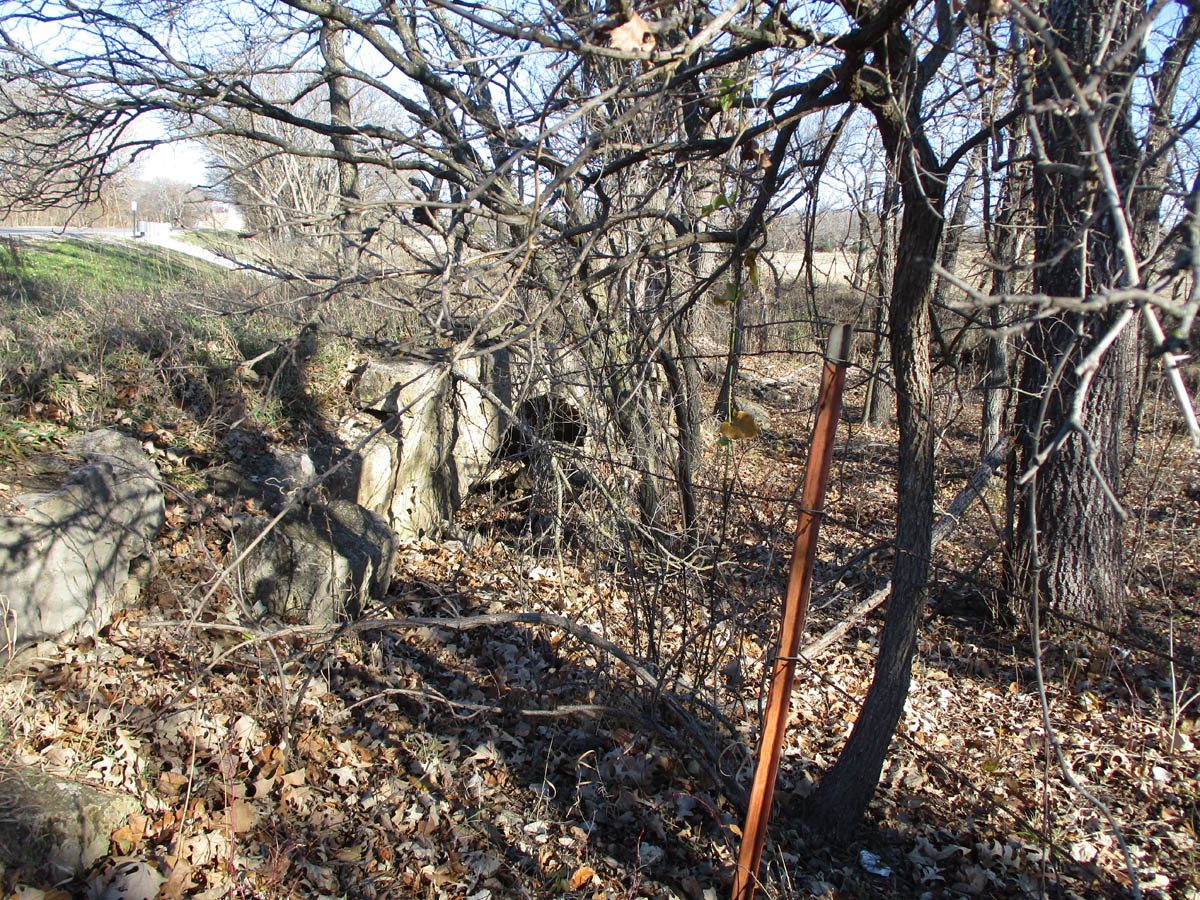
The Old Kentucky Creek Bridge
While little information can be found about this bridge, the workmanship is clearly outstanding, and the bridge is in a very good state of preservation, save for a few missing stones on the top. An on-site measurement was made to confirm that, yes, this is a bridge (20′ or greater) as opposed to a culvert, since the one newspaper reference we found referring to this bridge was somewhat ambiguous. The road obviously made a turn to cross the creek, and it appears that the creek was rerouted in order to allow the road to more easily follow a straight path. The old channel was filled in, and the stone bridge was partially blocked up with large rocks placed randomly at either end.

Butler Stone Bridges
The old Kentucky Creek Bridge brings the number of stone arch bridges (as opposed to culverts) in Butler County to 22. Since we list bridges first on our Butler stone bridge page and culverts second, this has necessitated a change in our numbering scheme, but our map and list have been updated to reflect this new find.
Butler appears to have more known stone bridges in use than any other county (including Cowley). Butler also has a peculiar heritage of bypassed stone bridges that are left high and dry due to various water re-routings over the years. The Peter Johnson’s Bridge and the Kentucky Creek Bridge are abandoned structures now built into road embankments. The Walz Ford Bridge is another such structure, only it actually carries the road, though one side is completely filled in.

How many more stone arch bridges are there in Butler County that are high and dry but still remain, waiting to be found?
 Stone Arch Bridges