We recently completed a stone arch bridge at Camp Quaker Haven, a Christian retreat located just outside Arkansas City, Cowley County, Kansas. This bridge replaced a shaky wooden bridge and was built using traditional masonry techniques such as were used in Cowley over a hundred years ago. This is the final post in the series about building this bridge.
Removing the Forms
The arch forms were removed June 23, 2025, amidst a touching ceremony arranged by the camp director. The forms had to be broken up, as things turned out, for the grout had stuck to the forms, making the removal a 2-hour process. The completion of the arch was celebrated with prayers, attendance of all the staff, a christening of the bridge with soda cans broken (exploded!) on the bridge, and, for lunch, cake. The camp presented the builder with a memorial stone carved with an image of an arch bridge and signed by the sculptor, all the staff, and the camp director and his wife. This memorial stone is one of the builder’s most treasured possessions.

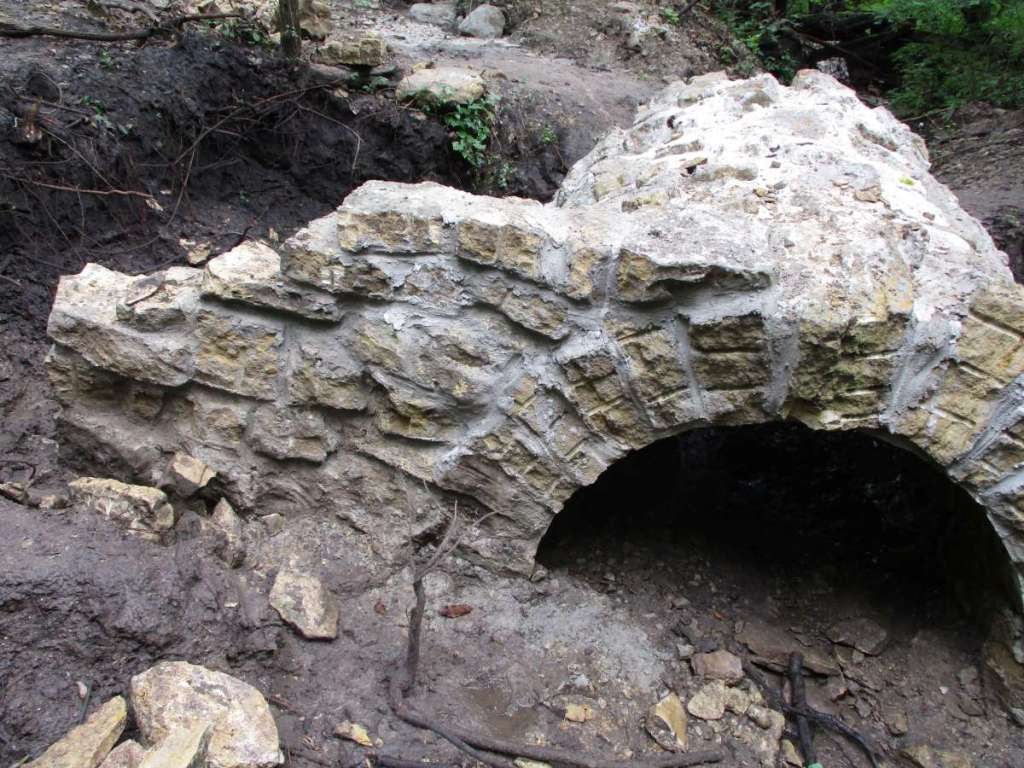
The underside of the arch is coated with mortar on the top which thins out to just sections of mortar at the joints further down the arch. This mortar is the result of the construction process described in last week’s post, and in places the mortar carries the imprints of the wooden form; even the grain of the wood is visible in places. This is a common feature of small rubble arches, and it can be seen on some of Cowley’s stone arch culverts.
Building the Approaches
The approaches were built up to the now freestanding arch. The approaches were purposely built with a tendency to lean inward to resist the outwards push of the fill. Where the stones sloped the wrong way, this lean was achieved by allowing the stones to stick into the fill rather than be flush with the face of the wall.
One approach was finished in time for the Fourth of July, when Camp Quaker Haven celebrated their 75th year of ministry. This was a memorable time, and groups stopped by to see the unfinished bridge. The building of the approach went rapidly, though with several noteworthy incidents.

One incident in the building of the approaches was cutting a strangely shaped stone. The builder prayed for wisdom, and the method for cutting the strange angles required for a good joint became apparent. Part of the process involved how the stone was propped up; by propping the stone in the right place, the stone would be more likely to break where desired. Ironically, afterwards the builder spotted an old camp photo on a bulletin board where a builder cutting a stone for an old camp building was using the exact same method!

Another incident during the construction of the approaches was an unexpected flood, that caught the bridge unprepared, with unset mortar below the waterline. Prayers for the work were made as, if the mortar failed, part of the bridge would have to be torn out with difficulties and relaid. When the flood was over, the mortar joints had been submerged. However, a test of the mortar revealed it had set up strong. And yet, mortar spilled on the face of the stone near the joint had been wrecked by the water.
Scour Protection
A flash flood hit Arkansas City after the arch had been completed. The massive influx of water rushed down the hill, racing under the bridge. The bridge was completely undamaged, but it became apparent that the preliminary scour barrier was inadequate for the job. The water had torn off some of the thin, flat stones used, and, even more alarming, had moved a 15″ by 15″ by 4″ stone that had been left laying in the stream bed 3 feet downstream!
To prevent any chance of damage, a supply of Silverdale stone that had been contributed to the cause was used. Many of the pieces were used to heavily riprap around the approaches, guaranteeing their long-term stability. Most of the rest was used to create a scour pavement under the bridge. This pavement was placed in the mud that washed under the bridge on top of the old scour barrier. Excess mud was removed, and the rest was reinforced with masonry cement to help compact and solidify it. Then the stones were pounded into this mud, and, finally, the whole lot watered down to help set the cement. This creates a hard barrier and also raised the streambed back up to the desired depth.
Filling In
The backing of the bridge on the west approach consists primarily of stones scavenged off the nearby hillside, and on the east side leftover stones from the construction. The backing was built up to about a foot or so below the top of the walls, then dirt was used to fill in along the sides of the bridge and in many places in the top of the bridge.

The final filling of the bridge was done with gravel available from a cutting in the side of the hill. This gravel consists primary of shale, which gives the bridge a nice, solid surface. Once all the approaches were done, the backing placed and the basic filling done, the whole bridge was given a once-over with a bushing hammer to clean up the extra mortar squeezed out. After this, the final stone was laid to even up the cosmetic appearance of the bridge and the final grading was finished. Then the bridge was washed down and was complete!
In Conclusion
The bridge was officially completed August 9, 2025. The bridge was built using traditional methods, and is made of local stone found on the camp. The span is 5 feet, the width 9 feet, and the arch a 15-inch-thick Roman arch. This was an amazing project, and one that the builder won’t ever forget.
Special thanks goes out first of all to the camp president, who found this builder in the first place and has been incredibly supportive throughout the process. Also to the camp director and his wife, who made the builder feel at home at the camp and have helped extensively throughout the project. Finally a shout goes out to all the camp staff of 2025. You know who you are and your contributions, and they are greatly appreciated!

The camp has impacted many lives (including that of the builder!), and the builder hopes and prays the bridge will somehow become a noteworthy part of the camp and its ministry. The Camp Quaker Haven Bridge was a God-given and God-guided project; a sermon in stone. May it be said,
“Faith built that bridge[.]”
Quote from E.W. Hoch, newspaper editor and later Kansas Governor, in a speech given at the dedication of the first major stone bridge in Greenwood County, Kansas. The speech is reprinted in the June 29, 1900, edition of the Walnut Valley Times.
For the previous post on this bridge, see Part 3.
 Stone Arch Bridges