The spandrel wall of a stone arch bridge holds in the fill to create a level roadway. After all, the round curve of the arch alone is far from conducive to safe driving. Hence the need for spandrels. But the spandrel wall has a major structural effect on the arch as well. It serves to hold the arch rigid, and is actually a major factor in how much weight a stone bridge can carry.
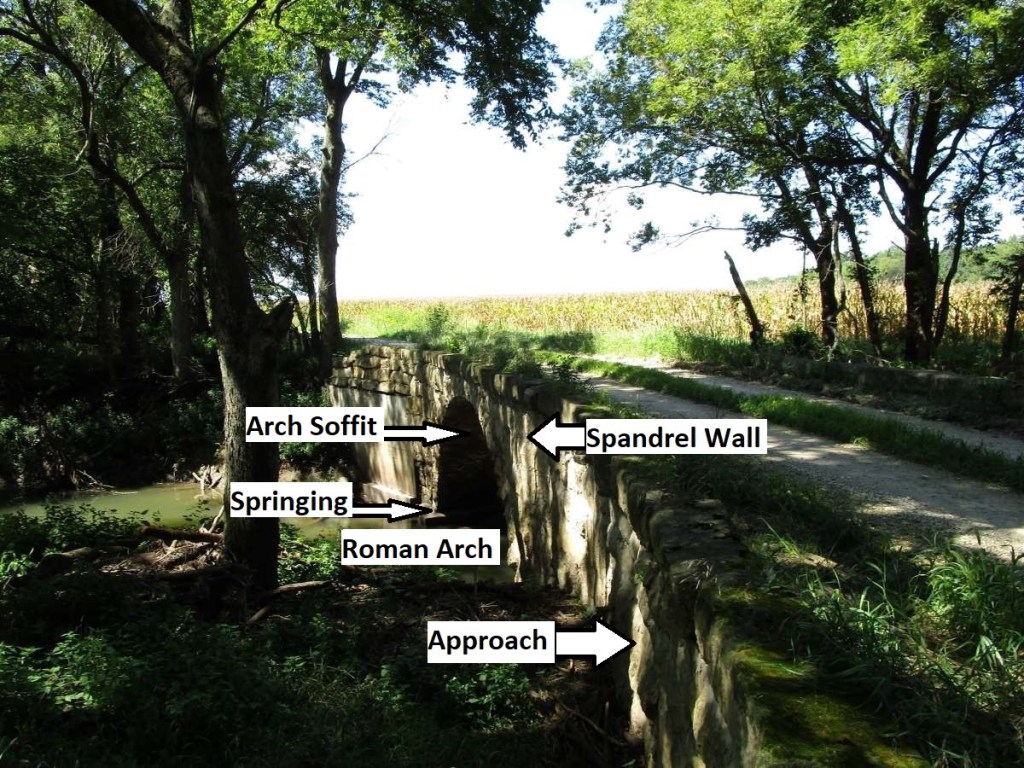
Bracing the Arch
For the sake of discussion, we will assume a spandrel built wide enough to cover the entire width of the arch; in other words, there is no fill, just a large, rigid spandrel wall.
Imagine a spandrel wall which is utterly immovable. It cannot slide, lift, or otherwise be shifted. In this scenario, an arch of tight-fitting stones on rigid abutments cannot collapse short of being entirely undermined or the stones themselves being crushed! Why? Because for an arch to collapse, it has to move. Some part of the arch buckles, while another slides out or lifts up. If the spandrel wall is rigid, the arch cannot move.
Now, the spandrel wall is rarely built up and over the arch. If the top of the arch can lift, then collapse can occur through a relatively uncommon three-hinge failure where the top lifts and the haunches buckle. Incidentally, this type of failure is usually associated with arches that are too thin to begin with. Adding fill on top of the bridge can helps stabilize these structures, for the obvious reason that the weight of the fill will help keep the top of the arch from rising.
Structural Implications
What do the interactions of the spandrel wall with the arch mean practically? The end result is that, while in reality a spandrel wall is not immovable, it still plays a massive role in bracing the arch, and hence ultimate weight-carrying ability. While in the final tally how much of a role the spandrels will play in the strength of a bridge depends on how the spandrels are constructed, the spandrels contributing about one quarter of the total load-carrying ability of a bridge is by no means impossible.
Furthermore, this interaction between the spandrels and the arch is why solid backing is so important. If loose fill is placed between the spandrels, only the ends of the arch are braced. Not only does this make the bridge not as strong as it could be, but it can also lead to interesting structural problems where the sections of the arch under the spandrels break free from the rest of the arch, since the center of the arch can flex while the ends are held fairly rigid.
In the end, the spandrel walls are far more than just a means of holding fill onto a bridge; they are a major structural component of the stone arch bridge as a whole.
 Stone Arch Bridges