The following article was prepared for us by homesteadontherange.com, and covers the little-known history of a stone bridge in New Mexico built by the renowned Kansas stone bridge builder Walter Sharp.
The original Don Gaspar Avenue Bridge of Santa Fe was a double-arch stone bridge built by none other than Walter Sharp of Kansas stone arch bridge renown. These days, a more famous concrete bridge from the New Deal era spans the Santa Fe River on Don Gaspar Avenue. But the old stone bridge once served a vital purpose in the politics, economy, and daily life of Santa Fe, aiding the city in its transition from territorial capital to tourist stop on Route 66.
The Need for a Bridge
Before Don Gaspar Avenue Bridge was built, traffic to and from the territorial capitol building traversed a flimsy structure over the Santa Fe River that gave constant trouble. High waters undermined one of the approaches in April 1891. In April 1901, strong winds blew the railing off and into the street, where it remained for a week before city newspapers objected. By March 5, 1903, a large hole in the floor had appeared and begun imperiling horses.
The last straw came in June 1903, when a severe thunderstorm triggered a flash flood that eroded one end of the bridge. From that point forward, the old bridge on Don Gaspar Avenue was safe for foot traffic only.
However, times were changing. So far New Mexico Territory had built few roads. But in 1903, the territorial legislature appropriated $5,000 for new roads, to be constructed by convict labor for cost savings. A new era had begun in New Mexico road-building.
The Plans
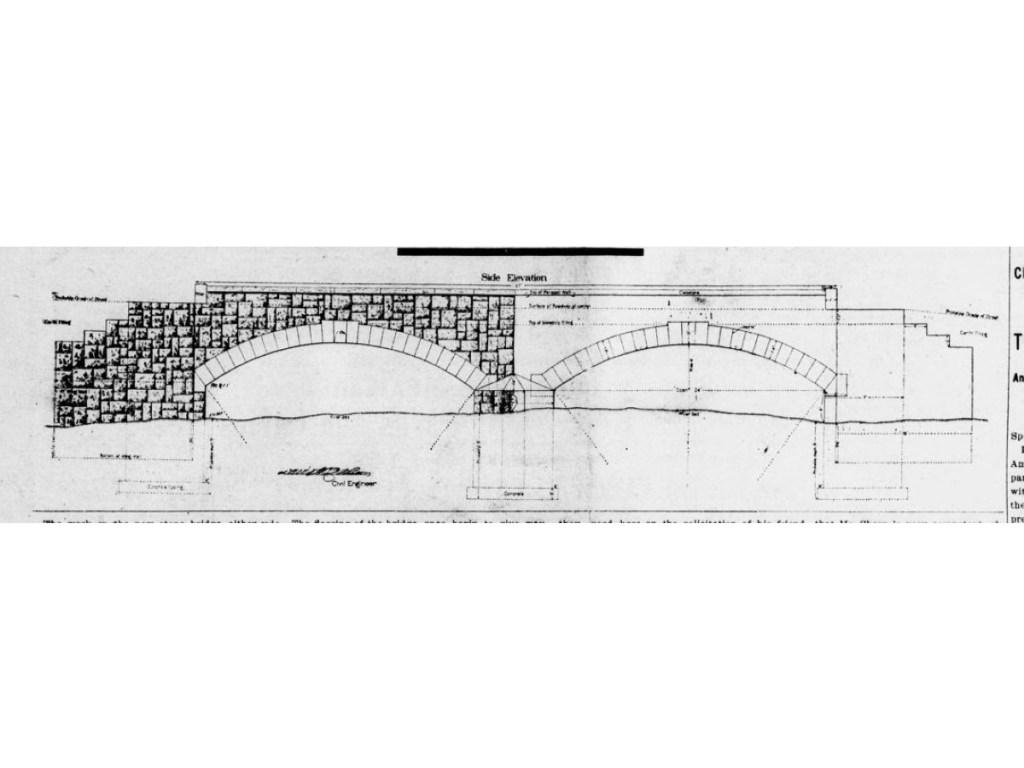
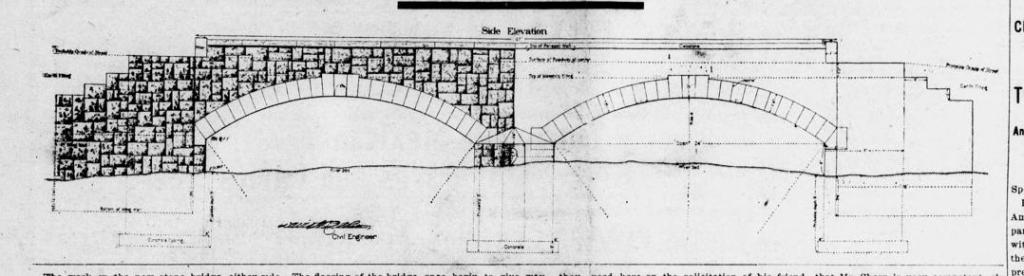
Plans for a new bridge on Don Gaspar Avenue were furnished by David M. White, locating engineer of the U.S. land commission. The bridge was to be a 67-foot structure with two segmental arches, each 24 feet in span and designed for beauty. The centers of the intrados were to be 6 feet above the bed of the river, prompting the Santa Fe New Mexican newspaper to happily remark, “Thus, it will readily be seen that a great volume of water may pass beneath the two arches more in fact than will ever be likely to come down the river.”
To further secure the bridge from floods, the pier would include a starling, or pointed scour apron. The wing walls were likewise intended for the dual purpose of deflecting flood waters and to hold up the street.
On top of the bridge, an 18-foot carriageway was provided, with 5-foot sidewalks on either side, separated from vehicle traffic by retaining walls. The roadway was to be constructed by topping the masonry with a layer of gravel 8 to 11 inches thick. On top of the gravel, two inches of sand were to be spread, with brick flooring to be set into the sand.
The provisions for draining the bridge of rainwater were considered novel:
The roadway of the bridge is planned to have a slight slope from the center to either side and the walks will drain into the roadway. The plans also make the bridge slope slightly to the north. Thus when it rains, the water that falls on the roadway will run to the sides while that from the walks will flow into the roadway and the whole of it will immediately drain off at the north end of the bridge. Bridges of a similar build are usually drained by means of piping which runs down through the arches, but the plans in these specifications are original with the designer and are an improvement over the pipes.
Why the writer for the Santa Fe New Mexican thought that the typical method for draining a stone arch bridge involved pipes through the arches is unclear.
Overall, the bridge was to be primarily constructed of limestone. However, sandstone was to be used as an accent on the arch stones and the coping and pillars of the parapet walls. White further specified that the builder use only the best grade of American Portland cement manufactured in Iola, Kansas, by the Iola Portland Cement Company (headquartered in St. Louis, Missouri).
The Contract
The contract for the project was awarded to Walter Sharp on July 30, 1903. Walter Sharp was then in New Mexico building a bridge at Raton at the urging of the county clerk. Hearing that a contract for another bridge at Santa Fe was to be let, Sharp decided to bid on this new project, too, since he was already in the area. His bid of $4,600 was the lowest of the three received, the high bid being $10,460.
Half of the $4,600 was to be paid on completion, the other half on the first of July of the following year. Originally, newspapers reported that dividing the payment into installments was intended to provide enough time to raise funds for the structure. Later, however, the papers stated that the purpose in the delay was to confirm that the bridge would stand for at least six months.
Click here for the next part of this series.

