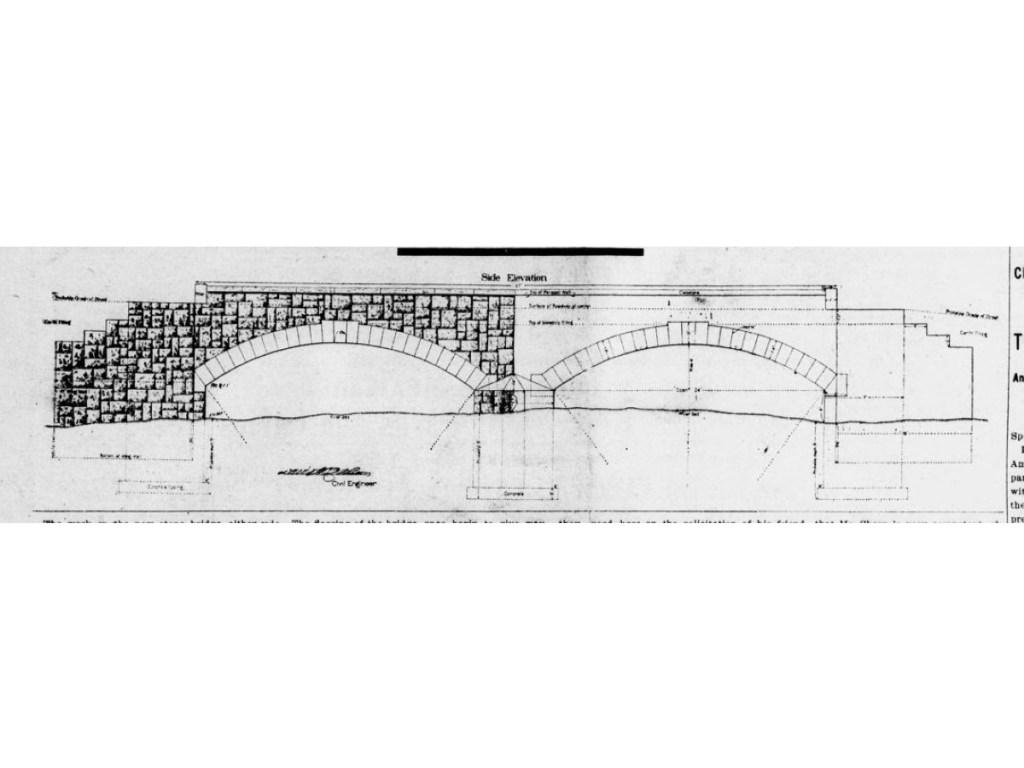
The following article was prepared for us by homesteadontherange.com, and is the second part in a series that covers the little-known history of a stone bridge in New Mexico built by the renowned Kansas stone bridge builder Walter Sharp.
Mañana
Walter Sharp arrived at the work site about a month later, bringing his family and his quarry foreman, William Kellett of Marion, Kansas. Work officially began on Monday, August 31, 1903. The first tasks were excavation and setting up derricks.
The plan was to push construction as quickly as possible so that the bridge would be complete in about three months. Initially, the local press was enthralled:
Foreman Kellett is getting out magnificent stone blocks for the Don Gasper avenue stone bridge. He has the work well systemitized and it is progressing nicely. The bridge will be completed within contract time and will be a structure of which the city will be proud.
However, Sharp was still finishing the bridge at Raton, and he had also taken a job to repair the buttresses on the nearby capitol building at the same time. Three months soon provided to be insufficient for the task. The delays prompted the Santa Fe New Mexican to indulge in a little mockery in mid-November:
“What is the meaning of that word ‘ma[ñ]ana’ I hear on the streets so much?” said the new comer seating himself beside the old timer, who was sunning himself in the plaza.
“Ma[ñ]ana,” answered the old timer, relighting his pipe, “is a Spanish word meaning tomorrow. It is also applied to any indefinite time in the future. When we speak of the ma[ñ]ana policy it is synon[y]mous with the policy of procrastination. For instance one would say the Don Gaspar Avenue bridge will be completed, ma[ñ]ana.”
“O, I see,” said the other, “and you will have your brick sidewalk along Palace Avenue finished, ma[ñ]ana.”
“Exactly,” said his companion, “and the pavement along San Francisco Street will conform to an established grade, ma[ñ]ana. We will get a new school house that will be somewhere near adequate to our needs, ma[ñ]ana. We will have a better sewerage system ma[ñ]ana. We will get statehood, ma[ñ]ana and when a man strikes you to borrow a five or a ten, always answer him, ma[ñ]ana.”
Nevertheless, the report on November 16 was that Walter Sharp had set a new deadline of January 1. The abutments and pier were completed, and the stonecutting for the arches was progressing rapidly.
On November 23, the Santa Fe New Mexican quoted Walter Sharp:
All of the stone for the archways of the new Don Gaspar Avenue bridge will be on the ground this week…. One of the two archways will be completed this week, and work on the second will be pushed to an early completion. If no further setbacks are brooked, the bridge will be open for traffic by January 1, and will be one of the finest bridges in the Territory.
By Christmas Eve, the New Mexican was able to report, “Contractor Sharp is pushing the work on the Don Gaspar Avenue bridge very rapidly and the structure will be completed by the first of the year.”
Reports from the Work Site
The same article also noted:
Superintendent H. O. Bursum of the territorial penitentiary, is certainly entitled to the thanks of the citizens of Santa Fe for furnishing teams and convicts for the work of filling in the approaches to the Don Gaspar Avenue bridge. Had it not been for his timely aid in the matter this work would have had to be done at the expense of the county and would have cost a good bit.
However, a cinder bed was laid over the approaches, which evidently did not suit Sharp. He provided some leftover lumber to the city marshal in exchange for a layer of adobe and gravel over the cinder.
Unfortunately, the bridge was not destined for completion on January 1, either. On December 31, the Santa Fe New Mexican reported:
The supporting timbers under the archways of the Don Gaspar Avenue bridge were removed today and work on the parapet walls is progressing. Barring bad weather the bridge will be formally turned over to the county commissioners by Contractor Walter Sharp two weeks hence.
A meeting of the board of county commissioners on January 4, 1904, ordered that Walter Sharp be paid half of the contract price: $2,300. The rest was retained for the time being, with the county board to make the final acceptance in July. (An extra $1,140 was paid out in February to cover expenses incurred in widening the bridge beyond what the original plans had dictated.)
Nevertheless, the work was still not quite complete at the time of the first payment:
Work on the Don Gaspar Avenue bridge is being pushed, and Contractor Walter Sharp expects to have it completed within two weeks. The two south wing walls have been completed, and work was started Saturday on the two north wing walls…. Work on the parapet walls is also being rushed, the west wall being already up, and the east one nearing completion.
Even after the wing walls were complete, work on the approaches dragged on. On January 12, the Santa Fe New Mexican reported that four convicts were at work on the southern approach under Sharp’s direction and that the work was progressing rapidly. Unfortunately, prisoner 1701, otherwise known as James Smith, escaped. Hounds were promptly set on his track and a description posted to the front page of the New Mexican. By the end of the week, however, it was reported that Smith “made good his escape.”
A Handsome and Valuable Improvement
As the project drew to a close, the New Mexican countered its previous ridicule with the compliment that the bridge “when completed will be a handsome and valuable improvement.…Mr. Sharp is industrious, energetic and capable, and deserves the success and esteem which he has won both as a citizen and in his chosen vocation.”
The final payment was duly made and reported in July 1904:
The total cost of this bridge is as follows: Contract price of Walter Sharp, contractor, $4,600; cost of extras, as widening of the bridge five feet, increased size of wing walls and other necessary changes, not provided for in the original contract, $1,100; to D. M. White, engineer, for plans and services, $460. Total cost, $6,160.
Newspaper writers and city official alike tended to regard the price of the plans as being a little high.
Click here for the next part of this series.
Click here for the previous part of this series.

