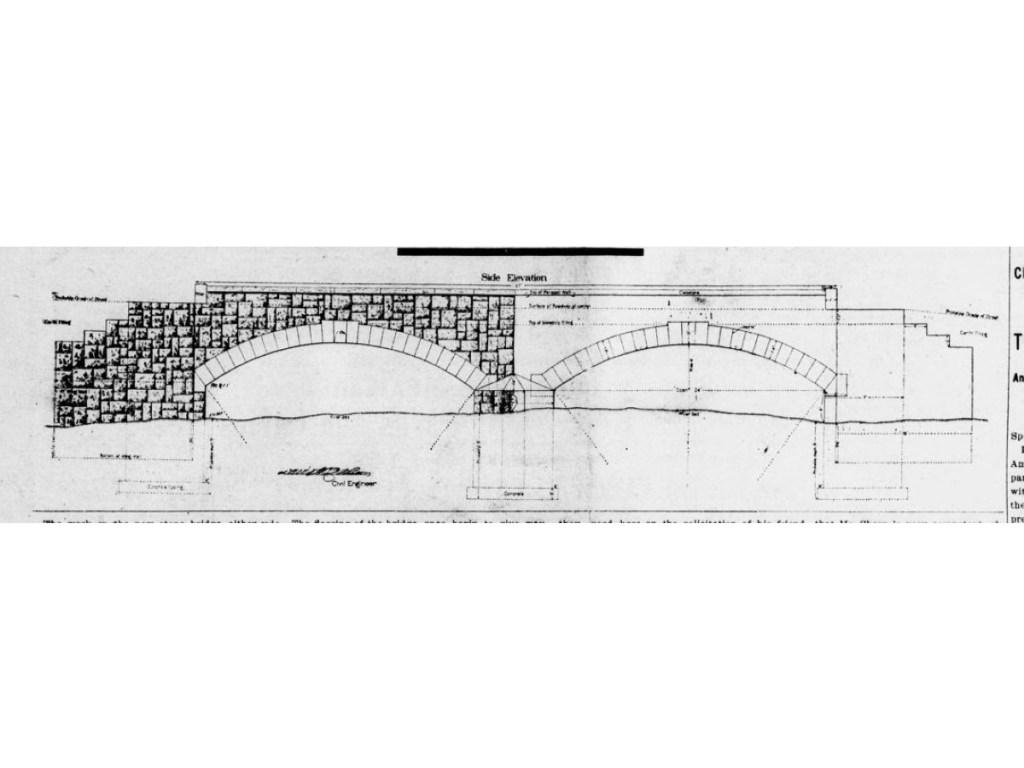
The following article was prepared for us by homesteadontherange.com, and covers the little-known history of a stone bridge in New Mexico built by the renowned Kansas stone bridge builder Walter Sharp.
The Flooding Begins
Fall rains quickly put the Don Gaspar Avenue Bridge to the test. The Santa Fe River began flooding in early August. Some large pieces of timber and several tree branches were washed up against the pier of the bridge, along with leftover soil and debris from construction, forming a dam across the river. This event was hailed with nervousness by the flood-wary residents:
This is a dangerous condition and should another large amount of water be carried down the river within the next few days, as the result of a cloudburst or heavy rains in the ca[ñ]on east of town, this dam and obstruction may become very dangerous and injurious to the bridge structure. The city authorities should take immediate steps for the removal of this dam, timber and dirt so as to give the water free flow, thus obviating all possible danger of a break in the masonry of the bridge.
As the rains continued through the month, the river widened its channel considerably, threatening buildings and other property between College Street and Don Gaspar Avenue. To protect these structures, and to prevent the Santa Fe River from digging a new channel around the bridge, city officials decided to build breakwaters on both sides of the river. The north breakwater was to be constructed by the city, while the south breakwater was to be built by owners of the adjoining properties. The superintendent of the territorial penitentiary pledged to provide labor for the project if the city would provide material and guards, which offer was promptly accepted. The convicts were put to work at once hauling stone and brick to the work site. Nevertheless, the construction of the breakwaters would take some time, and the citizens continued to monitor the river rather uneasily.
Meanwhile, the gutters along Don Gaspar Avenue began to overflow due to a lack of maintenance. This overflow started to eat away at the approaches of the bridge.
Damage
With the breakwater incomplete and the bridge approaches damaged, the scene was set for disaster. From 4 AM on September 29 to 4 AM on September 30, 2.51 inches of rain fell. Peak flooding on the Santa Fe River occurred at 3 AM on the 30th. The river severely eroded its south bank. Several wooden bridges upstream from Don Gaspar Avenue were swept away by the floodwaters. At the stone bridge, the wing walls were undermined and the soil in the approaches washed away. An onlooker was very nearly swept away when the soil near the wing of the north approach collapsed into the river. The bridge was completely cut off from the street at both ends—but was otherwise undamaged.
The Santa Fe New Mexican took the opportunity to remark:
The damages to the Don Gasper Avenue bridge, which consisted of the loss of two of the wingwalls and the approaches to the bridge, was caused by the failure of the property owners to build break waters and of the officials who had promised to clean out the channel of the river to perform their agreement.
County Commissioner Arthur Seligman, who was instrumental in securing this improvement for the county, stated to a representative of the New Mexican this morning that he had received promises fro[m ]the penitentiary officials that they would remove the superfluous stone and plough out a channel in the river which would lead directly to the arches. This had been promised when D. M. White, who was the engineer in charge of the construction of the bridge, had called his attention to the condition of the river channel above and under the bridge. “If the city and property owners had built breakwaters along both banks in compliance with the city ordinance, and the channel had been cleaned out in front of the bridge the large volume of water would have passed under the arches of the Don Gaspar bridge with no damage at all,” said Mr. Seligman. “At the highest point of the river, the water did not reach the spring line of the arches and there was plenty of room for all of it to pass comfortably through. Some of the property owners had built breakwaters and others had neglected to do so. This caused the river to assume an ‘S’ shape and allowed the water to wing in behind the wing walls. The damage will only amount to $270 on this bridge.…”
Walter Sharp was also called upon to comment, and he obliged by stating his confidence in his work:
Contractor Sharpe, who built the Don Gaspar Avenue bridge asserted that he was sure that no volume of water that possibly could come down the river would injure the Don Gaspar Avenue bridge proper, but that unless suitable breakwaters were had along the banks above it and the channel of the stream was kept clean and deep, the approaches to the bridge would suffer. This is fully born[e] out by what occurred last night at the bridge.
That same morning, men set to work to repair the damage. Logs and piles of brush wired together were thrown into the holes in the banks. In the afternoon, the damage was more completely repaired by a work gang of 25 convicts, the newspapers noting that “much work was done by them in the water, the men working hard and willingly.”
The breakwater was not completed until May 25, 1905.
Click here for the next part of this series.
Click here for the previous part of this series.

