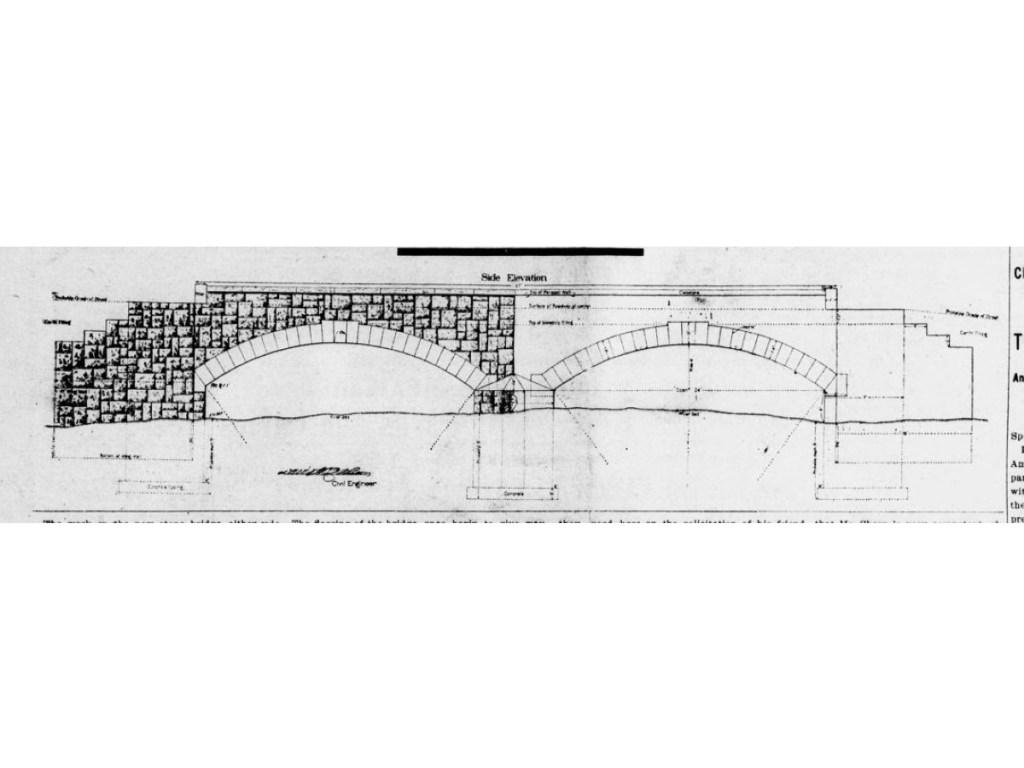
The following article was prepared for us by homesteadontherange.com, and covers the little-known history of a stone bridge in New Mexico built by the renowned Kansas stone bridge builder Walter Sharp.
The Good Roads Movement
Despite the fact that the Don Gaspar Avenue Bridge served Santa Fe (albeit far more quietly) for the next few decades, changes were not far away, thanks in part to the Atchison, Topeka & Santa Fe Railroad. In an effort to gain a leg up on the competition, railroad officials began a promotional campaign around 1900 to gain more traffic by encouraging tourism. Through traveling photo galleries and calendar giveaways, the Santa Fe Railroad offered visual presentations of the rugged beauty of the Desert Southwest, drawing curious sightseers from across America. The rise of Harvey Houses and easy-to-use cameras about this time further boosted tourism.
To accommodate the new visitors, automobile tours quickly became an attraction in Santa Fe, with the natural result that a demand for better roads soon followed. A Territorial Good Roads Association was established in 1909, accompanied by local Good Roads associations of various dates. These organizations conducted promotions and even built small sections of road in hopes of assistance from state and local governments. Some measure of support was secured when New Mexico achieved statehood in 1912 and the State Highway Commission was established.
Federal funding for road improvements became available under the Federal Aid Post Road Act of 1916. A total of $75 million would be available over the next five years. However, the funds were to be used only for construction, not maintenance, and the roads had to conform to improved standards. To ensure oversight, the federal government would not provide funding unless the state first created a state highway system overseen by a State Highway Engineer.
Route 66
With the federal government’s entry into road improvement, organization of a federal road system became a natural next step, especially as during World War I the nation witnessed firsthand the importance of good roads for moving troops and supplies. But creating a federal road system need not be daunting— implementation would be easy if the new system relied on state and local roads already constructed.
In 1925, the United States Secretary of Agriculture appointed a committee of state and federal highway officials to organize a national highway system. The committee set to work to pick through a patchwork of dirt and gravel to splice together something coherent and duly numbered.
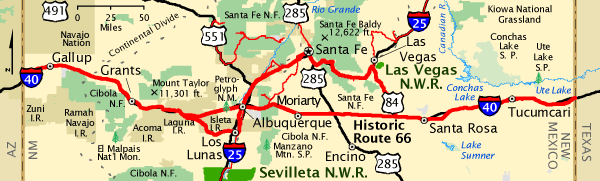
Accordingly, in 1926, Route 66, stretching from Chicago to Los Angeles, arrived in New Mexico, swinging northwest across the state in a lengthy curve to hit Santa Fe, then exiting the town in a series of terrifying switchbacks before turning back south toward Albuquerque. With the automobile by this time commonplace, tourists could now easily drive themselves to Santa Fe if they chose. At the same time, Route 66 also became the preferred route from Chicago to the Pacific for the emerging trucking industry.
While originally Route 66 followed College Street (now Old Santa Fe Trail) just to the east of Don Gaspar Avenue, the stone arch bridge still received an increase of traffic. Garages and gas stations sprang up around the bridge to accommodate the influx of visitors. The narrow roadway over the arch was beginning to become an issue, and the city officials evidently had acquired no more relish for cleaning debris off the bridge pier than they had possessed 25 years before.
New Mexico residents viewed these changes with mixed reactions at first. While the economic boom along Route 66 was self-evident, some writers noted concerns that smaller towns, smaller roads, and smaller businesses would suffer as a result. However, these concerns were eventually swept away by the pressing demands of the Great Depression. Displaced families from the Dust Bowl regions poured over the route to find new lives in California, immortalizing Route 66 as the path to hope and prosperity. At the same time, Franklin Delano Roosevelt’s administration held out the promise of infrastructure improvements as a means of creating jobs. And an obvious candidate for such improvement was Route 66.
The Realignment
In early 1926, Democratic Governor of New Mexico Arthur T. Hannett had ordered a new road grade cut from Santa Rosa to Moriarty, a route that bypassed the long curve to Santa Fe and routed traffic through Albuquerque instead. The Santa Rosa Cutoff saved 107 miles of distance for travelers, and it bypassed the hair-raising switchbacks just outside of Santa Fe. However, the prevailing opinion was that Hannett’s actions were politically motivated. Hannett had just lost his bid for reelection and may have been using his remaining time in power to deliver an economic blow to the Republican stronghold of Santa Fe.
Although the rerouting of Route 66 was not complete until 1937, a steady stream of traffic bypassing Route 66 for the new Santa Rosa Cutoff, plus some enthusiastic promotion efforts from Albuquerque, made it clear which direction the winds were blowing. In 1932, the Bureau of Public Roads accepted the request of the State Highway Commission to realign Route 66.
But tourists and truckers would still need a way to access Santa Fe from the new route. In 1933, the National Recovery Municipal (NRM) program was established under the auspices of the New Deal. $400,000,000 were made available to the states for the highway repairs, improvement, and construction. New Mexico received nearly $58,000 of the funds. The state allotted part of this money toward rerouting U.S. Highway 64 over Don Gaspar Avenue to reconnect Santa Fe with Route 66. Plans for a new concrete structure with a 41-foot roadway and a 15-ton capacity were drawn up to take the place of the stone arch bridge.
Great pains were taken to design a structure reflective of Spanish influence, and the new Don Gaspar bridge served as a pattern for a great deal of subsequent construction work across the city. Nevertheless, this achievement of the New Deal cost Santa Fe its locally funded and still sound stone arch early in 1934. The Don Gaspar Avenue Bridge may have been floodproof, but it was no match for federal aid programs — or irate politicians.
Want to learn more about Walter Sharp? Check out our book!
Click here for the previous article of this series.
Sources
Albuquerque Daily Citizen. “Storm at Santa Fe.” June 17, 1903. Chronicling America, Library of Congress.
Kammer, David J. “Historic and Architectural Resources of Route 66 through New Mexico.” National Register of Historic Places Registration Form. National Park Service, 1993. npgallery.nps.gov/GetAsset/caae0289-563b-48ee-8c92-38d62d7f5ec0.
Las Vegas Daily Optic. “Havoc Created by the Flood at Santa Fe.” October 6, 1904. Chronicling America, Library of Congress.
National Park Service. “Don Gaspar Bridge.” National Register of Historic Places Registration Form. 2002. npgallery.nps.gov/NRHP/GetAsset/NRHP/02001163_text.
———. “New Mexico: Road Segments.” Updated June 6, 2022. www.nps.gov/places/new-mexico-road-segments.htm.
New Mexico Museum of Art. “History: Route 66.” Accessed April 22, 2026. online.nmartmuseum.org/nmhistory/opening-the-west/route-66/history-route-66.html.
New Mexico Tourism Department. “Route 66 History.” Accessed April 22, 2026. www.newmexico.org/route66/route-66-history/.
Research Route 66. “Description and Historic Context for Pre-1937 Highway Alignments.” Accessed April 27, 2026. researchroute66.org/new-mexico/.
Santa Fe New Mexican. “Breakwater Is Inspected,” May 26, 1905. Chronicling America, Library of Congress.
———. The College Street Bridge. July 11, 1904.
———. Commissioners Meet. January 5, 1904.
———. Convict Escapes,. January 12, 1904.
———. County Commissioners. February 5, 1904.
———. The Escaped Convict Smith. January 16, 1904.
———. Heard in the Hotel Lobbies. November 23, 1903.
———. Minor City Topics. April 11, 1901.
———. Minor City Topics. March 5, 1903.
———. Minor City Topics. December 24, 1903.
———. Minor City Topics. December 31, 1903.
———. Minor City Topics. January 11, 1904.
———. Minor City Topics. January 12, 1904.
———. Minor City Topics. August 8, 1904.
———. Minor City Topics. August 30, 1904.
———. Minor City Topics. September 24, 1904.
———. Minor City Topics. September 30, 1904.
———. New Bridge Across the Rio Santa Fe. September 1, 1903.
———. Official Proceedings. September 11, 1903.
———. Official Proceedings. May 12, 1905.
———. Personal Mention. September 21, 1903.
———. Personal Mention. September 25, 1903.
———. Personal Mention. October 7, 1903.
———. Personal Mention. October 15, 1903.
———. Round About Town. April 9, 1891.
———. Thoughts on Things. November 14, 1903.
———. Two of the Handsomest and Most Substantial Bridges. April 10, 1905.
———. Walter H. Sharp. January 13, 1904.
———. Work on New Bridge. November 16, 1903.

