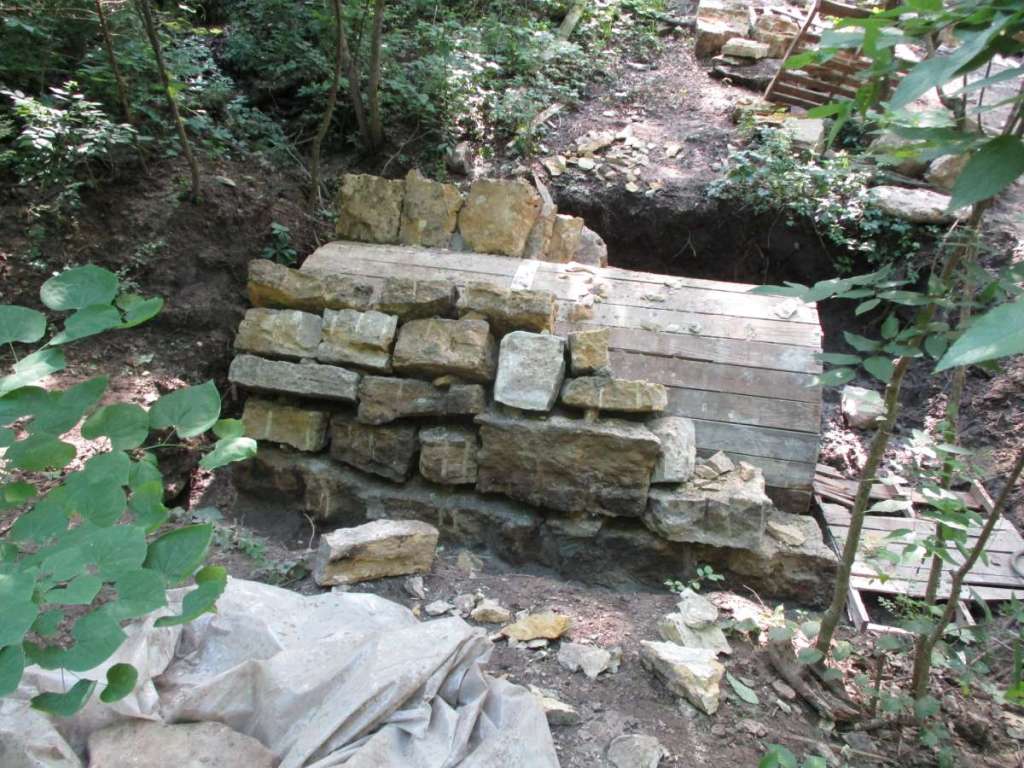
Laying the arch stones is one of the most critical parts of building a stone arch bridge. These stones need to be laid with the tapered end down against the form (and almost all stones are naturally tapered in some fashion, even if entirely untrimmed) and then need to be propped up to the proper angle if rubble masonry is used.
The proper angle for the arch stones is easily measured against the arch form; the stone should rest 90 degrees relative to the section of the form it is placed on. With practice, this can be done by eye. For large forms, a square such as is used in carpentry can give a good approximation. If a Roman arch is being built, a string can be hooked to a screw or nail located at the center of the bottom of the form. If the stones are truly radial, the string should pass parallel to the joints between the arch stones. Some error is allowable. For a segmental arch, if there is room below the form, a board can be attached to the form that sticks down far enough to reach the radius point of the circle segment the arch describes and a string attached to this board.
Another difficulty when laying arch stones arises as you near the top of the form: namely, the stones tend to tip over easily. For large blocks , this is less of a problem, but for thin slabs, this tendency can become very annoying. If the stones are bedded in mortar, this is less of a problem once the mortar sets up, but until thin will be a problem to consider. For mortarless construction, even more care is needed. A board can be temporarily mounted to the arch form to hold the stones in as needed, and then removed before the next course is added. In either case, cutting a correct curve into the bottom of the stones will help significantly, or, at the very least, using shims underneath to hold them in place better.
Climbing the form of a big arch while carrying stones can be difficult, so some planning will be required. If necessary, one option is to properly bed and set the lower stones in the arch and then start building the spandrel walls from each side and filling between them to create a ramp from which to work. Regardless of how the stones are lifted up onto the form, it is critical to build both sides of the arch up simultaneously. Otherwise, the uneven loading can lead to a dangerous situation, as it strains the form unnecessarily.
 Stone Arch Bridges