Finding out how serious damage to stonework is, then determining the best way to repair it, is an important part of maintaining a historic stone structure. Frequently there are several possible ways to make repairs. When deciding how to make an effective repair, it is important to understand the forces at play and what caused the damage in the first place.
Arch Damage
Arch damage is generally more serious than any other damage to a stone bridge. After all, the arch is the main component of the bridge. Repairing an arch can be a delicate procedure (after all, almost all the weight of the entire structure is carried by the arch) and frequently requires shoring of the arch to prevent arch failure during the work.
Example 1

In the photo above, there is a very decided crack that has detached the front part of the arch from the main body of the arch barrel. A quick look shows that the wall behind the arch has buckled, and is probably responsible for taking the front part of the arch with it. Failure to repair would eventually lead to collapse of the front part of the arch.
A thorough repair would require the damaged portion of the arch to be dismantled as well as the wall behind it. An arch form would need to be erected, which would extend partly into the remaining portion of the arch barrel. Then the arch could be repaired, interleaving the new portion with the old, cutting out small pieces of the old as needed to ensure a good bond. The damaged wall would also need to be rebuilt, but to prevent another failure, the new wall would need to be built thicker than the old, the extra thickness being hidden under the roadway. This is easily done by making all but the final course thicker, then laying the final course of stonework to the original width so that the alteration is not visible. Another solution would be to keep the wall the original thickness, but replace all the fill with solid stone or concrete. This would help prevent other spandrel walls from failing as well.
Example 2
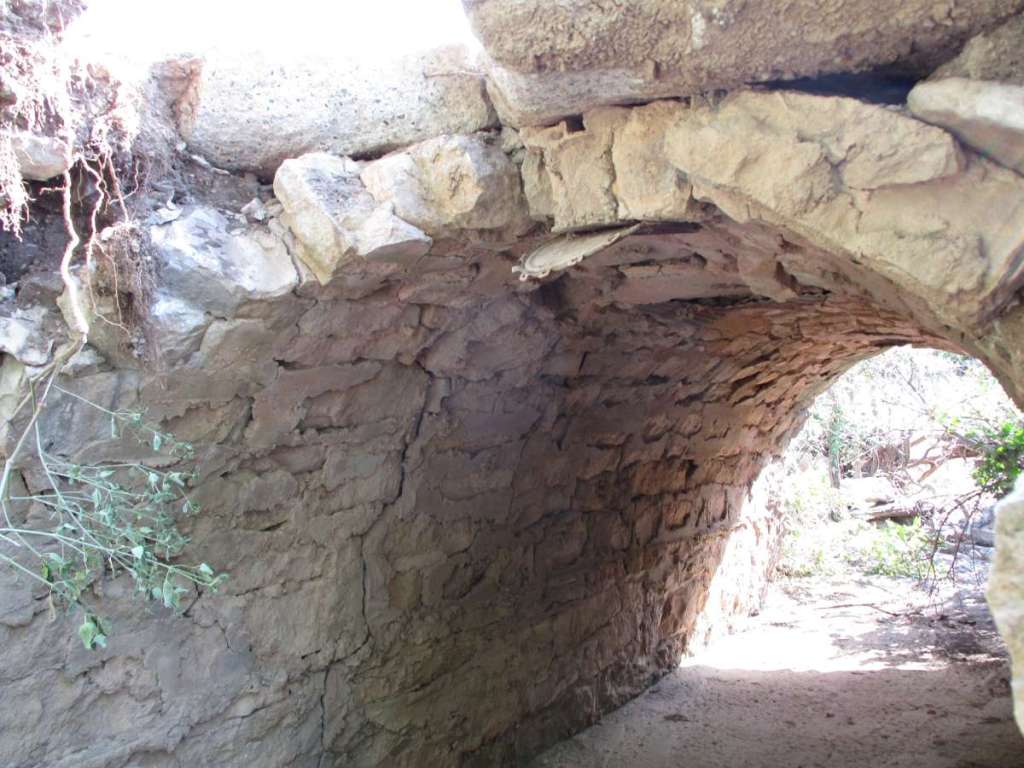
On the culvert above, the front face has collapsed, and several stones have punched through the arch. An examination of the structure reveals that the arch is incredibly thin, so the failures broadly were caused by overloading. Failure to repair would lead to further damage, though of course, the road being closed as a result of the collapse is a major functional problem.
A repair of damage of this sort would require a temporary form to be erected, and the collapsed portion of the arch rebuilt, interweaving the new with the old. Where stones punched through, the fill would need removed and new stones added as needed; the spandrel wall will need rebuilt over the missing portion of the arch. Old repairs with concrete would probably be best left in place, as removal would threaten the integrity of the structure. To prevent further damage, the mortar would need repointed, ensuring integrity of the joints. Since the arch is so thin, increasing the load-carrying capacity by adding a thick reinforced concrete slab on top of the bridge to distribute loads and add dead weight to the arch would be highly beneficial to prevent further damage.
Example 3

In the arch shown above, several face stones have fallen out. The cause is loosening of the mortar joints (the mortar has all washed out) most likely coupled with impacts. Failure to repair could gradually lead to further damage, though the structure appears to be reasonably stable, if cosmetically unappealing.
Repairing the arch would simply consist of collecting and resetting the stones in good mortar beds; only minimal formwork would likely be required. The arch would then need repointed, and the spandrels rebuilt.
Conclusion
The examples above are intended to show the line of reasoning and work required to repair the damage to the structures. As always, the cause of the original problem is important to ascertain. This done, the work should be done such that the root cause of the trouble is rectified and the damage repaired, while minimizing alterations to the appearance of the structure.

