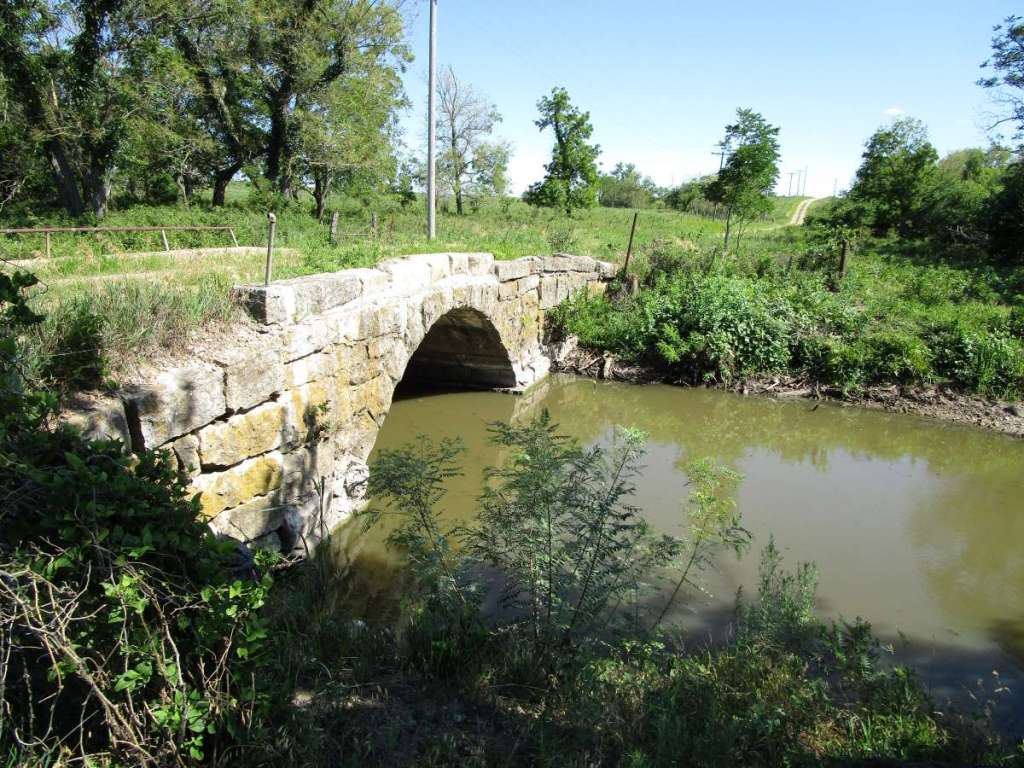
The Flint Hills of Kansas feature numerous stone arch bridges made of the materials of the hills themselves. Though all the major Flint Hills counties built stone arch bridges in some fashion, Butler and Cowley counties took the lead. In fact, Butler County made the stone bridge a common sight, and Cowley County copied Butler when they began building their own.
Butler and the Stone Arch Bridge
Butler County chose a cautious approach to stone bridge building. After Fairview Township successfully built some stone culverts, R. W. Robison, of Whitewater Falls Stock Farm fame, began to advocate for the construction of a real stone bridge. This coupled with constant support for stone bridges from major newspapers in the county prompted Butler to build its first major stone arch bridge: a 20′ structure north of Towanda. This bridge was a success, so what followed was a double-arch bridge near El Dorado. This bridge succeeded, at least at first, so Butler began building stone bridges as a regular thing. However, Butler was content to build stone bridges for up to medium-sized bridges.

By 1899, Butler County had brought the local steel bridge trust under control, for the county commissioners made it plain to the representatives of various steel bridge companies that, if they wanted to continue business in Butler, they would have to give the county fair prices. Otherwise, the county would put in stone bridges instead. The result was Butler could purchase a steel bridge at a considerably lower price than other counties, so the county never found a need to build massive stone bridges. Though steel bridges were still built in Butler (later superseded by concrete bridges), the stone culvert and even modest stone bridge spans became quite common throughout the county.
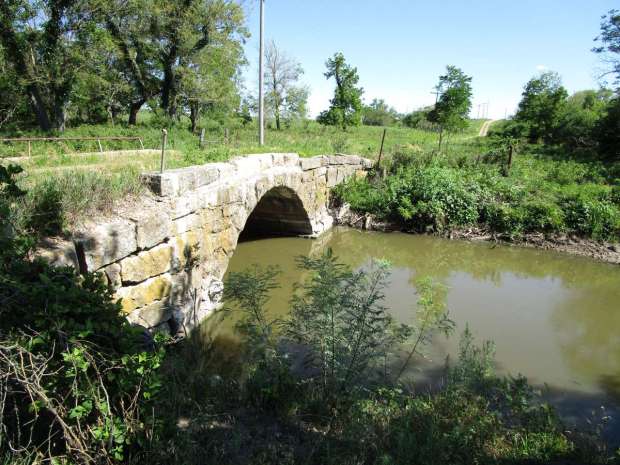
As a result of the success of these permanent structures, Butler’s stone bridge fame was told throughout the state, and soon commissioners of other counties visited Butler to see how Butler County stone bridges were built. In the final tally, evidence suggests that no Flint Hills county built as many stone bridges as Butler County; Butler County also had hundreds of stone culverts built in addition to the stone bridges. And even to this day, no county in the Flint Hills has as many true stone bridges as Butler. As Walter Sharp, a famous Kansas stone bridge builder, put it:
“The county commissioners of Butler county, Kansas, estimate that they save from $500 to $700 yearly on the stone bridges erected over the steel structures, in repairs alone, and this is a very considerable item. To show you how well the stone bridge is thought of in that county, no wooden culverts are now put in, even on the country roads. They are all built of stone and the township boards have built almost 300 of them. Butler county, Kansas, is in the lead in stone bridges and culverts and in years to come in this respect its fame will go abroad. The county will have nothing else.”
Walter Sharp, “For Stone Bridges Now,” The Kansas City Star, October 4, 1905.
Enter Cowley
Cowley County became famous for its stone bridges, even more so than Butler County, though Cowley took the idea in the matter from Butler and did not, perhaps, build as many bridge as Butler. However, what the Cowley bridges may have lacked in quantity they made up in size. Cowley County was plagued by the steel bridge trust. They soon learned of the work Butler and Greenwood counties (the commissioners of which county had toured Butler in 1899 and decided the stone arch bridge was what they needed) and heard that the stone arch bridges could be built affordably. As a result they toured the stone bridges of Butler and Greenwood and soon built the first of their famous stone bridges: a modest 36′ span north of Winfield. Though there was some resistance at first to the building of stone bridges in Cowley, before long the stone bridge became the norm in Cowley. And unlike Butler County, Cowley County began to use stone bridges for everything, even massive structures like the quadruple-arch Dunkard Mill Bridge over the Walnut River.
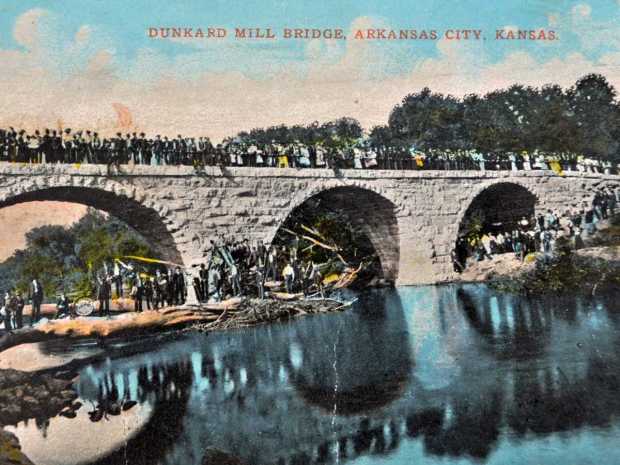
In Cowley the stone bridge meant a lot, especially along Grouse Creek. These picturesque bridges readily survived floods, and were built with pride by the local farmers, who frequently had a large celebration at the completion of one of these structures. The stone bridge in Cowley became almost synonymous with prosperity, community, and goodwill. The stone bridge continued to be a mainstay in Cowley even after concrete came into its own, though more and more concrete bridges and fewer and fewer stone bridges were being built. At last, by the 1920s, state regulations forced the abandonment of the stone arch bridge that had served the county well throughout its developing years, though a few latecomers were built such as the 1935 Dr. Snyder Bridge near Arkansas City.

Cowley County still is famous for its stone bridges, though time has been rather hard on them. That said, there are quite a few stone bridges to see in the county and any number of stone culverts left. Those who wish to see the Cowley stone bridges may find our Stone Arch Bridges of Cowley County, Kansas page helpful. Also check out our Stone Arch Bridges of Butler County, Kansas page to see the smaller but plentiful bridges of this Flint Hills county.
 Stone Arch Bridges