Many times in stonework stones will need to be leveled a little bit for a better fit and the ends lightly trimmed. True, you can shim the rock until it is steady, but in many cases a very basic trimming will make a vast difference in the stability of the stone in question. This will make the structure more durable and vastly simplify the shimming afterwards.
Sharp Projections
Sharp projections on a stone are rather easily knocked off with a blunt hammer. The bricklayer hammer works best for smaller rocks with small projections, while larger rocks with larger projections will require something larger; gauge the size of the hammer by how much force is needed to make an impression on the stone. If you have to whack the rock very hard, you are using too light of a hammer. For medium-sized rocks (200 – 500lb range), we found a 4 lb sledgehammer works wonders. The trick here is the angle at which the hammer is held; different angles will result in different cuts. A sharp corner is easily knocked off by hitting it dead on. To fine-tune an already sloped surface, you may need to aim your blows slightly into the rock itself. (See Working With Stone Part 3: Hammer Cutting for more details.)

Surface Bulges
Nothing is more annoying than a stone with a surface bulge. This is a slight domed surface to the rock that makes it anything but stable when laid. Removal of this type of projection in a stone is a little more involved than for a large projection, simply because a blunt hammer cannot dig in enough to grab a break free the projection. For very minor projections (or even large projections in sandstone) the sharp end of a bricklayer’s hammer can be used to literally hack away at the defect. For a large, rounded surface, though, more care is needed.
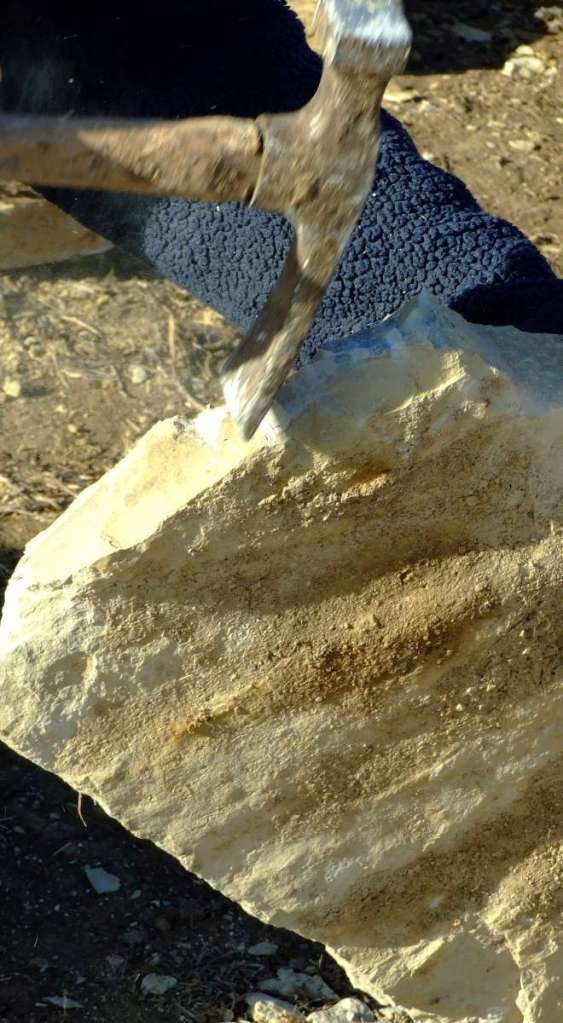
Large areas of rock can easily be smoothed with a bushing hammer…assuming the stone in question is limestone. If you are tooling limestone, use the bushing hammer. If you are not working with limestone, use a pointed chisel to every so often create a small hole in the surface of the stone.

Once the surface of the stone is thoroughly pocked and roughed either with the pointed chisel or bushing hammer, determine if this roughening was enough to fix the problem. If it was not, take a chisel and, cutting along the surface of the stone, cut off the roughened surface. If this is still not enough, repeat the procedure. You will find that while a chisel can but rarely smooth a hard stone by itself, roughening and pocking the surface gives the chisel something to grab, allowing it to cut into the offending portion of the stone.

